For employers and contractors in British Columbia, adherence to WorkSafeBC Part 18 Traffic Control is essential to ensure the safety of workers in high-risk roadside environments, safeguarding not only human lives but also the integrity of their operations against significant financial repercussions. Prioritizing these safety requirements is critical for fostering a secure work atmosphere and minimizing the potential for tragic incidents. Every spring, as British Columbia’s construction season kicks into high gear, thousands of contractors, utility workers, and road maintenance crews take to the province’s highways and municipal streets. But beneath the routine of orange cones and detour signs lies a sobering reality: roadside work zones are among the most dangerous workplaces in the province. Between 2014 and 2023, roadside incidents claimed nine worker lives, caused 71 serious injuries, resulted in over 30,770 lost workdays, and generated more than $16 million in insurance claims. For employers and contractors operating in BC, compliance with WorkSafeBC Part 18 Traffic Control isn’t just a regulatory checkbox, it’s a legal obligation, a moral imperative, and a business-critical risk management strategy.
What Is WorkSafeBC Part 18 Traffic Control?
Part 18 of the Occupational Health and Safety Regulation governs how employers must protect workers wherever traffic could pose a hazard. This applies not just to highway construction crews, but to any worker who performs duties on or beside a roadway, whether that’s a utility technician repairing underground infrastructure, a delivery driver securing a load on the shoulder, or a landscaping crew trimming boulevard trees.
The regulation was significantly revised in December 2021, introducing stricter requirements for risk assessments, traffic control plans, and worker training. These changes reflect a fundamental shift in how BC approaches roadside safety: moving from reactive measures to proactive, hazard-based planning.
Who Does Part 18 Apply To?
-
-
Construction and infrastructure contractors
-
Utility companies (gas, electric, telecommunications)
-
Municipal road maintenance crews
-
Tow truck operators and emergency responders
-
Landscaping and arborist services
-
Delivery and logistics companies with roadside operations
-
The key principle is simple: a roadside work zone is a workplace, and employers have the same duty to ensure health and safety there as they would in a factory or office.
The Three-Step Compliance Framework
WorkSafeBC Part 18 establishes a clear, three-step process that every employer must follow when planning work near traffic:
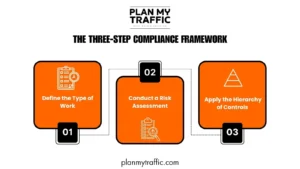
Step 1: Define the Type of Work
| Work Type | Duration | Key Requirement |
|---|---|---|
| Emergent Work | Less than 5 minutes | On-site risk assessment before exiting vehicle |
| Brief Duration Work | 15 minutes or less | Written work procedures with specified temporary traffic control devices |
| Short Duration Work | More than 15 minutes, single daylight period | Written risk assessment and traffic control plan |
| Long Duration Work | Multiple daylight periods, night work, or mobile work | Comprehensive written risk assessment and traffic control plan |
Understanding which category your work falls into determines the depth of planning required. A utility crew performing an emergency gas leak repair faces different obligations than a paving contractor working a multi-week highway project.
Step 2: Conduct a Risk Assessment
The December 2021 amendments made risk assessments mandatory and specific. Your assessment must evaluate:
-
-
Work duration and timing: Rush hour operations carry different risks than overnight work
-
Traffic volume and speed: Higher speeds and volumes demand more robust controls
-
Lines of sight: Curves, hills, and intersections create unique hazards
-
Work zone configuration: Lane closures, narrow shoulders, and equipment movement paths
-
Environmental conditions: Weather, lighting, avalanche zones, and overhead structures
-
Coordination of overlapping activities: Multiple contractors working in the same zone
-
For short and long duration work, this assessment must be in writing and must specifically address whether traffic control persons (TCPs) are required, including their positioning and escape routes.
Step 3: Apply the Hierarchy of Controls
Part 18 requires employers to follow the “order of controls”, a ranked approach to hazard mitigation. You must start at the top and work down, using the most effective measures practicable for your situation:
-
-
Detours and alternate routes that completely remove traffic from the work zone
-
Road closures during off-peak hours
-
-
Concrete barriers and crash attenuators
-
Automated flagger assistance devices (AFADs)
-
Portable traffic signals
Important: The 2021 amendments specifically emphasize that traffic cones alone provide insufficient protection. WorkSafeBC now strongly recommends concrete barrier isolation of work zones where feasible
-
-
Scheduling work during low-traffic periods
-
Speed limit reductions and enhanced signage
-
Communication strategies to inform the public in advance
-
-
-
Properly trained TCPs with high-visibility garments
-
Used only when other controls are insufficient or impractical
-
This hierarchy is non-negotiable. You cannot default to flaggers simply because they’re cheaper than installing barriers. The regulation explicitly requires you to investigate elimination and engineering options first.
Need help building a compliant traffic control plan for your next BC project? Our certified consultants design site-specific plans that meet WorkSafeBC Part 18 and municipal requirements, get your plan reviewed and approved faster.
The Traffic Control Plan: Your Blueprint for Safety
For short and long duration work, Part 18 mandates a written traffic control plan based on your risk assessment. This isn’t a generic template you can photocopy from project to project, it’s a site-specific document that must include:
-
-
Traffic control strategy: How you’ll manage vehicle flow through or around the zone
-
Traffic measures: Specific devices and layouts based on the hierarchy of controls
-
Implementation instructions: Step-by-step procedures for setup, maintenance, and removal
-
Roles and responsibilities: Who does what, when, and with what authority
-
Schedule: When each phase of traffic control will be implemented
-
The plan must also align with the BC Ministry of Transportation and Transit’s 2020 Traffic Management Manual for Work on Roadways (TMM). Where Part 18 and the TMM conflict, Part 18 takes precedence particularly regarding winter road maintenance, prime contractor responsibilities, and TCP use.
Critical Plan Elements
For provincial highway work, your plan must be accepted by the District Highway Manager. For municipal roads (Vancouver, Surrey, Abbotsford, etc.), submission is typically required at least 7 business days before work begins, with complex projects needing 7–14 days for review.
-
-
Proposed traffic detour routes
-
TCP positioning and supervision protocols
-
Signage layout per BC standards
-
Emergency vehicle access
-
Pedestrian safety zones and alternative pathways
-
Risk assessment documentation
-
Incident response protocols
-
Starting work without an approved plan can trigger a WorkSafeBC stop-work order, permit denial, project delays, and doubled fines in active work zones.
Traffic Control Persons: Training, Certification, and Restrictions
When TCPs Are Prohibited
Part 18 explicitly bans TCPs in three scenarios:
-
-
Speed limits greater than 70 km/h—TCPs cannot be used to control traffic on high-speed roadways
-
Directing traffic contrary to signs or signals—TCPs must supplement, not contradict, existing traffic control devices
-
Positioning in intersections open to traffic flow—TCPs cannot stand in active intersections or travelled roadway portions
-
These prohibitions reflect a hard truth: human flaggers are vulnerable. Your risk assessment must identify safe positioning typically on the shoulder, curb, or in a lane closed by barriers with an unobstructed escape route.
TCP Training Requirements
All TCPs must complete a WorkSafeBC-approved training program. As of December 2023, these programs must meet rigorous international standards, including ISO/IEC 17024:2012 or CAN/CSA Z1001-18, and must include both knowledge assessment and practical competency evaluation.
Currently, only two providers are approved by WorkSafeBC:
Training is typically a two-day program covering regulations, equipment use, work zone setup and removal, and advanced traffic control skills. TCPs must bring CSA-approved steel-toed boots and weather-appropriate clothing for the practical component.
Site-Specific Orientation
-
-
Unique hazards identified in the risk assessment
-
Traffic control plan specifics
-
Escape routes and emergency procedures
-
Communication protocols
-
This orientation must be documented, and supervisors share responsibility with traffic control companies for ensuring TCPs are properly trained, instructed, and supervised.
Don’t risk stop-work orders or doubled fines. Book a free review with our WorkSafeBC-trained specialists and ensure your traffic control plan passes inspection the first time.
Beyond the Basics: Emerging Safety Considerations
Climate and Heat Stress
BC’s changing climate has introduced new hazards for roadside workers. The 2021 heat dome, which saw temperatures reach 44°C in some areas, forced a reckoning with heat stress protocols. Employers must now assess heat exposure risks and implement controls such as hydration stations, modified work-rest cycles, and lighter summer PPE where appropriate.
Violence and Aggression
Traffic control persons increasingly face verbal abuse and threats from frustrated drivers. Industry leaders report regular incidents of workplace violence, with new workers particularly vulnerable. Employers must address this through situational awareness training, clear escalation protocols, and support for workers who experience traumatic incidents.
Technology Integration
Automated Flagger Assistance Devices (AFADs) and portable traffic signals are becoming standard on BC worksites. These engineering controls reduce human exposure to traffic while maintaining traffic flow. Part 18’s emphasis on the hierarchy of controls means employers should evaluate these technologies before defaulting to human flaggers.
The Cost of Non-Compliance
-
-
Stop-work orders that halt all project activity
-
Permit denials from municipalities and the Ministry of Transportation
-
Doubled fines in active work zones where workers are present
-
Legal liability for incidents and injuries
-
Project delays that cascade through your entire construction schedule
-
Reputational damage that affects future bidding and insurance rates
-
Between 2013 and 2022, 9 roadside workers were killed and 239 seriously injured in BC alone. Each incident represents not just a human tragedy, but a potential criminal negligence investigation, civil lawsuit, and business-ending regulatory action.
Practical Compliance Checklist
2. Traffic control plan developed based on the risk assessment and hierarchy of controls.
3. Plan submitted to the appropriate road authority (MoTT District Highway Manager or municipality) with adequate lead time.
4. TCPs certified through a WorkSafeBC-approved provider with current credentials.
5. Site-specific orientation provided and documented for all TCPs before first shift.
6. Supervisor designated with knowledge of Part 18, the TMM, and the traffic control plan.
7. Engineering controls evaluated barriers, AFADs, and detours considered before defaulting to flaggers.
8. PPE verified high-visibility garments, safety headgear, and illuminated paddles where required.
9. Emergency procedures established with clear roles and contact information.
10. Daily safety briefings conducted and documented.
11. Plan reviewed and updated as work progresses or conditions change.
Conclusion
Every day without an approved traffic control plan is a day your project risks a stop-work order. Fill out the form below and get your WorkSafeBC Part 18 compliant plan started within 24 hours.
Frequently Asked Questions(FAQs)