Traffic Signal Timing Plan
Optimize traffic flow, reduce delays, and enhance safety with expert designed signal timing plans for intersections across Canada.
- Home
- Traffic Signal Timing Plan
Key Components of a Signal Timing Plan
- Cycle Length: Total time for all phases to complete, optimized for Canadian peak hour volumes and provincial intersection standards.
- Phases: Specific movements including left turns, pedestrian crossings, and transit priority phases in compliance with requirements across BC, Ontario, Alberta, Manitoba, and Saskatchewan.
- Green, Yellow & All-Red Times: Safety and efficiency intervals set in accordance with Canadian all-red clearance standards and provincial Ministry guidelines.
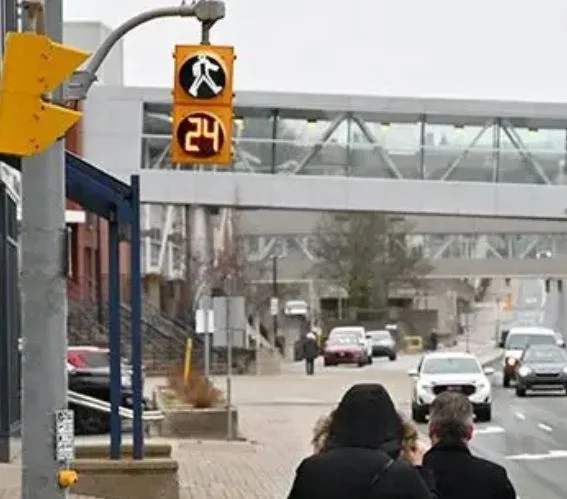
- Pedestrian Timing:Walk, Flash Don't Walk, and clearance intervals aligned with Canadian accessibility standards and Active Transportation policies.
- Detection Systems:Loop, radar, and video sensors for adaptive control suited to Canadian urban intersections and rural highway corridors.
- Coordination: Corridor-wide synchronization for green wave traffic flow along provincial highways and municipal arterials across all five provinces.
Signal Timing Plans for Temporary Construction Zones
Portable & Adaptive Timing for Canadian Roadwork and Detours
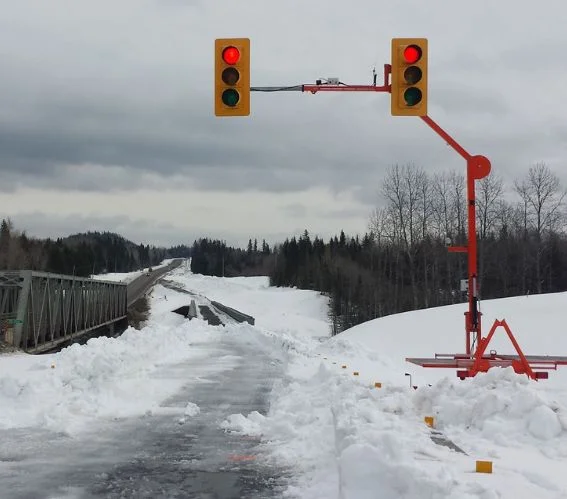
Temporary signal timing plans are essential for managing traffic during construction, bridge repairs, and utility work across BC, Ontario, Alberta, Manitoba, and Saskatchewan. Our plans prioritize worker and road user safety while minimizing disruption to provincial highway and municipal arterial traffic flow
Temporary Signal Timing Features
- Trailer-mounted or portable signal systems suited to Canadian construction zone requirements and provincial Ministry of Transportation temporary traffic control standards.
- Simplified phasing and staging sequences designed around Canadian work zone geometrics and compliant signage layouts.
- Detection integration (if applicable) using loop, radar, or video sensors compatible with existing Canadian municipal traffic management systems.
- Visibility focused signal head placement accounting for Canadian winter conditions, low-light environments, and sight distance requirements on provincial highways.
- Pedestrian and vehicle phase coordination aligned with Canadian accessibility standards and Active Transportation policies across BC, Ontario, Alberta, Manitoba, and Saskatchewan.
- Optimization using tools like Synchro and SimTraffic in accordance with provincial Ministry submission requirements and municipal traffic engineering standards.
Permanent Signal Timing Plans
Long-Term Optimization for Canadian Urban Intersections
Permanent signal timing plans are designed for continuous operation and integrated into city-wide traffic management systems across British Columbia, Ontario, Alberta, Manitoba, and Saskatchewan delivering maximum efficiency on municipal arterials and provincial highway corridors while meeting the ongoing operational standards of Canadian transportation authorities.
Permanent Signal Timing Features
- Full coordination with adjacent intersections along provincial highway corridors and municipal arterial networks across BC, Ontario, Alberta, Manitoba, and Saskatchewan.
- Adaptive systems using SCATS, ASCS, or similar technologies compatible with existing Canadian city-wide traffic management infrastructure.
- Detailed documentation including phasing diagrams and detection settings formatted to meet provincial Ministry and municipal traffic engineering submission standards.
- Integration with emergency pre-emption and transit signal priority supporting Canadian fire, police, EMS response times and public transit efficiency goals.
- Compliance with Canadian standards including OTM Book 12 (Ontario), BC MoTT Traffic Engineering Manual, Alberta Transportation Highway Geometric Design Guide, Manitoba Infrastructure Design Standards, and Saskatchewan Highways Engineering Standards ensuring full conformity with the signal timing requirements of every province we serve.
Who Benefits from Signal Timing Plans?
Improving Mobility for All Road Users Across Canadian Provinces
Signal timing plans enhance the experience and safety of everyone on the road from daily commuters on busy urban arterials in Vancouver, Toronto, Calgary, Winnipeg, and Saskatoon, to pedestrians, cyclists, transit riders, and emergency responders across BC, Ontario, Alberta, Manitoba, and Saskatchewan.
Stakeholders Served
- Drivers: Reduced delays and smoother travel on provincial highways and municipal arterials across BC, Ontario, Alberta, Manitoba, and Saskatchewan.
- Pedestrians & Cyclists: Safer crossings and better accessibility in compliance with Canadian Active Transportation policies and provincial Complete Streets standards.
- Transit Agencies: Improved bus priority and schedule adherence supporting BC Transit, Metrolinx, Calgary Transit, Winnipeg Transit, and Saskatoon Transit operations.
- Municipalities: Efficient traffic flow and reduced emissions aligned with Canadian municipal climate action plans and provincial sustainability commitments.
- Emergency Services: Faster response times with signal pre-emption supporting fire, police, and EMS operations across Canadian urban and rural communities.
- Businesses: Better access and customer convenience at commercial nodes along provincial highway corridors and city arterials in all five provinces.
Future of Traffic Signal Timing Plans
Smart Cities, AI & Sustainable Mobility Across Canadian Provinces
Signal timing is evolving with technology, making intersections smarter and more responsive to real-time conditions. From Vancouver’s smart corridor initiatives to Ontario’s connected vehicle pilots, Alberta’s highway modernization programs, and growing smart city investments in Winnipeg and Saskatoon.
Innovative Trends in Signal Timing
- AI & Machine Learning: Predictive models for real-time optimization of signal timing across high-volume Canadian urban intersections and provincial highway corridors.
- Connected Vehicles (V2X): Signals adapt based on vehicle data, supporting Canada's federal connected and automated vehicles strategy and provincial smart mobility pilots in BC and Ontario.
- Cloud Based Retiming: GPS data used to dynamically recalibrate signals along Canadian arterial networks, reducing peak-hour congestion in cities like Calgary, Edmonton, and Toronto.
- Sustainability Integration: Reduced fuel consumption and emissions supporting Canadian municipal climate action plans and provincial net-zero transportation commitments across BC, Ontario, Alberta, Manitoba, and Saskatchewan.
- Reinforcement Learning: Algorithms minimize queue lengths and delays at complex Canadian intersections, including multi-phase signals on provincial highway access points.
- CAV Integration: Seamless flow for autonomous and connected vehicles aligned with Transport Canada's emerging CAV regulatory framework and provincial transportation modernization programs.
Why Choose PLAN MY TRAFFIC?
- Expertise in both temporary and permanent signal timing plans for construction zones, new developments, and ongoing municipal operations across British Columbia, Ontario, Alberta, Manitoba, and Saskatchewan.
- Province-specific compliance with OTM Book 12, BC MoTT Traffic Engineering Manual, Alberta Transportation Highway Geometric Design Guide, Manitoba Infrastructure Design Standards, and Saskatchewan Highways Engineering Standards.
- Advanced modeling tools (Synchro, SimTraffic, VISSIM)
- Serving across Canada.
Client Testimonials
We required a detailed signal timing study for several high-volume intersections along a busy corridor in Metro Vancouver. The documentation included clear phasing diagrams, pedestrian timing considerations aligned with BC Active Transportation standards, and coordination strategies that met MoTT requirements. The structured report helped us implement improvements with confidence.
Senior Transportation Engineer, Municipal Authority - British ColumbiaThe signal timing plan prepared for our busy arterial corridor in the GTA significantly improved peak-hour flow. The cycle length adjustments and phase coordination were clearly documented in compliance with OTM Book 12 and technically sound. The supporting analysis made it easy for our internal review team to approve the recommendations
Traffic Operations Supervisor, City Transportation Department - OntarioThe signal timing analysis addressed congestion concerns during peak business hours at a key Calgary intersection. The optimized green splits and progression strategy were professionally presented in line with Alberta Transportation standards, and the recommendations were practical for real-world Canadian conditions.
Infrastructure Planning Manager, City Development Office - AlbertaThe timing plan included a comprehensive review of intersection delay, queue lengths, and signal coordination along a Winnipeg arterial corridor. The clarity of the documentation ensured alignment with Manitoba Infrastructure regulatory standards and supported faster internal approvals.
Transportation Planning Coordinator, Regional Agency - ManitobaThe proposed signal timing adjustments improved operational efficiency along a key arterial roadway in Saskatoon. The technical analysis was thorough, clearly supported with data, and fully aligned with Saskatchewan Highways engineering standards which strengthened stakeholder confidence in the final recommendations.
Civil Engineering Consultant, Infrastructure Advisory Group - SaskatchewanA Traffic Signal Timing Plan defines the green, yellow, and red phase durations for vehicle and pedestrian movements at signalized intersections. It is carefully engineered to balance competing traffic demands, minimize conflict points, and ensure safe, efficient movement for all road users throughout the day across varying traffic conditions.
A well-designed Traffic Signal Timing Plan significantly improves intersection flow, reduces vehicle delays, decreases fuel consumption, and enhances overall road safety for both drivers and pedestrians. Properly timed signals also reduce the likelihood of rear-end collisions and help municipalities meet congestion management and sustainability targets more effectively.
Temporary signal timing plans are developed for short-term needs such as construction zones, special events, or emergency detours, where traffic patterns shift significantly. Permanent plans are designed for long-term intersection optimization, accounting for growth in traffic volumes, land use changes, and evolving community transportation priorities over time.
Our Traffic Signal Timing Plan services include cycle length design, phase interval optimization, pedestrian crossing timing, and green wave coordination for arterial corridors. Every plan is developed using current traffic count data and industry-standard modelling tools to ensure compliance with provincial standards and optimal performance across all time periods.
Yes, we have experience working with leading adaptive signal control systems including SCATS, ASCS, and V2X-enabled platforms. These systems dynamically adjust signal timings in real time based on current traffic conditions, improving network efficiency, reducing unnecessary delays, and supporting connected and autonomous vehicle integration on modern urban roadways.
We proudly serve clients across Canada, with primary expertise in British Columbia, Alberta, Ontario, Manitoba, and Saskatchewan. Our team understands each province's signal timing standards, municipal requirements, and approval processes, ensuring every Traffic Signal Timing Plan we develop is compliant, submission-ready, and tailored to local traffic conditions.
To develop an accurate and effective Traffic Signal Timing Plan, we require intersection geometry details, current traffic volume counts by movement and time period, and existing signal timing parameters. Pedestrian crossing data and any known operational issues at the intersection are also helpful for informing a comprehensive and compliant timing solution.
Completion time for a Traffic Signal Timing Plan typically ranges from 1 to 4 weeks, depending on the number of intersections involved, data availability, and the complexity of the corridor being analyzed. We recommend starting early to align with construction schedules, event timelines, or municipal submission and implementation deadlines.
We provide implementation guidance and coordination support to help ensure your Traffic Signal Timing Plan is applied correctly in the field. While direct programming of signal controllers is outside our scope, our team works closely with municipal traffic operations staff and signal technicians to facilitate a smooth and accurate implementation process.
Yes, we coordinate directly with municipal and provincial traffic authorities throughout the timing plan development process to ensure full regulatory compliance. Our team aligns every plan with applicable standards and authority requirements, facilitating smoother review and approval while minimizing the risk of revisions or delays during the submission process.
Our signal timing plans are developed using industry-standard traffic engineering software including Synchro for signal optimization, SimTraffic for microsimulation and performance evaluation, and VISSIM for advanced multimodal traffic modelling. These tools allow us to accurately assess intersection performance and deliver data-driven, optimized timing solutions for any complexity level.
We stay current with emerging advancements in signal timing, including AI and machine learning for predictive optimization, cloud-based retiming platforms for remote management, V2X communication integration for connected vehicles, and sustainability metrics that measure emissions reductions and fuel savings resulting from improved signal coordination and reduced idling at intersections.
Pricing for Traffic Signal Timing Plans depends on the number of intersections included, corridor complexity, data collection requirements, and the level of modelling detail needed. Each project is scoped individually to ensure an accurate and fair quote. Contact our team to discuss your project and receive a customized cost estimate.
Getting started is straightforward. Submit your project details through our online quote form, and a member of our team will reach out promptly to confirm data requirements, discuss project scope, and outline expected timelines. Early engagement ensures we can align our workflow with your project schedule and submission deadlines.