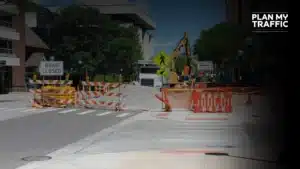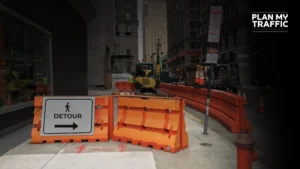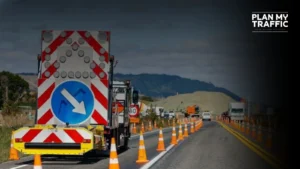
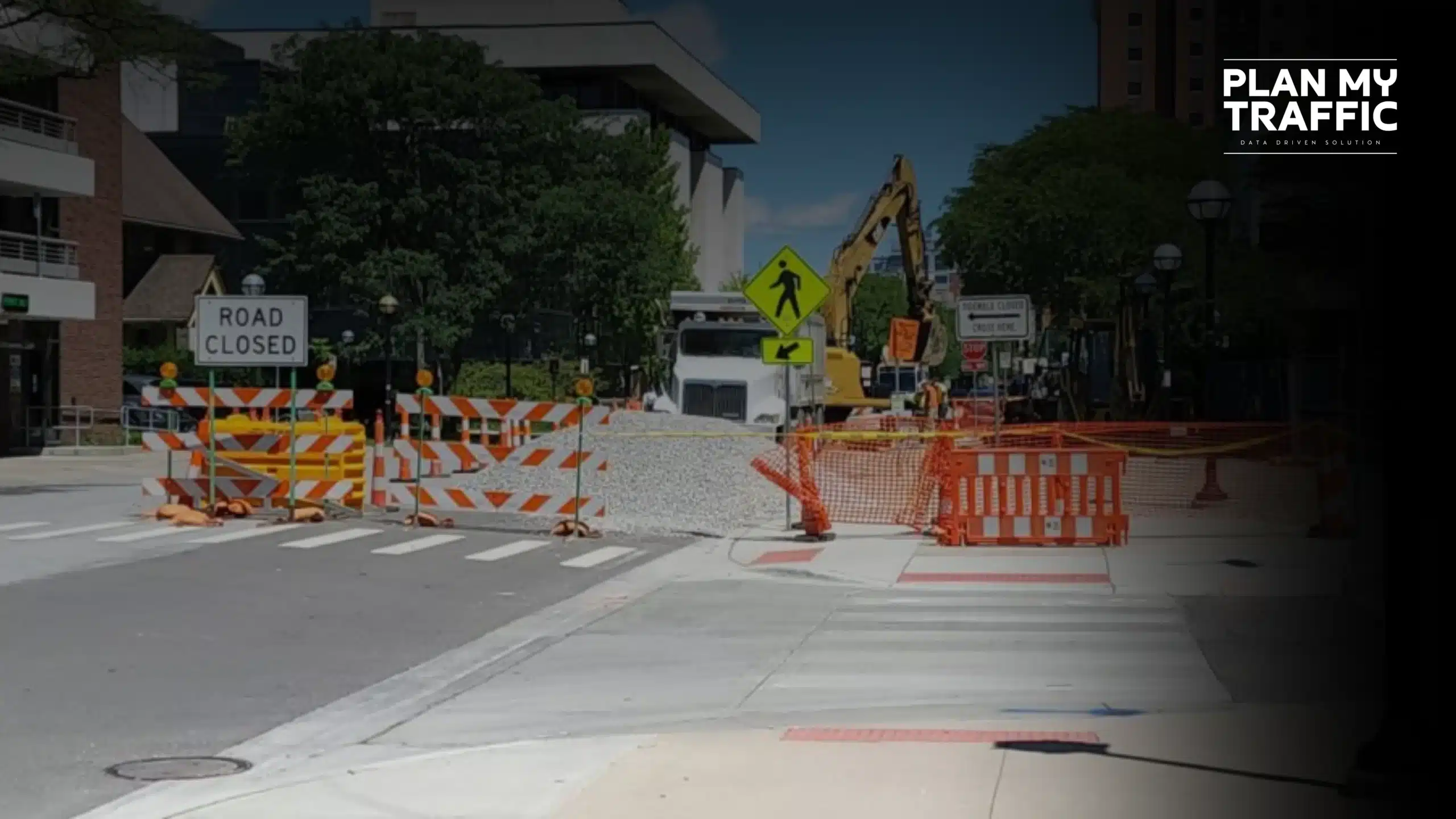
If you’re a contractor working on a construction site in British Columbia, having a proper construction traffic control plan template isn’t optional, it’s a legal requirement. Whether you’re managing a utility trench on a city street or a full lane closure on a provincial highway, your plan must meet the dual expectations of WorkSafeBC and the Ministry of Transportation and Transit (MOTT). Getting this right from the start saves you from costly rejections, stop-work orders, and liability exposure.
What Is a Construction Traffic Control Plan?
A construction traffic control plan (TCP) is a site-specific document that outlines how vehicle and pedestrian traffic will be safely managed around a work zone. It identifies the placement of signs, cones, delineators, barriers, flaggers, and arrow boards and specifies how workers are protected from live traffic throughout every phase of work.
In BC, this document must be prepared before any work that affects a roadway or public right-of-way begins.
WorkSafeBC Requirements
WorkSafeBC governs worker safety on construction sites under the Workers Compensation Act and the Occupational Health and Safety Regulation. For traffic control on or adjacent to roadways, Part 18 of the OHS Regulation is the governing section.
Key WorkSafeBC requirements that your construction traffic control plan template must address include:
Qualified Traffic Control Supervisor (TCS): A certified TCS must be present whenever workers are exposed to traffic hazards. The TCP must name the supervisor and confirm their certification level.
Flagger Qualifications: All flaggers must hold a valid Traffic Control Person (TCP) certificate issued through an accredited BC training provider. Their role, positioning, and communication protocol must be documented in the plan.
Advance Warning Distance: The template must specify the correct advance warning distances based on posted speed limits. For example, a 50 km/h zone requires different taper lengths and sign placement distances than a 90 km/h rural highway.
Personal Protective Equipment (PPE): All workers in the work zone must wear high-visibility vests or clothing that meets CSA Z96 Class 2 or 3 standards, and this must be stated in the plan.
Risk Assessment: WorkSafeBC expects a hazard identification and risk control section. This should document the specific risks present (e.g., limited sight lines, night work, heavy vehicle mix) and the controls in place.
MOTT (Ministry of Transportation and Transit) Standards
When your construction work falls on a provincial highway or road under MOTT jurisdiction, your TCP must also comply with MOTT’s Traffic Management Guidelines for Work on Roadways.
MOTT-specific requirements your template must incorporate include:
Standard Drawings: MOTT has a library of pre-approved typical drawings (TD series) for common work zone configurations, single lane closures, shoulder work, intersection work, and more. Your plan should reference and match the correct TD drawing for your scenario.
Speed Reduction and Regulatory Signage: MOTT requires specific signage packages based on road classification and work type. Temporary speed reductions in work zones must be justified and consistently enforced.
Permit Submission: A TCP submitted to MOTT for a highway work permit must include a scaled site plan, sign schedule, equipment list, and a description of each work phase. Incomplete submissions are a primary reason for permit delays.
Contractor Responsibilities: MOTT places responsibility on the prime contractor to ensure all subcontractors and workers operate within the approved plan. Any deviation requires a plan amendment and re-approval before implementation.
What a Compliant Template Should Include
A solid construction traffic control plan template structured for BC projects should contain the following sections:
-
- Project information (location, contractor name, permit numbers)
- Site diagram drawn to scale showing work zone layout, sign placement, and traffic flow
- Sign schedule (sign type, size, quantity, mounting height)
- Flagger positioning and communication protocol
- Advance warning distances and taper calculations
- Phasing plan if work spans multiple days or shifts
- Emergency access provisions
- Contact list for TCS, site supervisor, and local authority
- Risk assessment and control measures
Not sure if your template covers everything? Download free, field-tested construction templates from our library, no sign-up needed.
Get your Template Now
How PlanMyTraffic Can Help
If building a WorkSafeBC and MOTT-compliant TCP from scratch sounds like a lot, it is. That’s where PlanMyTraffic steps in.
PlanMyTraffic specializes in drafting fully compliant traffic control plans for construction projects across BC. Their certified team understands exactly what WorkSafeBC inspectors and MOTT reviewers look for, which means your plan is built for approval the first time not after two rounds of costly revisions.
They also offer a practical Tools & Resources library where contractors can download free, field-tested construction templates including site inspection checklists, incident report forms, daily progress reports, and permit application templates. These are fully editable Word documents, no email sign-up required.
For projects that go beyond a simple template, multi-phase work, highway closures, complex intersections PlanMyTraffic’s team handles the full TCP drafting, permit submission assistance, and revision management. Their turnaround is fast, their plans are city and province-ready.
Conclusion
A construction traffic control plan template built to WorkSafeBC and MOTT standards is not just a paperwork formality, it’s the document that protects your workers, keeps the public safe, and keeps your project moving without regulatory interruption. Know the standards, use the right template structure, and when the project demands it, lean on professionals who do this every day.
Problem & Solution, Your next project can’t afford a rejected plan. Tell us about your site and we’ll have a compliant, permit-ready traffic control plan back to you fast.
Request a Quote
Ready to Work Together? Build a project with us!
Frequently Asked Questions
1. Is a traffic control plan required for all construction sites in BC?
Any construction activity that places workers in or adjacent to a public roadway requires a TCP under both WorkSafeBC’s OHS Regulation and MOTT’s permitting requirements. This includes short-duration work like utility repairs or tree trimming.
2. Who is allowed to prepare a construction traffic control plan in BC?
The plan must be prepared by or under the supervision of a qualified Traffic Control Supervisor (TCS). For complex highway work under MOTT jurisdiction, it is strongly recommended that a professional engineer or certified traffic management professional prepares the plan.
3. What happens if my TCP doesn’t meet WorkSafeBC standards?
A WorkSafeBC officer can issue a stop-work order immediately if the traffic control setup does not match the approved plan or fails to meet minimum safety standards. Fines and penalties can also apply to the prime contractor.
4. Can I use a generic template for both WorkSafeBC and MOTT submissions?
You can start with a standard template, but it must be customized to your specific site conditions, work type, and road classification. A generic template that isn’t site-specific will typically be rejected by MOTT and may not satisfy a WorkSafeBC inspection.