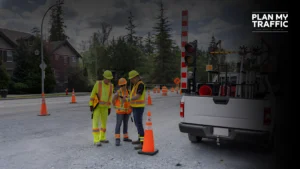
Construction is a constant across British Columbia from utility repairs in Vancouver to road widening projects in Surrey and Kelowna. When that work spills onto sidewalks or crosswalks, pedestrians bear the burden. A poorly planned pedestrian detour doesn’t just inconvenience people, it can create serious safety hazards and put your project at risk of non-compliance fines or stop-work orders.
Here is exactly what you need to know to design a proper pedestrian detour around a BC construction site.
Why Pedestrian Detours Matter in BC
British Columbia requires all construction projects affecting public pathways to provide a safe, continuous alternative route for pedestrians. This obligation is governed by the BC Ministry of Transportation and Transit guidelines, local municipal bylaws, and the Manual of Standard Traffic Signs and Pavement Markings used in Canada (MUTCDC).
Ignoring pedestrian access even temporarily can expose contractors to liability if someone is injured. It can also delay permit approval, result in complaints from adjacent businesses, or trigger enforcement from the city.
How to Design a Compliant Pedestrian Detour in BC
Step 1: Assess the Existing Pedestrian Environment
Before drawing a detour route, study the site. Walk the area and document:
-
- The width and condition of surrounding sidewalks
- Curb cuts and accessible ramps (required under BC’s Accessible Design for the Built Environment standard)
- Proximity to schools, seniors’ facilities, transit stops, or high foot traffic areas
- Intersections and crosswalk locations that may be affected
This assessment tells you how far the detour needs to extend and what accessibility accommodations will be required.
Step 2: Select a Safe Alternate Route
A good pedestrian detour route must be continuous, logical, and as short as reasonably possible. When selecting a route, ensure:
-
- The alternate sidewalk or pathway is at least 1.5 metres wide
- There are no conflicting hazards like open excavations, uneven surfaces, or vehicle staging areas along the path
- Lighting is adequate if work extends into evening hours
- The detour does not push pedestrians into active vehicle travel lanes
If no alternate sidewalk exists, a protected temporary pedestrian corridor may need to be constructed along the edge of the roadway.
Step 3: Install Proper Signage and Barriers
Signage is not optional, it is the foundation of a compliant pedestrian detour. In BC, signs must follow MUTCDC standards and be sized, reflectorized, and positioned correctly. A standard setup includes:
Closure Signs: Placed at the point where the normal path is blocked, well in advance so pedestrians can redirect before reaching the obstruction.
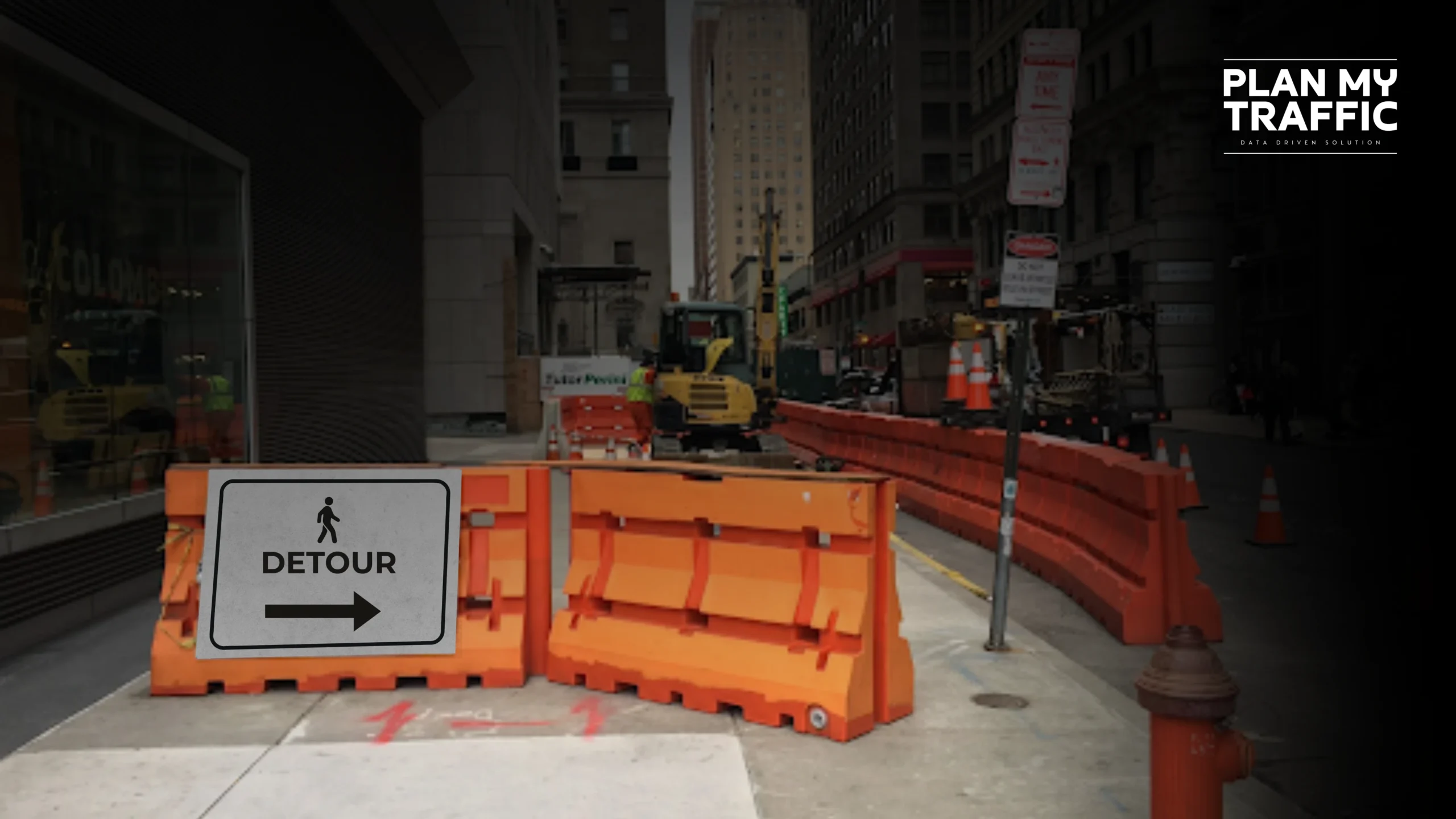
Detour Directional Signs: Arrow-based signs guiding pedestrians step-by-step along the alternate route, placed at every decision point or turn.
End of Detour Sign: Installed where pedestrians re-enter the normal pathway.
Barriers separating pedestrians from the active work zone must be solid and stable water-filled jersey barriers or solid hoarding are preferred over simple cones, which can be knocked over.
Step 4: Ensure Accessible Design Throughout
BC’s construction standards require that temporary pedestrian routes accommodate people with mobility impairments. This means:
-
- Temporary curb ramps must be installed if the detour crosses a roadway at a non-ramped location
- The surface must be firm, stable, and slip-resistant
- Any overhead clearance must be at least 2.1 metres
- Tactile walking surface indicators should be used at conflict points if the site is near a high-pedestrian-volume area
Failure to provide accessible routing is one of the most frequently cited issues by municipal inspectors in BC.
Step 5: Maintain and Monitor the Detour Daily
A pedestrian detour is not a set-it-and-forget-it solution. Assign someone on-site to inspect the route every morning and after any significant weather event. Check for:
-
- Displaced or fallen signs
- Debris or mud on the walking surface
- Barriers that have shifted into the pedestrian path
- Lighting failures if applicable
Log your inspections. This documentation protects you if an incident occurs and demonstrates due diligence to the municipality.
Need a compliant pedestrian detour plan fast? Skip the guesswork and get it done right the first time.
Get a Quote Now
How PlanMyTraffic Can Help
Designing a compliant pedestrian detour while managing everything else on a construction site is a lot to juggle. That is where PlanMyTraffic steps in.
PlanMyTraffic specializes in Traffic Control Plans (TCP) and Traffic Management Plans (TMP) for construction projects across BC and the rest of Canada, fully compliant with MUTCDC standards and local municipal requirements. Their certified traffic engineers can:
-
- Draft pedestrian detour layouts with proper signage schedules and barrier placement
- Ensure accessible routing is built into the plan from the start
- Submit plans that are designed to get municipal approval the first time and if a revision is needed, it is done at no extra cost
- Handle projects of any scale, from a single-block utility repair to a multi-phase downtown development
Whether you are a contractor in Burnaby, a developer in Kelowna, or a municipality managing infrastructure upgrades in Victoria, PlanMyTraffic gives you a compliant, professionally engineered plan without the back-and-forth of rejections.
Conclusion
A well-designed pedestrian detour is not just about putting up a few cones and an arrow sign. In BC, it requires a careful assessment of the site, a properly chosen alternate route, MUTCDC-compliant signage, accessible design elements, and ongoing daily maintenance. Getting this right protects the public, keeps your project on schedule, and keeps you on the right side of municipal regulations. If you want the plan done correctly the first time, working with a certified traffic management firm is the most efficient path forward.
Get your compliant pedestrian detour TCP drafted by certified engineers approved the first time.
Request a Quote
Ready to Work Together? Build a project with us!
Frequently Asked Questions
Q1: Is a pedestrian detour plan required by law for BC construction projects?
Yes, Any construction work that blocks or disrupts a sidewalk, crosswalk, or public pedestrian pathway in British Columbia requires a documented pedestrian detour plan as part of your Traffic Control Plan (TCP). Municipalities like Vancouver, Surrey, and Burnaby have specific bylaws that reinforce this requirement on top of provincial guidelines.
Q2: How wide does a temporary pedestrian detour path need to be in BC?
The minimum recommended width is 1.5 metres is the preferred standard to comply with accessible design guidelines. If the detour serves a high-volume area or must accommodate mobility devices, the wider dimension is strongly advisable.
Q3: Who is responsible for maintaining the pedestrian detour during construction?
The contractor or project owner is responsible for the installation, ongoing maintenance, and daily inspection of the pedestrian detour for the entire duration of the work. This responsibility does not transfer to the municipality unless specifically agreed upon in the permit conditions.
Q4: What happens if my pedestrian detour does not meet BC standards?
Non-compliant detours can result in a stop-work order from the municipality, monetary fines, and increased liability exposure if a pedestrian is injured. In some cases, the permit itself can be revoked until a compliant plan is submitted and approved.