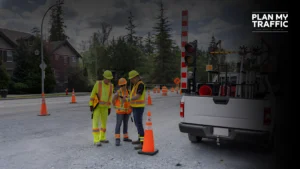
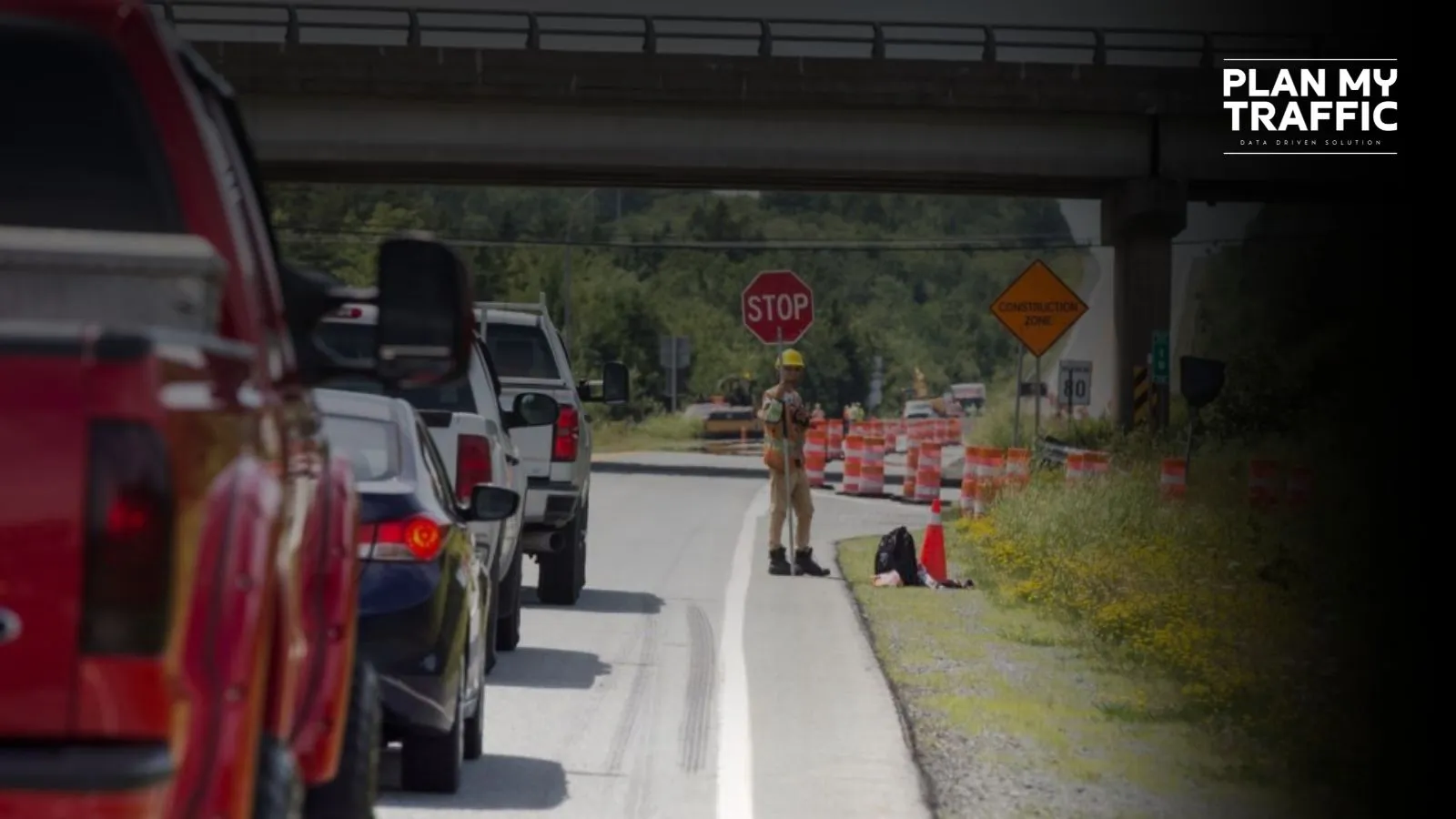
What Is a Traffic Management Plan?
A Traffic Management Plan (TMP) is a comprehensive, site-specific document that details how traffic will be safely managed around a construction zone or work area on public roads. It includes detailed drawings showing signage placement, lane closures, detour routes, pedestrian accommodations, cyclist safety measures, and worker protection protocols.
In Surrey, the TMP must be designed in accordance with the Ministry of Transportation and Transit’s Traffic Management Manual for Work on Roadways (TMM). The plan serves as both a safety blueprint and a legal compliance document that demonstrates your commitment to protecting workers, motorists, cyclists, and pedestrians.
When Is a Traffic Management Plan Surrey Legally Required?
The City of Surrey mandates TMP submission under specific circumstances, with requirements varying based on road classification and project scope.
Arterial and Collector Roads: Always Required
A Traffic Management Plan is always legally required when your work impacts an arterial or collector road in Surrey. These roads form the backbone of Surrey’s transportation network, carrying high traffic volumes and serving critical regional mobility functions. The City requires site-specific, detailed plans for any obstruction activity on these road classifications.
Local Roads: Conditional Requirements
-
Significant obstructions such as temporary full road closures on local roads require a full TMP
-
Minor obstructions on local roads including storage container placements in parking areas, do not require TMP drawings. Instead, applicants must simply provide the traffic control figure number from the MOTT Traffic Management Manual that will be implemented
Any Temporary Closure Requires a Permit
Regardless of road classification, you must obtain a Traffic Obstruction Permit (TOP)before obstructing or temporarily closing any road, cycling, or pedestrian facility for any reason. Effective June 1, 2024, Request to Proceed submissions are no longer required for Traffic Obstruction Permits, streamlining the application process.
Not sure if your Traffic Management Plan Surrey meets all City requirements? A small mistake can lead to immediate rejection and project delays.
Get Your Traffic Management Plan Reviewed
Step-by-Step: How to Check If You Need a Traffic Management Plan
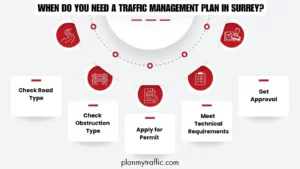
Step 1: Check Road Type
The first decision point is the road classification, which directly determines whether a Traffic Management Plan is mandatory.
-
- Arterial / Collector Roads → TMP always required
These roads carry high traffic volumes and are critical for city-wide movement. Even minor work like shoulder access or short-duration lane narrowing still requires a fully detailed, site-specific TMP. - Local Roads → Depends on obstruction severity
Residential or low-volume streets have flexible requirements, but this flexibility is often misunderstood. Many contractors assume no TMP is needed and face rejection later because the obstruction was considered “significant” by the City.
- Arterial / Collector Roads → TMP always required
Always verify road classification using Surrey’s mapping system before planning. Misidentifying the road type is one of the most common early-stage mistakes that leads to delays.
Step 2: Check Obstruction Type
Once the road type is confirmed, the next step is evaluating how your work impacts traffic flow.
-
- Full road closure → TMP is required (any road type)
Includes closures for utility work, crane lifts, or construction staging. Requires detour planning and advance signage. - Lane closure / lane shift → TMP is required
Even partial lane restrictions must show taper lengths, buffer zones, and transition areas based on MOTT standards. - Sidewalk or bike lane closure → TMP is required
You must provide safe alternate routes for pedestrians and cyclists. Missing this is a major rejection reason. - Minor local work → MOTT figure may be enough
Only applies when traffic flow is minimally impacted (e.g., container placement in parking areas). You must still reference the exact MOTT figure being used.
- Full road closure → TMP is required (any road type)
Critical Rule:
If your work impacts traffic for more than 5 business days, you must include Notice of Obstruction signage placed in advance to allow traffic diversion.
Step 3: Apply for Permit
Every project that affects public roads, sidewalks, or cycling paths requires a Traffic Obstruction Permit (TOP) this is non-negotiable.
Your application must include:
-
- Traffic Management Plan or MOTT figure number
Must match the exact site condition generic references are not accepted. - $5M Certificate of Insurance
Must name the City of Surrey as an additional insured. Missing or incorrect wording leads to instant rejection. - Prime Contractor Designation Form
Confirms responsibility for site safety and compliance under WorkSafeBC regulations. - Valid Surrey Business Licence
Required for all contractors working within the city.
- Traffic Management Plan or MOTT figure number
Most permit rejections happen at this stage not because of the process, but because one of these documents is missing or incomplete.
Step 4: Meet Technical Requirements
If your project requires a TMP, the technical quality of your drawings determines approval speed.
Your plan must include:
-
- Scaled drawings
Not-to-scale sketches are not accepted. - Actual sign distances (measured on-site)
Simply referencing MOTT tables is not enough, you must show exact placement distances. - Minimum lane widths
If this cannot be maintained, you must provide a safe alternate traffic control strategy. - Pedestrian & cyclist accommodation
Clearly defined detours with signage. Missing or unclear routes are one of the top rejection reasons. - Non-working hour conditions
You must show what happens when crews are not on-site, this is often overlooked. - Traffic control device placement
Cones, barricades, delineators, and signage must align with real-world site conditions.
- Scaled drawings
Important:
Generic or template-based plans are immediately rejected. Surrey expects every TMP to reflect the exact site layout, dimensions, and conditions.
Step 5: Get Approval
Submitting your Traffic Management Plan does not mean your work is approved. Formal acceptance is mandatory before any activity begins.
Approval process:
- Submit TMP to Traffic Management Section
- Technical review against MOTT + City requirements
- Revision requests (if issues found)
- Final approval issued
- Permit activated → work can begin
Key Reality:
There is no workaround to this step. Without approval:
- No pre-construction meeting
- No permit activation
- No site work allowed
Starting work without approval can result in immediate stop-work orders, fines, and project delays.
Legal Framework and Regulatory Authority
Municipal Authority: City of Surrey
The City of Surrey Engineering Department’s Traffic Management Section has authority to review, accept, or reject TMP submissions. No pre-construction meetings or work permits will be issued until TMP approval has been obtained from the Traffic Operations Section. The City can also direct that a specific local road requires a TMP even if it wouldn’t normally trigger the requirement.
Provincial Standards: MOTT Traffic Management Manual
All TMPs must comply with the Ministry of Transportation and Transit Traffic Management Manual for Work on Roadways. This provincial standard establishes traffic control device specifications, signage placement requirements, worker safety protocols, lane closure and detour procedures, and pedestrian and cyclist accommodation standards.
WorkSafeBC Occupational Health and Safety Regulations
Under Part 18 of the Workers Compensation Act, employers are legally obligated to protect workers engaged in traffic control operations. This includes using only WorkSafeBC certified Traffic Control Persons (TCPs), providing proper personal protective equipment (PPE), and implementing traffic control measures that meet provincial safety specifications. Failure to comply can result in stop-work orders, fines, and legal liability for workplace injuries.
Projects That Trigger Legal TMP Requirements
Construction and Development Projects
Land development projects, building construction, and infrastructure improvements that impact arterial or collector roads always require TMPs. This includes road widening or reconstruction, utility installations and repairs, building construction affecting adjacent roadways, and landscaping or site work extending into road allowances.
Utility and Service Work
Water, sewer, electrical, telecommunications, and gas work frequently requires road closures or lane restrictions. Any such work on arterial or collector roads triggers TMP requirements.
Special Events
Community events, filming, festivals, or races that temporarily close roads or significantly alter traffic patterns require TMPs and Traffic Obstruction Permits.
Emergency vs. Planned Work
The permit scheme applies to scheduled, non-emergency works. Emergency repairs may have different notification requirements, but contractors should still implement safe traffic control measures and notify the City promptly.
Consequences of Non-Compliance
Permit Denial and Project Delays
The City will not issue work permits or conduct pre-construction meetings until TMP approval is obtained. This can delay project starts, affect contractor schedules, and trigger cascading timeline impacts.
Enforcement Actions
Non-compliant work zones face escalating responses from City authorities: on-site orders to immediately correct deficiencies, formal warnings documented in project files, monetary fines and tickets, and permit cancellation requiring immediate site clearance and work stoppage.
WorkSafeBC Penalties
Liability Exposure
Without proper TMP approval and implementation, contractors assume full liability for accidents, injuries, or property damage occurring in or near the work zone. Insurance coverage may be invalidated if work is performed without required permits.
Reputational Damage
Best Practices for Traffic Management Plan Compliance in Surrey
Start Early
Begin TMP preparation well in advance of your planned work start date. Complex plans for arterial roads may require multiple revision cycles before approval.
Use Professional Services
Consider engaging traffic management consultants familiar with Surrey’s requirements. Professional plan preparation reduces revision cycles and approval delays.
Leverage City Resources
The City of Surrey Mapping Online System (Cosmos) provides aerial imagery, road centerlines, speed limits, and other data useful for accurate plan preparation.
Maintain Clear Communication
Designate a responsive Traffic Control Manager who can address City inquiries promptly and make real-time adjustments if conditions change during the project.
Monitor Regulatory Updates
Traffic management requirements evolve. Stay current with changes to the Highways and Traffic Bylaw, TMM updates, and City bulletin notices.
Surrey in Regional Context
While Vancouver does not charge for Traffic Control Plan review and approval, and Burnaby uses a detailed weekly fee structure based on infrastructure type and road classification, Surrey’s approach focuses on comprehensive plan requirements and strict approval gates before work authorization.
Surrey’s status as one of British Columbia’s fastest-growing cities with major arterial corridors like King George Boulevard, Fraser Highway, and 152nd Street carrying substantial regional traffic means the City takes traffic management compliance particularly seriously.
Conclusion
Ensure your project meets all Surrey requirements and avoids stop-work risks, get a compliant, approval-ready traffic plan tailored to your site.
Frequently Asked Questions
A TMP is always required for work impacting arterial or collector roads. For local roads, it’s required for significant obstructions like full road closures, but not for minor obstructions where a MOTT traffic control figure number suffices.
Working without a permit can result in immediate stop-work orders, fines, permit cancellation, and liability exposure. The City will not issue work permits or hold pre-construction meetings until your TMP is approved.
While the City doesn’t specify preparer qualifications, plans must meet MOTT TMM standards and include detailed, site-specific drawings. Professional traffic management consultants familiar with Surrey requirements can streamline approval and reduce revision cycles.
You must submit a Certificate of Insurance naming the City of Surrey as an additional insured with minimum $5 million in coverage. Additional WorkSafeBC clearance and professional errors and omissions insurance may also be required depending on project scope.