Traffic Control Plan Rejections are often misunderstood by contractors who assume that something small is missing in their submission.
That’s not how authorities think.
From a reviewer’s perspective, a TCP is not just a drawing, it’s a risk control document. If your plan doesn’t clearly prove that traffic, workers, and the public can be managed safely under real conditions, it will not pass.
The reality is:
Most rejected plans fail not because of obvious mistakes, but because they don’t answer the reviewer’s key questions.
This blog breaks down what authorities actually evaluate, what your plan is failing to communicate, and how to fix those gaps before submission.
How Authorities Actually Review a Traffic Control Plan
Understanding rejection starts with understanding the review process.
When a TCP is submitted, reviewers are not just checking compliance they are asking:
- Can traffic move safely through this work zone?
- Is the design realistic for peak conditions?
- Does this plan reduce risk or create new risks?
What they check first (in seconds)
Before going into details, most reviewers quickly scan:
- Work zone layout clarity
- Lane closure logic
- Signage sequence flow
If your plan fails to communicate clearly at this stage, it’s already at risk of rejection.
What they check next (in depth)
Once the basics pass, they go deeper into:
- Taper calculations vs speed limits
- Buffer spacing vs actual site constraints
- Pedestrian routing feasibility
- Emergency access continuity
A TCP that “looks right” but doesn’t function correctly in reality is where most rejections happen.
The Hidden Gaps That Cause TCP Rejections
These are not obvious mistakes. These are missing layers of thinking that most plans fail to include.
1. No Real Traffic Behavior Consideration
Most TCPs are drawn as static diagrams.
Authorities think in dynamic traffic flow:
- What happens during peak hours?
- Will queues extend into intersections?
- Can vehicles merge safely at this location?
If your plan doesn’t reflect real-world behavior, it gets flagged.
2. Lane Closures Without Operational Justification
Closing a lane is a high-impact decision.
Reviewers expect:
- Why this lane is being closed
- Why alternatives (shoulder work, night work) are not used
- Impact on traffic capacity
Without justification, it looks like poor planning not necessity.
3. Technically Correct but Practically Impossible Layouts
This is a major rejection trigger.
Example scenarios:
- Taper lengths that don’t physically fit the site
- Sign spacing that conflicts with intersections
- Buffer zones overlapping driveways
Your plan may follow standards but if it can’t be implemented on-site, it will be rejected.
4. Missing Transition Between Zones
Many TCPs show zones but not how they connect.
Authorities look for:
- Smooth transition from warning → taper → buffer → work zone
- Logical driver guidance
- No sudden changes in direction or control
A disconnected plan increases confusion and risk.
5. No Consideration for Vulnerable Road Users
This is becoming a stricter requirement.
Your plan must consider:
- Pedestrians
- Cyclists
- Public transit stops
Ignoring these users is one of the fastest ways to get rejected.
Where Most TCPs Fail During Submission
Even before detailed review begins, many Traffic Control Plans fail at the submission level itself due to incomplete or poorly structured documentation.
Authorities expect submissions to include:
- Clear drawing sheets with proper scaling
- Supporting notes explaining key decisions
- Consistent labeling across all pages
- Proper file format and readability
If the submission package looks incomplete or inconsistent, it creates immediate doubt about the quality of the plan.
A poorly presented plan increases the chances of stricter review, where even minor issues are more likely to be flagged.
Why Looks Compliant Is Not Enough Anymore
A major shift in approvals today:
Authorities are moving from checklist-based approval → risk-based approval
That means:
- It’s not enough to “follow the manual”
- You must show that your plan works in reality
Example from real submissions
A TCP may include:
- Correct taper length
- Proper signage
- Standard layout
But still get rejected because:
- Traffic volume exceeds what the layout can handle
- Merge point is too close to a signalized intersection
- No queue management strategy
This is why many contractors feel confused:
“Everything is correct, so why was it rejected?”
Because correctness ≠ practicality.
Technical Elements That Authorities Expect
Let’s go deeper into what a strong TCP actually demonstrates.
Traffic Capacity Awareness
Your plan should reflect:
- Expected vehicle flow
- Lane capacity reduction impact
- Backup/queue risk
Even a simple note addressing this improves approval chances.
Spatial Feasibility
Every element must fit within actual site geometry:
- Taper lengths vs available distance
- Sign placement vs visibility constraints
- Work zone vs adjacent access points
Sequence Logic
The plan should guide drivers step-by-step:
- Early warning
- Gradual transition
- Safe buffer
- Controlled work area
- Clear exit
If this flow is unclear, the plan fails from a safety perspective.
Redundancy in Safety
Authorities look for backup safety layers:
- What happens if drivers ignore signs?
- Is there enough buffer space?
- Are there secondary warnings?
A plan with no redundancy feels risky.
Not sure if your TCP meets these expectations? We can review it and identify gaps before submission.
Why Your Traffic Control Plan Gets Rejected And How to Fix It
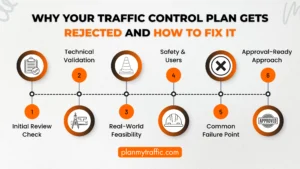
1. Initial Review Check
At the first stage, reviewers quickly scan your plan for clarity and logic, not calculations. If the layout looks confusing or the traffic flow isn’t immediately understandable, it may be flagged right away.
They check whether lane closures, signage sequence, and directions are clearly shown. A cluttered or unclear drawing creates doubt about on-site execution.
Fix: Keep the layout clean, use clear arrows and labels, and ensure the plan is easy to understand within seconds.
2. Technical Validation
Once the plan passes the initial scan, authorities verify technical accuracy. This includes taper lengths, buffer zones, sign spacing, and compliance with standards. These requirements are defined in official guidelines such as the BC Traffic Management Manual for Work on Roadways.
Even small mismatches like incorrect taper calculations or missing distances can lead to rejection.
Fix: Use exact calculations based on site speed and cross-check all values with the applicable standards before submission.
3. Real-World Feasibility
A plan may follow standards but still fail if it doesn’t fit real site conditions.
Common issues include taper lengths that don’t fit the road, signage conflicting with intersections, or limited space for safe merging.
Fix: Design based on actual site constraints. Ensure every element can be implemented safely in the real environment.
4. Safety & Users
Authorities now expect TCPs to address all road users, not just vehicles. Safety requirements for workers and road users must also align with WorkSafeBC regulations for traffic control
Missing pedestrian detours, unsafe cyclist routing, or blocked emergency access are major rejection triggers.
Fix: Include clear pedestrian paths, ensure accessibility, and maintain safe routes for emergency vehicles at all times.
5. Common Failure Point
Most rejected plans share similar patterns:
- Overuse of generic templates
- Missing dimensions or unclear details
- No justification for lane closures
- Ignoring traffic conditions like peak hours
Fix: Customize every plan, define all details clearly, and ensure each decision is logically justified.
6. Approval-Ready Approach
An approval-ready TCP focuses on function, not just compliance.
Start by identifying risks, then design based on real conditions. Ensure the plan guides drivers clearly and works during actual traffic scenarios.
Fix: Review your plan like an authority, if anything feels unclear, incomplete, or impractical, refine it before submission.
The Cost of Revisions You Don’t See
Most contractors focus only on approval delays, but the real impact of TCP rejection goes deeper.
Revisions create hidden costs such as:
- Rework time for redesign
- Project rescheduling
- Coordination delays with other teams
- Increased administrative effort
Each revision cycle slows down momentum and adds pressure to timelines.
Reducing even one revision cycle can significantly improve overall project efficiency.
What Separates Approved vs Rejected TCPs
The difference between an approved and rejected Traffic Control Plan is not just compliance—it is confidence.
Approved plans:
- Clearly communicate intent
- Address real-world conditions
- Minimize uncertainty
Rejected plans:
- Leave gaps in understanding
- Rely on assumptions
- Create doubt about execution
Authorities approve plans they trust will work safely and effectively in real conditions.
Conclusion
Traffic Control Plan Rejections by Local Authorities are not just about missing signs or incorrect dimensions they are the result of plans that fail to demonstrate real-world functionality, risk control, and practical feasibility. Today’s approval process goes beyond basic compliance; authorities expect plans to clearly show how traffic will behave, how risks are mitigated, and how the work zone operates under actual conditions. Contractors who continue to rely on template-based or checklist-driven approaches often face repeated rejections, delays, and rising costs. The key to faster approvals lies in shifting your approach from simply “following standards” to designing plans that align with how authorities evaluate safety, traffic flow, and on-site execution.
FAQs
1. Why do technically correct TCPs still get rejected?