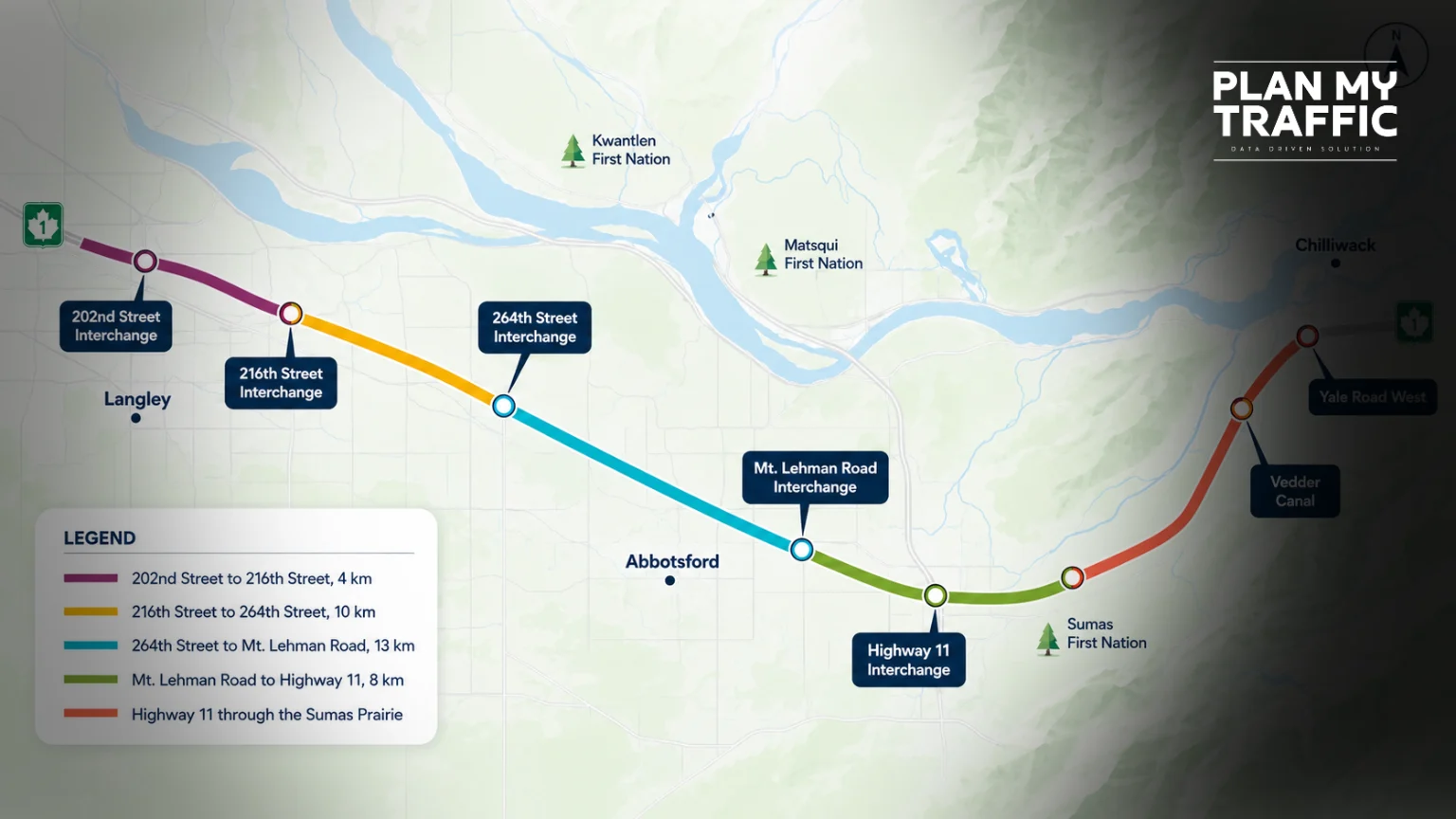
The Fraser Valley Highway 1 Corridor Improvement Program is a major transportation infrastructure project designed to improve safety, mobility, and traffic operations along one of British Columbia’s busiest highway corridors. As part of Project No. 13254-1002, contractors bidding on or working within the Highway 1 – Peardonville corridor must understand and comply with detailed Traffic Management Plan (TMP) requirements outlined in the tender documentation.
Managing traffic on a high-volume highway involves much more than placing signs and cones around a construction zone. Construction activities can affect commuters, commercial vehicles, emergency services, businesses, pedestrians, and cyclists. To minimize these impacts and maintain safe roadway operations, contractors must develop comprehensive traffic management strategies that address both worker safety and public mobility.
This guide explains the key Traffic Management Plan requirements associated with the Fraser Valley Highway 1 Corridor Improvement Program and highlights the practical considerations contractors should address when preparing their submissions.
Understanding the Fraser Valley Highway 1 Corridor Improvement Program
The Fraser Valley Highway 1 Corridor Improvement Program focuses on improvements along Highway 1 near Peardonville and surrounding transportation infrastructure. Highway 1 serves as a critical transportation route connecting communities, supporting commercial freight movement, and accommodating thousands of daily road users.
Because of the importance of this corridor, construction activities must be carefully planned to minimize disruptions while maintaining safe and efficient traffic flow. The Ministry of Transportation and Transit requires contractors to develop detailed Traffic Management Plans that address traffic operations during all stages of construction.
Unlike smaller projects that may only require basic traffic control measures, this project demands a comprehensive and professionally prepared Traffic Management Plan due to the complexity of the work, traffic volumes, and public safety considerations.
Why Traffic Management Is Critical for This Project
A Traffic Management Plan (TMP) is a project-specific document that outlines how road users will be safely and efficiently guided through or around a construction zone while protecting workers and maintaining operational safety. Poor planning can lead to traffic congestion, increased safety risks, project delays, public complaints, and compliance issues. Many people confuse a Traffic Management Plan with a Traffic Control Plan (TCP), but they are not the same.
For the Fraser Valley Highway 1 Corridor Improvement Program, contractors must effectively manage:
- High-speed traffic operations
- Lane closures and work zone transitions
- Pedestrian and cyclist accommodation
- Emergency vehicle access
- Traffic delays and queue management
- Temporary detours
- Incident response procedures
- Public communication requirements
- Coordination with local agencies and stakeholders
Because of these challenges, the project has been designated as a Category 3 Traffic Management Plan project, requiring a higher level of planning, documentation, and professional oversight.
Traffic Management Plan Requirements for Project No. 13254-1002
The tender documentation identifies several mandatory components that must be included in the Traffic Management Plan.
Risk Assessment Requirements
The Traffic Management Plan must include a detailed Risk Assessment that identifies site-specific risks and hazards associated with construction activities.
The assessment should evaluate:
- Worker exposure to traffic
- Traffic flow conditions
- Vehicle interactions
- Work zone hazards
- Temporary traffic control measures
- Safety risks to pedestrians and cyclists
Contractors must also explain how risks will be mitigated and justify the use of Traffic Control Persons where applicable.
A generic risk assessment is unlikely to meet project requirements. The assessment must reflect actual conditions within the Fraser Valley Highway 1 corridor.
Traffic Control Plan Requirements
The Traffic Control Plan forms a key component of the overall Traffic Management Plan.
Traffic control layouts must be developed for various project conditions, including:
- Lane closures
- Shoulder closures
- Road closures
- Temporary detours
- Excavation activities
- Paving operations
- Temporary barrier installations
- Intersections
- Periods of inactivity
The tender specifically requires project-specific traffic control layouts. Standard drawings copied directly from manuals without site-specific modifications may not be considered compliant.
Each layout should clearly demonstrate how traffic will be managed safely throughout construction.
Incident Management Plan Requirements
Construction activities on major highways can result in unexpected incidents that affect traffic operations.
The Incident Management Plan should include procedures for:
- Traffic incidents
- Emergency situations
- Vehicle breakdowns
- Significant traffic delays
- Road closures
- Alternate route activation
Contractors must also establish communication procedures to ensure road users receive timely information regarding delays, closures, and reopening times.
An effective Incident Management Plan helps reduce disruption and improve public safety during unexpected events.
Public Information Plan Requirements
Public communication is an important component of the Traffic Management Plan.
The Public Information Plan should identify how information will be communicated to:
- Emergency services
- Road users
- Local stakeholders
- Municipal authorities
- Transit agencies
- Businesses
- Residents
Advance notification may be required for planned road closures, lane closures, and significant traffic impacts.
Keeping the public informed helps reduce confusion, improve compliance with temporary traffic measures, and minimize frustration among affected road users.
Implementation Plan Requirements
The Implementation Plan outlines how traffic management measures will be deployed, monitored, maintained, and adjusted throughout the project.
The plan should address:
- Traffic control inspections
- Monitoring procedures
- Maintenance activities
- Documentation requirements
- Traffic operations reviews
- Work zone modifications
Traffic management is not a one-time activity. Contractors must continually evaluate traffic conditions and make adjustments as construction progresses.
Key Traffic Management Challenges Contractors Must Address
Lane Closures and Traffic Delays
Lane closures are often necessary to complete highway construction activities, but they must be carefully managed to minimize disruption.
Contractors should consider:
- Closure timing
- Traffic volumes
- Queue lengths
- Peak travel periods
- Public impacts
Effective planning helps maintain traffic flow while allowing construction activities to proceed safely.
Detour Planning
Detours play a critical role when traffic must be redirected around work zones.
A successful detour plan should:
- Provide clear routing
- Maintain safety
- Accommodate expected traffic volumes
- Support commercial vehicles
- Minimize travel disruptions
Poorly designed detours can lead to confusion, congestion, and increased safety risks.
Pedestrian and Cyclist Accommodation
Traffic management extends beyond motor vehicles.
The tender requires contractors to consider:
- Pedestrian routes
- Accessible pathways
- Cyclist movements
- Temporary crossings
- Work zone barriers
Safe accommodation for vulnerable road users is essential throughout all phases of construction.
Dynamic Message Signs (DMS)
Dynamic Message Signs provide real-time information to road users regarding:
- Lane closures
- Delays
- Construction activities
- Traffic conditions
- Alternate routes
These signs help drivers make informed travel decisions and improve overall traffic operations.
Temporary Traffic Signals
Temporary traffic signals may be required for specific traffic management scenarios.
These systems must be carefully designed, monitored, and maintained to ensure:
- Safe traffic flow
- Appropriate signal timing
- Reliable operation
- Accommodation of all road users
Traffic signal failures or improper operation can quickly create congestion and safety concerns.
Common Reasons Traffic Management Plans Get Rejected
Even experienced contractors can encounter issues when preparing Traffic Management Plans.
Some common reasons for rejection include:
Generic Traffic Control Layouts
Using standard drawings without adapting them to site-specific conditions is a common issue.
Incomplete Risk Assessments
Failing to identify and address project-specific risks can result in non-compliant submissions.
Poor Detour Planning
Detours that do not adequately accommodate traffic volumes or vehicle types may require revisions.
Missing Pedestrian and Cyclist Considerations
Traffic Management Plans must address all road users, not just vehicles.
Insufficient Incident Management Procedures
Contractors must demonstrate how unexpected traffic disruptions will be managed.
Lack of Supporting Documentation
Missing plans, incomplete information, or unclear traffic control strategies can delay approval.
How Plan My Traffic Can Help
Preparing a Traffic Management Plan for a major highway infrastructure project requires technical expertise, regulatory knowledge, and an understanding of project-specific requirements.
At Plan My Traffic, we help contractors develop professional Traffic Management Plans designed to support compliance and operational efficiency.
Our services include:
- Traffic Management Plans (TMPs)
- Traffic Control Plans (TCPs)
- Detour Planning
- Lane Closure Planning
- Pedestrian Accommodation Plans
- Cyclist Accommodation Plans
- Risk Assessments
- Incident Management Planning
- Public Information Planning
- Temporary Traffic Control Layouts
By working with experienced traffic planning professionals, contractors can reduce revisions, improve submission quality, and focus on delivering successful projects.
Conclusion
The Fraser Valley Highway 1 Corridor Improvement Program presents significant opportunities for contractors, but it also requires a high level of traffic management planning and compliance.
A well-prepared Traffic Management Plan helps ensure worker safety, maintain traffic flow, reduce public impacts, and support successful project delivery. From risk assessments and traffic control layouts to incident management and public communication, every component of the Traffic Management Plan plays an important role in project success.
Contractors should begin planning early, review all project requirements carefully, and ensure their Traffic Management Plans are tailored to the specific conditions of the Highway 1 – Peardonville corridor.
For complex infrastructure projects, partnering with experienced traffic planning specialists can help streamline compliance, reduce delays, and improve overall project outcomes.
Frequently Asked Questions
1. Does the Fraser Valley Highway 1 Corridor Improvement Program require a Traffic Management Plan?
Yes. The project requires a comprehensive Traffic Management Plan that addresses traffic operations, worker safety, public communication, risk management, and traffic control measures.
2. What is the difference between a Traffic Management Plan and a Traffic Control Plan?
A Traffic Management Plan is the overall strategy for managing traffic impacts during construction, while a Traffic Control Plan focuses on the specific traffic control devices and layouts used within work zones.
3. Why is a Risk Assessment required within the Traffic Management Plan?
Risk Assessments help identify project-specific hazards and demonstrate how contractors will protect workers and road users during construction activities.
4. Can contractors use standard manual drawings for their Traffic Control Plan layouts?
No. The tender documentation for Project No. 13254-1002 specifically requires project-specific traffic control layouts. Standard drawings copied directly from manuals without site-specific modifications are unlikely to be considered compliant.