If you’re planning an event in Vancouver whether it’s a marathon, street festival, parade, or public gathering, your success depends heavily on one critical document: a compliant Event Traffic Management Plan Vancouver(TMP). Without it, permits get delayed, approvals get rejected, and your entire event timeline can collapse.
For event organizers in Vancouver, traffic planning is not just a formality, it’s a regulatory requirement enforced by authorities like City of Vancouver, WorkSafeBC, and British Columbia Ministry of Transportation and Transit.
In this guide, you’ll learn:
- What an Event Traffic Management Plan includes
- Why approvals get delayed or rejected
- Key compliance requirements in Vancouver
- Common mistakes event organizers make
- A step-by-step process to get your plan approved faster
What Is an Event Traffic Management Plan in Vancouver?
An Event Traffic Management Plan (TMP) is a detailed document that outlines how traffic, pedestrians, and emergency access will be safely managed during an event.
It includes:
- Road closures and detours
- Pedestrian routing and accessibility
- Traffic control devices (signage, cones, barricades)
- Vehicle flow management
- Emergency vehicle access routes
- Staffing (flaggers, traffic control personnel)
In Vancouver, TMPs must align with the Traffic Management Manual for Work on Roadways, which sets strict standards for temporary traffic control.
Unlike construction TMPs, event TMPs often deal with:
- High pedestrian density
- Temporary infrastructure
- Unpredictable crowd movement
- Multi-agency coordination
Why Event TMPs Matter And How Delays Happen
Many event organizers underestimate how critical a traffic plan is until it delays their permit.
Permit Delays
If your TMP is incomplete or unclear, approval timelines can extend by 5–10+ business days. This affects:
- Event setup schedules
- Vendor coordination
- Public announcements
Cost Overruns
Delays lead to:
- Rescheduling crews
- Equipment rental extensions
- Increased staffing costs
Even a small delay can cost thousands for mid-sized events.
Rejection Risks
Authorities frequently reject TMPs due to:
- Missing signage details
- Poor crowd control strategy
- Lack of emergency access planning
- Non-compliance with BC standards
Fast Approval Advantage
A properly designed TMP can:
- Get approved within standard timelines
- Reduce back-and-forth revisions
- Keep your event on schedule
Core Requirements for a Compliant Event Traffic Management Plan Vancouver
To avoid delays, your plan must meet specific expectations.
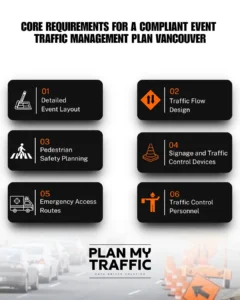
1. Detailed Event Layout
Your plan must clearly show:
- Event boundaries
- Road usage
- Restricted zones
This helps reviewers understand how your event interacts with the city.
2. Traffic Flow Design
You need to define:
- Vehicle routes
- Detours
- Access points
Everything should be logical and easy to follow.
3. Pedestrian Safety Planning
This is critical.
Your plan must include:
- Crowd movement routes
- Safe crossings
- Barrier placement
4. Signage and Traffic Control Devices
You must specify:
- Sign types
- Placement
- Spacing
All signage should align with TAC standards.
5. Emergency Access Routes
Authorities will check:
- How emergency vehicles access the site
- Whether routes remain unobstructed
6. Traffic Control Personnel
If required, include:
- Number of personnel
- Their locations
- Their responsibilities
Not sure if your event TMP meets Vancouver compliance standards? Get a free review, we’ll check it within 24 hours.
Get Your TMP Reviewed in 24 Hours
Common Mistakes That Lead to TMP Rejection in Vancouver
Even experienced organizers make critical errors. Here are the most common ones:
1. Generic or Template-Based Plans
Using non-Vancouver templates that don’t follow Traffic Management Manual for Work on Roadways is a common issue. TMPs must be site-specific, considering road type, traffic volume, and event conditions. Generic layouts fail to reflect real-world conditions, leading to rejection.
2. Missing Signage Details
Authorities expect precise signage planning not assumptions. Plans must define sign types, placement distances, and sequencing. Vague instructions like “install signage as required” are not acceptable and often result in revisions.
3. No Emergency Access Planning
A TMP must clearly maintain access for emergency vehicles at all times. Missing routes, blocked access points, or unclear entry/exit paths are major compliance failures and can lead to immediate rejection under WorkSafeBC guidelines.
4. Poor Pedestrian Flow Design
Events require structured pedestrian management. Plans must include safe walkways, barriers, and controlled crossings. Poor planning creates safety risks and fails municipal review, especially in high-density areas.
5. Ignoring Road Classification
Traffic control must vary based on road type. Applying the same setup everywhere shows a lack of technical understanding and often leads to rejection.
6. Lack of Coordination with Authorities
Failure to align with:
- Municipal permits
- Police requirements
- Transportation departments
Avoid rejection before it happens. Talk to our team for free consultation, no commitment.
Ensure Your Plan Gets Approved – Talk to an Expert
Step-by-Step Process to Create an Approval-Ready Event TMP
Here’s a practical workflow used by professionals:
Step 1: Define Event Scope
- Location
- Duration
- Expected attendance
- Type of event
Step 2: Identify Impact Zones
- Affected roads
- Nearby intersections
- Public transit routes
Step 3: Design Traffic Control Layout
- Road closures
- Detours
- Signage placement
- Buffer zones
Step 4: Plan Pedestrian & Crowd Flow
- Entry/exit points
- Safe walkways
- Emergency evacuation routes
Step 5: Integrate Emergency Access
- Dedicated lanes
- Coordination with emergency services
Step 6: Review Against BC Standards
Ensure compliance with:
- Traffic Management Manual for Work on Roadways
- Municipal permit requirements
- WorkSafeBC guidelines
Step 7: Submit & Monitor Approval
- Submit to the relevant authority
- Respond quickly to feedback
- Revise if required
Real-World Scenario: Why TMPs Get Delayed in Vancouver
In a recent event submission for a downtown Vancouver street festival, the TMP was delayed by over a week.
Reason:
- No clear pedestrian diversion plan
- Missing signage spacing details
After revision:
- Plan was approved within standard timelines
This shows one thing clearly that small technical gaps create major delays.
Conclusion
An Event Traffic Management Plan in Vancouver is not just paperwork, it is a critical approval document that directly influences your event timeline, budget, and overall safety outcomes. A poorly prepared plan can lead to permit delays, repeated revisions, increased operational costs, and unnecessary stress for organizers. These delays often impact vendor coordination, staffing, and event execution. On the other hand, a professionally designed and fully compliant plan aligned with standards like the Traffic Management Manual for Work on Roadways ensures faster approvals, minimizes risk, and provides clear traffic and pedestrian management strategies. Ultimately, a well-prepared TMP allows your event to run smoothly, safely, and without last-minute disruptions.
Planning an event in Vancouver and need a compliant traffic management plan? Don’t risk delays or rejection, get expert support and ensure your plan is approved the first time.
FAQs
1. Do I need a traffic management plan for all events in Vancouver?
In most cases, yes. Any event that impacts public roads, sidewalks, parking areas, or normal traffic flow in Vancouver requires a Traffic Management Plan (TMP) as part of the permit approval process. This includes street festivals, parades, marathons, filming activities, and even smaller community events if they involve partial road closures or increased pedestrian movement. Authorities like the City of Vancouver assess whether your event creates any disruption to traffic or public safety. Even if a full TMP is not required, you may still need a basic traffic control setup. Submitting a compliant TMP early helps avoid delays and ensures your event meets all safety and regulatory requirements.
2. How long does it take to get a TMP approved in Vancouver?
Approval timelines can vary depending on the complexity of the event, location, and completeness of your submission. For a properly prepared and compliant TMP, approvals can typically move within standard municipal timelines. However, delays often occur when plans are incomplete, unclear, or require multiple revisions. In real-world scenarios, TMP approvals can take an additional 5–10+ business days if corrections are needed. Factors that influence approval time include road classification, event size, coordination with emergency services, and adherence to standards like the Traffic Management Manual for Work on Roadways. Submitting a detailed and technically accurate plan on the first attempt is the fastest way to avoid delays.
3. What is the most common reason for TMP rejection?
The most common reason for TMP rejection is lack of technical detail and non-compliance with required standards. This often includes missing signage placement, unclear traffic control layouts, and failure to define pedestrian or emergency access routes. Authorities expect precise, site-specific information—not general or template-based plans. Another major issue is failing to align with guidelines from organizations like WorkSafeBC, especially when it comes to safety and worker protection. In many cases, TMPs are rejected not because the concept is wrong, but because the execution lacks clarity, accuracy, and compliance.
4. Can I create a TMP myself for an event?
Yes, it is possible to create a TMP yourself, but it requires a solid understanding of traffic management principles, local regulations, and compliance standards. Event organizers must be able to design accurate layouts, define signage placement, ensure pedestrian safety, and maintain emergency access routes—all while following guidelines like the Traffic Management Manual for Work on Roadways. Without this technical knowledge, DIY plans often result in delays or rejections due to errors or missing details. For this reason, many organizers choose to work with professionals to ensure their plan is accurate, compliant, and approved on the first submission.