On most construction projects, delays don’t start in the schedule they start on the ground. Poorly planned construction site traffic flow management leads to congestion at access points, unsafe worker interactions, inefficient haul routes, and ultimately permit delays.
If your Traffic Control Plan (TCP) or Traffic Management Plan (TMP) does not properly define vehicle movement, lane closures, and work zone transitions, you are not just risking safety, you are risking your entire project timeline.
This guide is written for contractors, site supervisors, and project managers who want to reduce delays, avoid TCP rejections, and maintain continuous site productivity through proper traffic flow design.
What Traffic Flow Management Actually Means on a Construction Site
In real construction terms, traffic flow management is not just about cones and signs, it’s about how materials, vehicles, and workers move through the site without conflict.
It includes:
- Haul routes for dump trucks and material delivery
- Site access points (ingress/egress control)
- Lane closure configurations (single lane, multi-lane, shoulder closures)
- Temporary Traffic Control (TTC) devices placement
- Pedestrian detour routing
- Work zone phasing and sequencing
In British Columbia, this must align with:
A proper system ensures that both public traffic and construction traffic operate safely and efficiently without interfering with each other.
Where Construction Sites Actually Break Down
Most delays are not due to “bad planning”, they’re due to poor coordination between traffic flow and construction operations.
Common real-world breakdowns:
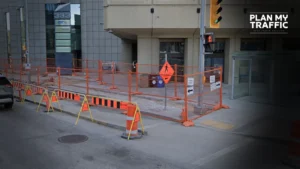
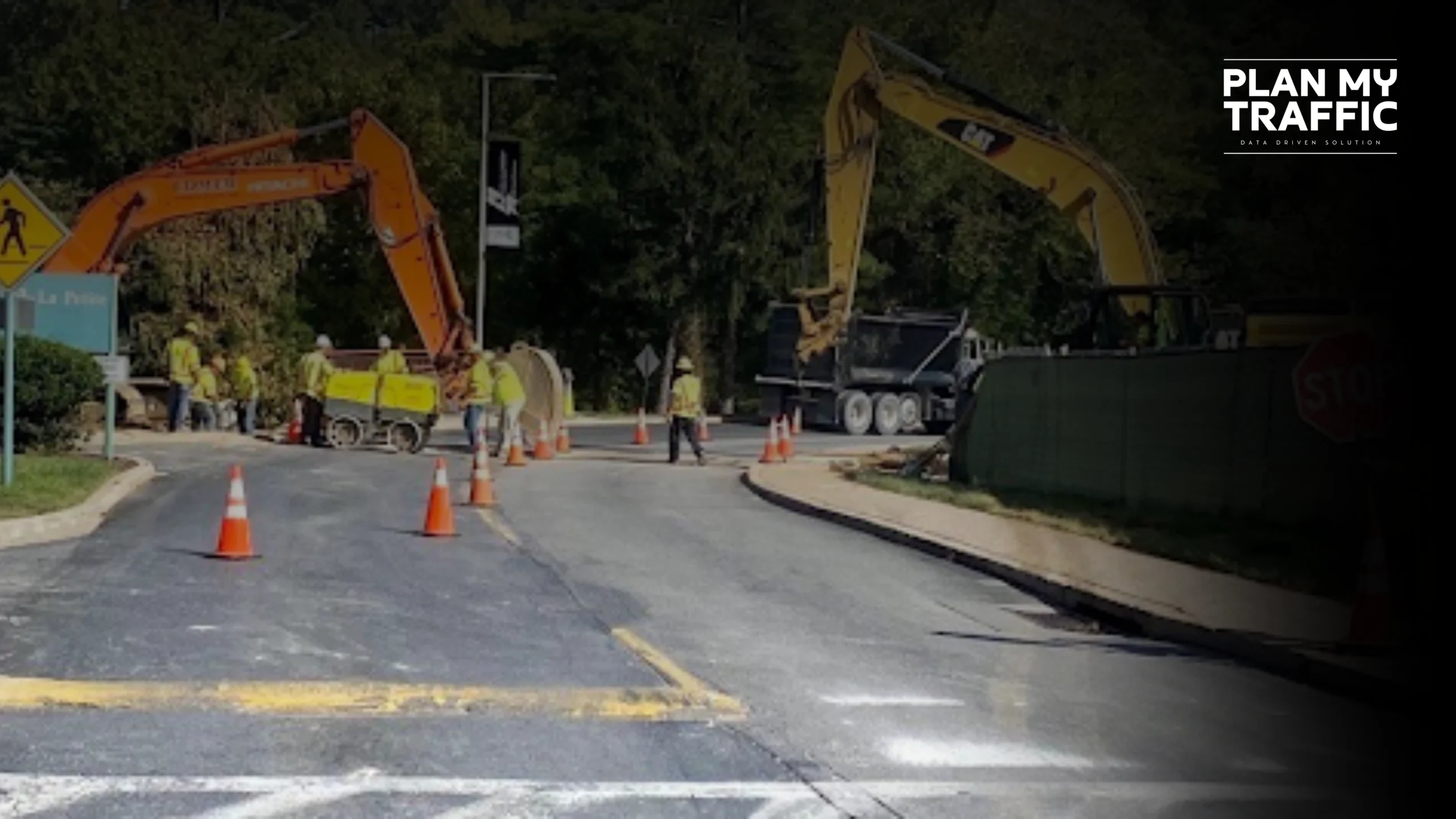
- Haul trucks blocking live traffic lanes due to poor staging
- No defined truck turning radii, causing multi-point turns
- Equipment crossing active lanes without spotters
- Improper taper lengths causing unsafe merges
- No buffer space between traffic and work zone
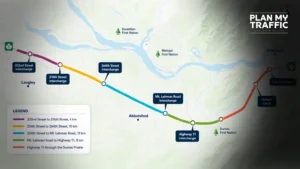
In one Surrey infrastructure project, lack of proper staging and haul route separation caused repeated traffic stoppages leading to inspection flags and a 6-day delay.
Critical Traffic Engineering Elements Every Site Must Get Right
This is where technical accuracy matters.
1. Taper Length & Transition Design
Tapers guide traffic safely from normal flow into a work zone.
Formula depends on:
- Speed limit
- Lane width
- Road classification
Incorrect taper lengths are one of the most common reasons for TCP rejection.
2. Buffer Space
Buffer zones provide safety margins between traffic and workers.
- Longitudinal buffer → distance between taper and work zone
- Lateral buffer → distance between traffic lane and workers
Missing or undersized buffers = major compliance issue
3. Temporary Traffic Control Devices (TTC)
Includes:
- Channelizing devices (cones, drums)
- Arrow boards
- Portable Variable Message Signs (PVMS)
- Temporary barriers
Placement must follow exact spacing standards not guesswork.
4. Work Zone Segmentation
Every TCP must clearly define:
- Advance warning area
- Transition area
- Activity/work area
- Termination area
Each zone has specific device placement and spacing rules.
5. Sight Distance & Visibility
If drivers cannot see your work zone in time, your plan fails.
You must consider:
- Horizontal/vertical curves
- Obstructions
- Night-time visibility (retroreflectivity)
If your plan does not define these elements clearly, it is not approval-ready.
Get Your Approval Ready Plan Now
The Connection Between Traffic Flow and Construction Sequencing
This is where most contractors fail.
Traffic planning must align with construction phasing, not sit separately.
Example:
If your project has:
- Excavation phase
- Utility installation
- Paving
Each phase requires a different traffic control setup.
But most plans:
Use one static layout which doesn’t works, so they should use phased TCPs.
Why this matters:
- Reduces unnecessary lane closures
- Minimizes disruption to public traffic
- Improves approval chances
- Keeps site operations efficient
Authorities expect phase-based traffic management, especially in urban corridors.
Common Technical Mistakes That Lead to TCP Rejection
These are not “basic mistakes” these are real rejection triggers.
1. Incorrect or Missing Taper Calculations
Using generic values instead of speed-based calculations
2. No Lane Closure Justification
Authorities require reasoning, not assumptions
3. Improper Device Spacing
Cones/drums placed without standard spacing
4. Missing Pedestrian Detour Plan
No ADA/accessible pathway = immediate red flag
5. No Emergency Vehicle Access
Fire/ambulance routes must remain clear
6. Ignoring Local Authority Requirements
Municipal vs MoTT standards confusion
Avoid rejection before submission. A single mistake can delay approval by 5–10+ days.
Fix Mistakes Before They Delay Your Project
A Field-Tested Workflow for Managing Traffic Flow on Active Sites
This is not theory, this is what actually works on construction projects.
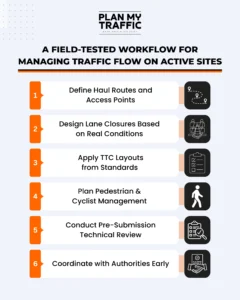
Step 1: Define Haul Routes and Access Points
- Separate entry and exit where possible
- Avoid reversing into live traffic
- Ensure turning radii for large vehicles
Step 2: Design Lane Closures Based on Real Conditions
- Match closure type to road classification
- Consider peak-hour restrictions
- Use off-peak scheduling where possible
Step 3: Apply TTC Layouts from Standards
- Use correct TMM/MUTCD layout
- Adjust based on site constraints
- Verify all dimensions
Step 4: Plan Pedestrian & Cyclist Management
- Provide safe detours
- Maintain accessibility compliance
- Use barriers where needed
Step 5: Conduct Pre-Submission Technical Review
- Check taper lengths
- Verify buffer zones
- Confirm signage placement
- Ensure clarity in drawings
Step 6: Coordinate with Authorities Early
- Municipal vs provincial jurisdiction
- Permit timelines
- Inspection requirements
When Traffic Planning Starts Slowing Down Your Project Instead of Supporting It
On paper, handling traffic planning internally seems efficient. In reality, it often becomes a bottleneck that slows down execution.
Modern construction projects demand traffic plans that are not just compliant, but accurate, site-specific, and aligned with real construction sequencing. This requires more than basic knowledge, it requires continuous familiarity with evolving standards, authority expectations, and on-ground execution challenges.
Where internal teams struggle most:
- Difficulty aligning TCP/TMP layouts with actual construction phasing
- Inconsistent application of TMM or MUTCD-based standards
- Rework due to missed technical details like taper transitions or buffer sizing
- Delays in submission caused by competing site priorities
As a result, what was supposed to be a supporting task turns into a critical delay point in the project workflow.
What changes when specialists handle it:
- Plans are built around real traffic conditions and site logistics, not assumptions
- Technical elements like lane configurations, device spacing, and sight distance are handled correctly the first time
- Drawings are prepared with approval expectations in mind, reducing revision cycles
- Site teams can focus on execution instead of documentation
For projects involving arterial roads, urban corridors, or multi-phase construction, traffic planning becomes too critical to treat as a secondary task.
At that level, it’s no longer about who can create a plan, it’s about who can create a plan that actually works in the field and gets approved without delays.
Conclusion
Construction Site Traffic Flow Management is not just about directing vehicles, it’s about integrating traffic engineering with real construction operations to ensure continuous, efficient site performance. From accurate taper design and proper buffer spacing to well-defined haul routes, staging areas, and phased lane closures, every technical element plays a direct role in maintaining safety, meeting compliance standards, and protecting your project timeline. In reality, most delays are not caused by slow approvals but by incomplete, generic, or poorly coordinated plans that fail under actual site conditions. When traffic flow is planned with precision aligned with construction sequencing, authority requirements, and on-ground execution you eliminate bottlenecks, reduce rework, and improve productivity across the entire project. A well-designed traffic management approach doesn’t just prevent problems; it creates a controlled, predictable workflow that keeps crews active, materials moving, and projects progressing without unnecessary disruption.
Need a permit-ready traffic control plan with correct taper lengths, TTC layouts, and phased construction planning? Get a professional review before submission.
Frequently Asked Questions(FAQs)
1. What is included in a construction traffic control plan?
A construction Traffic Control Plan (TCP) includes all the details required to safely manage vehicle and pedestrian movement around a work zone. This typically covers lane closure layouts, taper lengths based on speed limits, buffer zones, signage placement, and the use of Temporary Traffic Control (TTC) devices such as cones, drums, arrow boards, and barriers. It also defines haul routes, site access and egress points, pedestrian detours, and emergency vehicle access. In more complex projects, the TCP may include phased layouts aligned with construction sequencing, ensuring traffic is managed effectively at each stage of the work.
2. What is the most common reason for TCP rejection?
The most common reason for TCP rejection is a lack of technical accuracy and site-specific detail. This includes incorrect taper calculations, improper device spacing, unclear lane closure justification, and missing pedestrian or accessibility planning. Many plans also get rejected because they rely on generic templates instead of reflecting actual site conditions such as traffic volume, road geometry, and visibility constraints. Authorities expect clear, compliant, and well-explained layouts any ambiguity or missing detail often leads to revisions and approval delays.
3. Do I need different traffic plans for different construction phases?