What Is an Event Traffic Management Plan Richmond?
According to Richmond’s official event planning resources, any gathering that impacts traffic flow or requires road closures falls under the city’s “event” definition and requires proper approvals.
The Transportation Division coordinates city services for special events, often working alongside Royal Canadian Mounted Police and Richmond Fire Department to provide traffic control during parades, filming, and large public gatherings.
When Do You Need an Event Traffic Management Plan Richmond?
-
-
Road closures (partial or full)
-
Traffic flow impacts or lane restrictions
-
Parades or processions on public streets
-
Bike races, marathons, or walkathons
-
Street festivals or block parties
-
Construction of temporary infrastructure affecting roadways
-
Events requiring exclusive use of city-owned streets or sidewalks
-
The City of Richmond defines an event as any gathering requiring exclusive site use that includes amplified sound, food/beverage sales, merchandise sales, liquor distribution, tent installations over 60 square meters, or activities affecting traffic patterns.
Key Components of an Event Traffic Management Plan Richmond
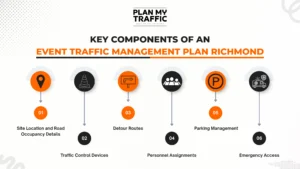
1. Site Location and Road Occupancy Details
-
-
Specific street names and limits of road occupancy
-
Duration of closure (start and end times)
-
Map showing exact closure boundaries
-
2. Traffic Control Devices
-
Barricade locations and quantities
-
Signage types and placement that must comply with regional traffic manual standards
-
Drop-off locations for equipment
-
Closure sign quantities and positioning
3. Detour Routes
-
-
Alternative routes for vehicles, cyclists, and pedestrians
-
Detours should match the capacity and configuration of closed roadways
-
Clear signage directing traffic around the event zone
-
4. Personnel Assignments
-
-
-
Placement of traffic control supervisors
-
Police officer or paid duty positions (if required)
-
Volunteer traffic marshals with specific duties
-
-
5. Parking Management
-
Additional parking restrictions during the event
-
Resident notification protocols for affected streets
-
Tow-away zones and enforcement measures
6. Emergency Access
-
-
Unobstructed routes for emergency vehicles at all times
-
Communication protocols with Richmond Fire Department and Royal Canadian Mounted Police
-
Incident response procedures
-
Event Traffic Management Plan Richmond Application Process
Step 1: Determine Your Event Category
Richmond classifies events based on size, scope, and impact. Check the city’s event checklist to confirm whether your gathering qualifies as an event requiring permits.
Step 2: Submit Initial Application
Complete the Community Festivals and Events Application through Richmond’s Event Services. Applications should be submitted minimum 90 days prior for events requiring road closures.
Step 3: Prepare Your Event Traffic Management Plan Richmond
Develop your Event Traffic Management Plan Richmond using the components outlined above. The plan must comply with applicable legislation and regional traffic manual guidelines.
Step 4: City Review and Approval
-
-
Safety compliance
-
Traffic impact mitigation
-
Emergency access provisions
-
Pedestrian and cyclist safety
-
Step 5: Implement and Monitor
Special Considerations for Event Traffic Management Plan Richmond
Vehicle Barriers and Hostile Vehicle Mitigation
Following modern safety standards, Richmond has implemented vehicle barrier protocols for high-risk events, including concrete barriers, mobile vehicle barriers, and police vehicle positioning.
Event organizers should consult with authorities on whether Hostile Vehicle Mitigation (HVM) measures are required based on crowd size, event profile, and threat assessment.
Coordination with Multiple Agencies
-
-
Royal Canadian Mounted Police
-
Richmond Fire Department
-
BC Ambulance Service
Filming and Special Events
Film productions and special oversized vehicle events require additional coordination with the Transportation Division for traffic signal modifications and special traffic control during filming.
Common Mistakes to Avoid in Your Event Traffic Management Plan Richmond
-
-
-
Late Applications: Submitting less than 90 days before your event risks permit denial
-
Incomplete Detour Plans: Failing to provide viable alternative routes for all road users
-
Missing Emergency Provisions: Not accounting for emergency vehicle access
-
Inadequate Signage: Using non-compliant or insufficient traffic control devices
-
No Resident Notification: Failing to inform affected residents of parking restrictions
-
-
Costs and Fees for Event Traffic Management Plan Richmond
-
-
Application processing fees
-
Traffic Management Plan review fees
-
Paid duty police officer costs (if required)
-
Equipment rental deposits (barricades, signage)
-
Damage deposits for park or street use
-
Conclusion
Frequently Asked Questions (FAQs)
1. How far in advance must I submit my Event Traffic Management Plan Richmond?
The City of Richmond requires event applications with road closures to be submitted minimum 90 days prior to the event date. This allows time for review, revisions, and coordination with Royal Canadian Mounted Police and emergency services.
2. Can I use volunteers instead of paid police officers for traffic control?
While volunteers can assist with certain traffic marshaling duties, Richmond staff will determine if Paid Duty Officers are required based on event size, risk level, and traffic impact. High-risk events typically require professional police presence.
If your Event Traffic Management Plan Richmond doesn’t meet requirements, Richmond Event Services will provide feedback for revisions. Common issues include inadequate detour routes, missing emergency access provisions, or non-compliant signage. Working with experienced traffic management consultants can prevent rejection.
4. Do I need separate permits if my event spans multiple Richmond locations?
Yes. Each location with road closures or traffic impacts requires separate Event Traffic Management Plan Richmond coverage. You must identify all affected streets, parks, and facilities in your application and ensure each area has appropriate traffic control measures.