Kelowna’s construction boom shows no signs of slowing. From downtown high-rises to highway expansions along Highway 97, contractors are racing to meet deadlines in one of Canada’s fastest-growing regions. But there’s a hidden bottleneck killing project timelines: incomplete or rejected Construction Traffic Management Plans Kelowna contractors depend on for permit approval.
If you’re a contractor working in Kelowna, you’ve likely faced the frustration of permit delays. A submission that sits in review for weeks. A rejection notice citing “insufficient traffic control details.” Or worse showing up to site only to discover your Road Usage Permit hasn’t been approved because your Traffic Control Plan (TCP) failed compliance.
Here’s what this guide delivers: A complete framework for creating compliant, fast-approved Construction Traffic Management Plans in Kelowna covering City of Kelowna requirements, BC MOTT standards, and the specific compliance gaps that cause rejections.
Whether you’re managing a residential subdivision on the Upper Mission or a commercial development near Orchard Park, this guide ensures your TMP moves from submission to approval without costly delays.
What Is a Construction Traffic Management Plan in Kelowna?
A Construction Traffic Management Plan Kelowna projects require is a comprehensive document that outlines how traffic, pedestrians, and cyclists will be safely managed around your construction zone. In Kelowna, this isn’t optional paperwork, it’s a legal requirement under the City of Kelowna’s Traffic Bylaw No. 8120 .
Your TMP must address:
Traffic Control Plan (TCP): Schematic diagrams showing lane closures, detours, signage placement, and work zone boundaries.
Public Communication Strategy: How nearby residents, businesses, and emergency services will be notified of impacts.
Implementation Protocol: Roles and responsibilities of your Traffic Control Supervisor and on-site team.
Compliance Documentation: Proof of insurance, WorkSafeBC alignment, and BC MOTT manual adherence.
The Critical Difference: Kelowna operates under dual jurisdiction. City roads fall under City of Kelowna Engineering, while provincial highways (like Highway 97) fall under BC Ministry of Transportation and Transit (MOTT). Your submission authority and requirements depend entirely on your work location.
Why Proper Construction Traffic Management Plan Kelowna Planning Matters: The Real Cost of Delays
The Financial Impact of Rejection
In a recent Kelowna commercial development project, a contractor submitted a TCP that lacked proper pedestrian accommodation along Bernard Avenue. The result?
A 14-day permit delay that pushed the project into peak tourist season, triggering:
Idle crew costs: $4,200/day for 14 days = $58,800
Extended equipment rental: $12,500 in additional fees
Liquidated damages: $2,000/day for missing the completion deadline
Total preventable loss: Over $85,000.
The Compliance Reality
The City of Kelowna and BC MOTT reject approximately 40% of initial Construction Traffic Management Plans Kelowna contractors submit due to common errors: missing lane closure justifications, inadequate sight distance analysis, or failure to coordinate with BC Transit for route impacts.
Every rejection costs you 7-14 business days minimum. In Kelowna’s compressed construction season, that’s the difference between finishing before winter shutdown or facing months of weather delays.
The Competitive Advantage
Contractors who master Construction Traffic Management Plan Kelowna compliance win more bids. Developers and project owners increasingly prioritize contractors with proven track records of fast permit approval. A contractor who can demonstrate “zero TMP rejections in 2024” stands out in competitive tenders for City of Kelowna infrastructure projects.
Core Components of a Compliant Construction Traffic Management Plan Kelowna
Municipal reviewers don’t just look for a traffic map. They audit for engineering rigor, safety compliance, and operational feasibility. Every submission must contain verifiable, site-specific data. Below are the non-negotiable elements your Construction Traffic Management Plan Kelowna must include.
Site Access, Detour Routing & Pedestrian Safety
Your CTMP must clearly define construction vehicle ingress/egress points, public detour routes, and temporary pedestrian/cyclist pathways. Kelowna’s active transportation standards require barrier-protected walkways with ADA-compliant gradients, tactile paving, and advance warning signage at least 150 meters from the work zone. Detour routes must be validated against real-time traffic volumes and emergency service response maps.
Traffic Control Devices & Signage Standards
Every cone, barricade, flashing arrow board, and regulatory sign must comply with BC Traffic Control Manual specifications for size, reflectivity, and placement distance. The plan must include a complete device inventory, maintenance schedule, and night-time visibility protocols. Missing or faded signage is one of the most common reasons inspectors issue immediate correction notices.
Emergency Access & Heavy Equipment Scheduling
Uninterrupted clearance for fire, ambulance, and police vehicles is mandatory. Your Construction Traffic Management Plan Kelowna must guarantee minimum lane widths, rapid-clearance procedures, and 24/7 site contact matrices. Heavy equipment movement, including crane lifts and oversized deliveries, must be scheduled outside peak commuter hours and coordinated with municipal traffic dispatch to prevent corridor blockages.
Common Mistakes That Cause Construction Traffic Management Plan Kelowna Rejections
Municipal engineering departments process hundreds of traffic plan submissions monthly. Incomplete or generic Construction Traffic Management Plans Kelowna are flagged, returned, or outright rejected. Understanding these pitfalls before you submit saves weeks of scheduling chaos.
Incomplete Sightline & Lane Closure Justifications
Reviewers require engineering-grade sightline analysis for every proposed lane reduction or temporary closure. Plans that rely on visual estimates or omit stopping sight distance calculations are routinely rejected. Kelowna’s hilly terrain and curve-heavy corridors amplify this requirement.
Unapproved Detours & Missing Stakeholder Coordination
Detour routes that bypass business districts, residential zones, or transit corridors without prior coordination trigger immediate pushback. Municipalities expect documented notification timelines, business access guarantees, and transit authority alignment before approving any public routing changes.
Inadequate Pedestrian and Cyclist Accommodation
Many Construction Traffic Management Plans Kelowna focus only on vehicle movement and ignore pedestrians and cyclists. Authorities expect safe, clearly defined detours with proper signage and barriers. Missing accessibility features like ramps or continuous pathways can lead to immediate rejection. Safety for all road users not just vehicles is a critical compliance requirement.
Incorrect Signage Specifications
Using wrong sign types, sizes, or placements is a common technical error. Each region (like BC TMM or MUTCD) has strict standards for signage spacing and visibility. Even small mistakes like incorrect taper warning signs can make the entire plan non-compliant. Reviewers check signage details very closely during approval.
No Emergency Vehicle Access Plan
Kelowna Fire Department requires guaranteed access routes for all TMPs. Blocking emergency access even temporarily results in immediate rejection.
Avoid rejection before it happens. Talk to our Kelowna CTMP specialists for a free consultation. We’ll identify compliance gaps and align your submission with municipal expectations no commitment, just clarity.
How PlanMyTraffic Accelerates Your Construction Traffic Management Plan Kelowna Approval
Navigating Kelowna’s permitting landscape requires more than a traffic diagram. It demands local regulatory knowledge, engineering precision, and proven municipal submission experience. Our team handles the entire Construction Traffic Management Plan Kelowna lifecycle so your project stays on schedule and your compliance stays airtight.
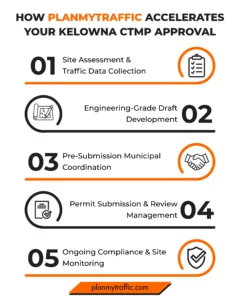
1. Site Assessment & Traffic Data Collection
We conduct on-site evaluations capturing existing traffic volumes, peak hour patterns, sightline restrictions, utility conflicts, and adjacent land use impacts.
2. Engineering-Grade Draft Development
Using CAD-based traffic control plans, we map lane configurations, detour routing, signage placement, and emergency access protocols. Every element cross-references City of Kelowna Engineering Standards and BC MoTT guidelines.
3. Pre-Submission Municipal Coordination
For projects impacting major corridors or commercial zones, we facilitate early consultations with municipal engineering reviewers and transit authorities to resolve potential conflicts before formal submission.
4. Permit Submission & Review Management
Your complete Construction Traffic Management Plan Kelowna package is submitted through the city’s permitting portal. Our specialists monitor review status, respond to technical queries within 48 hours, and handle all revision cycles to prevent timeline slippage.
5. Ongoing Compliance & Site Monitoring
Approval isn’t the finish line. We provide daily inspection templates, device maintenance schedules, traffic volume tracking, and phase-change plan updates to keep your permit active through closeout.
Advanced Compliance for Construction Traffic Management Plans Kelowna
Technology Integration
Modern Construction Traffic Management Plans Kelowna increasingly include: Real-time traffic monitoring: Cameras and sensors to verify traffic flow matches projections Variable message signs: Electronic boards that can update messaging based on conditions Digital submission platforms: The City of Kelowna is moving toward electronic TCP submission prepare your CAD files for digital upload.
Seasonal Considerations
Kelowna’s climate creates unique Construction Traffic Management Plan Kelowna challenges:
Winter Construction (November-March):
Snow removal equipment access requirements Reduced visibility signage (larger sizes, enhanced reflectivity) Cold weather impact on temporary pavement markings
Tourist Season (June-August):
Restricted hours for major highway work Enhanced pedestrian safety near beach access routes Coordination with special events (Ironman, Center of Gravity festival)
Multi-Phase Project Management
Long-term developments require amendment protocols. When your work phases change, submit TMP amendments rather than new applications, this maintains continuity while updating compliance documentation.
Conclusion
Kelowna’s construction landscape demands more than technical competence—it requires regulatory mastery. Every day your Construction Traffic Management Plan Kelowna sits in review costs your project thousands in idle labor, extended rentals, and missed deadlines. The difference between contractors who thrive and those who struggle often comes down to one factor: getting CTMP approval right the first time. The compliance framework outlined in this guide from dual jurisdiction navigation to sightline engineering and stakeholder coordination reflects the exact standards City of Kelowna and BC MoTT reviewers apply to every submission. Contractors who internalize these requirements don’t just avoid rejection; they gain competitive advantage through faster mobilization, stronger bid positioning, and reputation as reliable partners. The stakes are clear. A 14-day permit delay can cost $85,000+ in direct losses. A rejected plan can push your project into weather shutdowns or tourist season restrictions. But a compliant, professionally prepared CTMP moves you from submission to approval in 7–10 days—keeping crews working, equipment moving, and margins intact. Your next step is simple. Whether you’re preparing your first Kelowna submission or refining an existing plan, expert validation eliminates guesswork and guarantees compliance alignment.
Get your Construction Traffic Management Plan Kelowna reviewed by certified specialists today. PlanMyTraffic’s Kelowna team delivers engineering-grade CTMPs with a 98% first-time approval rate backed by direct municipal coordination, rapid revision turnaround, and full lifecycle compliance support.
Frequently Asked Questions
1. How long does Kelowna take to approve a construction traffic management plan?
Most compliant Construction Traffic Management Plans Kelowna are reviewed within 7–14 business days. However, plans requiring multi-department coordination or major corridor impacts may take 18–21 days. First-time approval rates increase significantly when plans include complete sightline analysis, emergency access protocols, and stakeholder notification timelines.
2. Can I use a generic CTMP template for my Kelowna project?
No. The City of Kelowna requires site-specific engineering drawings, traffic volume justifications, and detour routing validated against local conditions. Generic templates consistently fail municipal audits due to missing pedestrian accommodations, non-compliant signage spacing, and unapproved staging zones.
3. What happens if my CTMP is rejected by the city?
Rejected plans enter a revision cycle that delays permit issuance and halts site mobilization. Each resubmission adds 10–14 days to your timeline and may trigger additional compliance requirements. Working with a certified traffic management provider eliminates revision loops by aligning your submission with municipal standards from day one.
4. Do I need an updated CTMP if my project changes phases?
Yes. Any modification to work zone boundaries, lane closures, equipment movement schedules, or detour routes requires an amended Construction Traffic Management Plan Kelowna submission. Municipal permits remain conditional on active compliance, and unapproved changes can result in stop-work orders or fines.