
If you’re a contractor in British Columbia, you already know that timelines don’t wait. A bid opportunity opens up, the deadline is in 48 hours, and one of the last things standing between you and submitting a complete package is a stamped, approved 24 hour traffic control plan for construction. That single document can determine whether you win the project or watch it go to a competitor who had their paperwork ready.
This guide breaks down exactly what BC contractors need to know: what a compliant Traffic Control Plan requires, how the approval process works across MoTT and municipal jurisdictions, and how to get a plan submitted and approved within 24 hours without cutting corners.
Why Contractors in BC Need Traffic Control Plans Fast
In BC, traffic control plans aren’t optional. Under WorkSafeBC Part 18 and the BC Traffic Management Manual (TMM) 2020, any work that encroaches on a roadway whether on a provincial highway, a city street, or a municipal lane requires a compliant Traffic Control Plan before work can begin. Without one, you’re looking at stop-work orders, fines, and liability exposure that no contractor wants to deal with.
But the real pressure isn’t just regulatory it’s commercial. General contractors submitting bids to municipalities or to the Ministry of Transportation and Transit (MoTT) are increasingly required to include a TCP or a TCP framework as part of the bid package. That means you don’t just need a plan before construction starts. You need proof that you’ve planned for traffic management before you even win the contract.
Here’s where most contractors run into trouble:
- A bid surfaces on BC Bid or a municipal procurement portal with a 2–3 day turnaround
- Scoping, estimating, and scheduling already consume most of that time
- The TCP which requires site-specific engineering and regulatory knowledge gets left to the last minute
- Approval bottlenecks cause the plan to come back with revisions after the bid deadline
The result? A missed bid, a delayed project start, or worse mobilizing without an approved Traffic Control Plan and triggering a WorkSafeBC inspection.
Speed and compliance have to go together. That’s the core challenge this guide addresses.
What a Traffic Control Plan Must Include (BC Requirements)
BC’s Traffic Control Plan requirements are governed by two primary frameworks: WorkSafeBC Part 18 (Occupational Health and Safety Regulation) and the BC Traffic Management Manual 2020. Together, these documents define the minimum standards for any Traffic Control Plan used in a BC work zone.
A compliant BC traffic control plan must include:
- Site plan and scale drawing — Accurate representation of the work zone, road layout, and adjacent infrastructure
- Traffic control device layout — Placement of cones, barricades, delineators, and signs per TMM 2020 standards
- Sign schedule — All regulatory and warning signs required, with distances and mounting specifications
- Flagger/TCP personnel deployment — Positioning, responsibilities, and communication protocols for flaggers per WorkSafeBC Part 18
- Speed reduction strategy — Documented plan for reducing posted speed limits through the work zone
- Emergency vehicle access plan — Ensuring unobstructed access for fire, ambulance, and police at all times
- Contingency provisions — Alternative measures for adverse weather, unexpected traffic incidents, or schedule changes
- Preparer credentials — Plans must be prepared or reviewed by a certified Traffic Control Plan designer (many jurisdictions require a P.Eng. stamp for complex sites)
Skipping or glossing over any of these components is one of the fastest ways to get a plan rejected. And in a bidding scenario, a rejected plan means a missed deadline.
Why Most Traffic Control Plans Get Delayed or Rejected
Most delays in Traffic Control Plan approvals aren’t caused by fundamentally flawed plans they’re caused by avoidable gaps that a reviewing engineer or municipal inspector flags during the first pass. Understanding these patterns helps you avoid them.
Incomplete or outdated site data. Plans submitted without current field measurements or that use outdated aerial data get sent back for revision. BC’s reviewing bodies whether MoTT regional offices or municipal traffic departments expect current, site-verified information.
Wrong TMM template for the road type. A Traffic Control Plan designed using a two-lane undivided highway template submitted for a multi-lane arterial project in a municipality like Metro Vancouver or the City of Kelowna won’t pass. Each road classification has specific TMM requirements.
No WorkSafeBC Part 18 compliance notation. WorkSafeBC requires that flagger positioning and communication protocols be explicitly documented. Plans that delegate this detail to a generic “as required” note often come back with comments.
Missing pedestrian/cyclist accommodation. Urban projects in BC particularly in cities like Vancouver, Burnaby, or Victoria require documented provisions for vulnerable road users. This is increasingly a firm requirement, not a nice-to-have.
Submitting to the wrong authority. A contractor submitting a plan for work on a provincial highway to a city engineering department won’t get far. Understanding the approval pathway MoTT
vs. municipality is critical.
Need a compliant TCP before your next bid deadline?
How to Get a 24 Hour Traffic Control Plan in BC
Getting a fully compliant 24 hour traffic control plan for construction in BC requires a disciplined, fast-track process. Here’s what that process looks like when it’s done right:
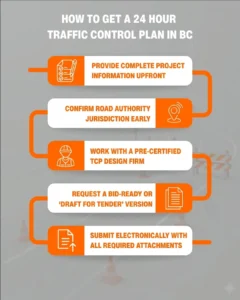
- Provide complete project information upfront. Location (address, NTS coordinates, or legal description), road authority jurisdiction, type of work, lane closure requirements, duration, and any known hazards or constraints. The more specific, the faster the plan can be produced.
- Confirm road authority jurisdiction early. Is this a provincial highway (MoTT)? A regional road? A municipal street? The answer determines which standards apply and who receives the submission.
- Work with a pre-certified TCP design firm. Firms that regularly work with MoTT regional offices and BC municipalities understand local reviewer expectations. This institutional familiarity dramatically reduces the chance of first-pass rejection.
- Request a bid-ready or ‘draft for tender’ version. Some jurisdictions allow a preliminary Traffic Control Plan concept to be included with the bid, with a final stamped plan required prior to mobilization. Know what your tender package requires.
- Submit electronically with all required attachments. Most BC road authorities now have digital submission portals or designated email inboxes. Sending a complete package the first time no missing attachments, no missing credentials is essential for meeting 24-hour turnarounds.
MoTT vs Municipal Approval Process in British Columbia
One of the most common sources of confusion and delay for BC contractors is understanding which authority has jurisdiction over the road they’re working on, and what that means for Traffic Control Plan approval.
MoTT (Ministry of Transportation and Transit)
Provincial highways in BC fall under MoTT jurisdiction. This includes major routes like Highway 1 (Trans-Canada), Highway 99, Highway 97, and hundreds of other numbered routes throughout the province. Traffic Control Plan submissions for MoTT roads must:
- Be prepared in accordance with the BC Traffic Management Manual 2020
- Meet MoTT’s regional district requirements (Interior, South Coast, North, etc.)
- Be submitted through the appropriate MoTT district office or their designated permit system
- Include a Professional Engineer stamp for complex work zones or major arterials
MoTT approval timelines vary by complexity and district workload, but routine plans can often be processed within 1–3 business days when submitted correctly.
Municipal Road Authorities
Work on city or district roads in municipalities like the City of Vancouver, the City of Surrey, the City of Kelowna, the District of Saanich, or the City of Prince George requires approval from that municipality’s engineering or traffic department. Municipal requirements can vary significantly from each other and from MoTT:
- Some municipalities have their own supplementary Traffic Control Plan standards on top of the BC TMM
- Utility work permits may have additional Traffic Control Plan requirements
- Some cities require pre-approval meetings or site walkthroughs for complex closures
- Approval timelines range from same-day (for routine, pre-approved standard configurations) to 5+ business days for complex or high-impact closures
The bottom line: knowing which authority you’re dealing with before you start preparing the Traffic Control Plan saves you significant time. Submitting to the wrong desk can cost you 24–48 hours you don’t have.
Common Mistakes That Delay TCP Approval
Even experienced contractors run into these. Here are the most common mistakes we see when BC contractors try to fast-track their Traffic Control Plan submissions:
- Using a generic or previously approved plan without modification. Every site is different. Reviewers will spot a recycled plan immediately different road width, different signage distances, different hazard profile. It gets rejected.
- Not accounting for adjacent businesses or access points. BC municipalities increasingly require documented provisions for driveway access and business disruption notifications, especially for closures exceeding 4 hours.
- Inadequate detour route documentation. For any full closure, a detour route needs to be drawn, signed, and approved not just referenced verbally in the plan.
- Missing or expired preparer credentials. WorkSafeBC and many road authorities require a certified Traffic Control Plan designer or P.Eng. For bids requiring a stamped plan, an expired certification kills the submission.
- Submitting a plan that doesn’t match the permit application. When the permit describes a 2-week partial closure but the Traffic Control Plan shows full nightly closures, approvers flag the discrepancy and send everything back.
Real Example: When a TCP Delay Costs a Contractor a Bid
Consider a mid-sized civil contractor based in the Lower Mainland bidding on a utility upgrade project for a Metro Vancouver municipality. The project involves a partial lane closure on a major arterial road four blocks, two weeks, with a nightly full closure window.
The contractor’s estimating team worked up competitive numbers. The project was well within their capacity. But the bid package required a complete Traffic Control Plan framework, stamped and signed, as a submission requirement.
Three days before the deadline, they reached out to a Traffic Control Plan consultant. The consultant came back with a quote and a 5-business-day turnaround. That was two days past the bid deadline.
The contractor submitted the bid without the Traffic Control Plan framework, noting that the plan would be provided upon award. The municipality’s procurement rules required a complete package at submission. The bid was disqualified.
The project went to a competitor who had an established relationship with a Traffic Control Plan firm and submitted a full plan on day one of the bid window.
This isn’t an edge case. It happens regularly across BC, particularly for projects managed by the City of Burnaby, the City of Richmond, and regional districts where procurement criteria are strict. The cost of that Traffic Control Plan delay wasn’t just the $800–$1,500 plan fee it was the entire value of the contract.
How to Avoid Delays and Get Approved Faster
There are concrete, actionable steps BC contractors can take to consistently secure fast Traffic Control Plan approvals without rushing or cutting corners:
- Build TCP lead time into your bidding workflow. As soon as a relevant bid surfaces, initiate the TCP scoping process in parallel with estimating not after. A 24-hour Traffic Control Plan is achievable, but only if the request goes in immediately.
- Maintain an up-to-date site data package. For recurring work corridors municipal utility programs, road maintenance contracts keep current site measurements, photos, and utility conflict data on file. This dramatically compresses Traffic Control Plan preparation time.
- Know your jurisdiction before you start. Check whether the road is MoTT or municipal, identify the reviewing body, and confirm the submission format they require. This five-minute step can save a day of back-and-forth.
- Partner with a firm that specializes in BC TCP design. General engineering consultants can produce TCPs, but firms that do this daily have templates calibrated for BC standards, established relationships with regional reviewers, and processes optimized for fast turnaround.
- Review WorkSafeBC Part 18 requirements annually. Regulations do get updated. Making sure your team and your Traffic Control Plan partner are working from current standards prevents compliance gaps that slow down approvals.
- For repeat projects, establish pre-approved standard configurations. Some BC road authorities will pre-approve standard Traffic Control Plan templates for routine work types (e.g., residential utility cuts under 6m wide). Working with the authority to establish these ahead of time creates a fast-track pathway for future projects.
Final Thoughts
A 24 hour traffic control plan for construction in BC isn’t a luxury for competitive contractors, it’s a strategic requirement. The bidding environment across BC’s municipal and provincial infrastructure projects has tightened, and Traffic Control Plan readiness is increasingly a differentiator between contractors who win work and those who don’t.
WorkSafeBC Part 18 and the BC Traffic Management Manual 2020 set clear requirements. MoTT and municipal authorities have defined approval processes. What’s variable and where contractors consistently win or lose is how fast and how accurately they navigate those requirements under bid-deadline pressure.
If your current workflow doesn’t include a reliable path to a stamped, compliant Traffic Control Plan within 24 hours, that’s the gap worth closing first. Visit our traffic control plan service page to learn how we help BC contractors get bid-ready fast.
For additional resources on BC construction traffic management, read our detailed guide: Construction Traffic Control Plan for British Columbia: The Essential Guide for Contractors covering regulatory requirements, site-specific planning, and approval best practices across the province.
Ready to Stop Losing Bids Over Missing TCPs?
PlanMyTraffic delivers BC-compliant, site-specific traffic control plans in as little as 24 hours meeting WorkSafeBC Part 18 and BC TMM 2020 standards across MoTT and municipal jurisdictions.
→ Get Your 24 Hour Traffic Control Plan Today
Frequently Asked Questions (FAQs)
Q1: Is a traffic control plan legally required for all construction work on BC roads?
Yes. Under WorkSafeBC Part 18, any work that encroaches on a roadway including road allowances requires a traffic control plan. This applies regardless of project size or duration, though the complexity of the required plan varies by road type and traffic volume.
Q2: Who is authorized to prepare a traffic control plan in BC?
Traffic Control Plan preparers must meet certification requirements set by the road authority. WorkSafeBC recognizes certified Traffic Control Supervisors (TCS) for standard work zones. For complex closures on provincial highways or major arterials, a Professional Engineer (P.Eng.) stamp may be required. It’s important to verify the specific requirements with the relevant road authority before submission.
Q3: What’s the difference between submitting a TCP to MoTT versus a municipality?
MoTT manages provincial highways and applies the BC Traffic Management Manual 2020 as the primary standard, with submissions going to the relevant regional district office. Municipal road authorities manage city and district streets, and while the BC TMM remains the baseline, many municipalities have supplementary requirements. Submission processes, approval timelines, and specific standards can vary considerably between jurisdictions.
Q4: Can I include a TCP in a bid package before the plan is stamped and finalized?
It depends on the tender requirements. Some BC municipalities and MoTT projects accept a ‘Traffic Control Plan concept’ or ‘draft for tender’ as part of the bid package, with a final stamped plan required as a condition of award. Others require a complete, stamped plan at submission. Always read the tender documents carefully and confirm with the project owner if there’s any ambiguity.
Q5: How much does a 24 hour traffic control plan typically cost in BC?
Traffic Control Plan costs in BC vary based on complexity, road classification, and turnaround time. Simple lane closure traffic control plan cost less while more complex plans involving multi-lane provincial highways, detour routing, or P.Eng. stamps will be priced higher. For urgent, 24-hour turnarounds, expect a premium over standard timelines. Visit our traffic control plan service page for current pricing and turnaround options.