FIFA World Cup 2026: Vancouver’s Event Traffic Management Plan Explained
In summer 2026, Vancouver will host seven FIFA World Cup matches at BC Place, turning parts of downtown into a pedestrian‑first fan zone. For event organizers, venues, and nearby businesses, a clear Event Traffic Management Plan (TMP) is essential to keep people safe, maintain access, and meet city and FIFA requirements.
This guide explains, in simple terms, what Vancouver’s World Cup road closures mean for you and what must be in an effective event TMP. A well-designed Event Traffic Management Plan ensures smooth movement of vehicles, pedestrians, and transit during high-volume events like the World Cup.
1. What Will Happen Around BC Place During the World Cup?
During the tournament period (mid‑May to late July), roads around BC Place and False Creek will operate very differently than normal. Key changes include:
-
Extended closures and “local traffic only” zones near the stadium.
-
Full and partial closures along sections of Pacific Boulevard, especially between Cambie Street and Carrall Street.
-
Closure of the Cambie Bridge northbound off‑ramp to Pacific Boulevard during the tournament period.
-
Larger “last mile” walking routes connecting SkyTrain stations (Yaletown–Roundhouse and Main Street–Science World) to BC Place.
On match days themselves, closures expand even further to create a safe, pedestrian‑only environment for tens of thousands of fans moving to and from the stadium and nearby fan zones.
2. Why an Event TMP Is Different from a Construction TMP
A construction TMP focuses on protecting a work zone and moving traffic safely past it. An event TMP for the World Cup must also handle:
-
Short, intense arrival and departure surges before and after each match.
-
Large pedestrian flows that fully occupy certain streets.
-
Coordination with transit agencies running enhanced service.
-
VIP and FIFA‑accredited vehicle movements, sometimes in bus lanes or restricted areas.
-
Noise, security, and crowd‑safety requirements linked to the hosting agreement.
Because of this, “just closing the road” is not enough. Your plan must show how vehicles, pedestrians, cyclists, and transit will all move safely in a very busy, constantly changing environment. This is why a detailed Event Traffic Management Plan is critical for managing both traffic flow and crowd safety during major tournaments.
Planning a World Cup event near BC Place? Don’t risk approval delays , get a site-specific event traffic management plan that aligns with Vancouver’s official closure and transit strategy.
Get Your Event TMP Approved Fast
3. Core Elements of a World Cup Event Traffic Management Plan
Any event TMP you prepare for World Cup‑related activities in Vancouver should clearly cover the following.
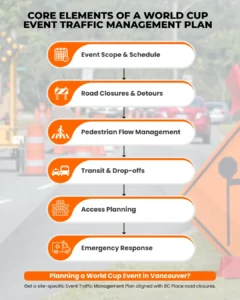
3.1 Event Scope and Schedule
-
Event name, type, and location (for example, viewing party, fan zone, hospitality event).
-
Set‑up, operating, and tear‑down dates and times.
-
Expected attendance and peak arrival/departure times, especially on match days.
This helps the City understand how your event interacts with existing World Cup road closures and transit plans.
3.2 Road Closures, Lane Use, and Detours
A strong Event Traffic Management Plan must clearly define all road closures, detours, and access points. For each day your event runs, your TMP should show:
-
Which streets or lanes you propose to close and for how long.
-
How those closures tie into the city’s base World Cup closure plan around BC Place and Pacific Boulevard.
-
Vehicle detour routes and which roads remain open to general traffic, local traffic, delivery vehicles, and emergency services.
Drawings should clearly mark barricades, “local traffic only” limits, and any loading or drop‑off points you need.
3.3 Pedestrian and Crowd Management
Managing the “last mile” on foot is one of the biggest tasks for World Cup events. Your TMP should describe:
-
Main pedestrian routes to and from SkyTrain stations, bus stops, parking, and your event site.
-
Areas that will be pedestrian‑only and how you will separate them from moving vehicles.
-
Any temporary crossings, controlled points, or one‑way walking flows at peak times.
This can be coordinated with your overall crowd management and security plan, but it must be clear in your TMP where pedestrians will walk and how they will be protected.
3.4 Transit, Taxis, and Rideshare
During the World Cup, Vancouver and TransLink will run enhanced transit services and may designate special curb space for transit and event vehicles. Your TMP should address:
-
Where buses can still run and where stops must be temporarily moved.
-
Where taxis and rideshare can safely drop‑off/pick‑up without blocking key walking routes.
-
How you will sign or staff these locations so fans know where to go.
Good coordination here reduces congestion and prevents dangerous stopping in the wrong places.
3.5 Access for Residents, Businesses, and Deliveries
Many businesses and homes surround BC Place and the downtown waterfront. Your plan should:
-
Identify which addresses are within or near your road closure area.
-
Explain how residents, employees, deliveries, and service vehicles will reach these locations.
-
Describe your communication approach (for example, advance notices, lobby posters, emails) so people know what to expect.
The goal is to support the event without “shutting out” the neighbourhood.
3.6 Emergency and Incident Response
The City will expect to see how you will respond to incidents during periods when streets operate differently than normal. In your TMP, include:
-
Confirmed emergency access routes in and out of your event area.
-
Locations where vehicles can pull over or be quickly moved if there is a breakdown or crash.
-
On‑site contact details for your event’s traffic or operations lead who can coordinate with police, fire, and ambulance.
4. Common Mistakes in Event TMPs for Major Tournaments
Organizers sometimes underestimate how strict and complex traffic requirements are for global events like the World Cup. Typical mistakes include:
-
Ignoring the base city closure plan and drawing something that conflicts with it.
-
Not accounting for pedestrian volumes that completely fill a street after a match.
-
Forgetting about access needs for tower residents, hotels, and nearby businesses.
-
Providing diagrams that are too general and not site‑specific.
-
Omitting a clear plan for drop‑offs, pick‑ups, and transit changes.
Fixing these issues after submission can delay approvals and force last‑minute changes just before your event.
5. How We Help Event Organizers and Venues in Vancouver
If you are planning a World Cup‑related event in downtown Vancouver or near BC Place, you do not need to navigate this alone. We can help you:
-
Interpret the City’s World Cup road closure maps and base traffic plan.
-
Design site‑specific event TMPs that fit within those closures and transit changes.
-
Show safe, efficient routes for pedestrians, fans, and service vehicles.
-
Prepare clear drawings and written descriptions that city reviewers can approve quickly.
-
Adjust your plan if requirements change as the tournament approaches.
Frequently Asked Questions (FAQ)
1. What are the most common mistakes organizers make in Event TMP submissions?
One of the biggest mistakes is preparing a plan that ignores Vancouver’s official World Cup road closure and pedestrian routing strategy. Other common issues include underestimating pedestrian volumes after matches, failing to plan for resident and business access, providing drawings that are too generic, and leaving out clear pickup, drop-off, or transit coordination details. These mistakes often lead to review comments, revisions, and last-minute pressure before the event. For a major tournament, even a small planning gap can create safety concerns or delay approvals.
2. Do I need to account for pedestrians and crowd movement in my TMP?
Yes, absolutely. During the World Cup, pedestrian movement around BC Place will be one of the biggest operational pressures. Your TMP should clearly show how people will walk between SkyTrain stations, bus stops, fan zones, hospitality venues, and your event location. It should also explain how pedestrian-only areas will be separated from moving vehicles and how crossings or one-way walking routes will be handled during peak periods. A plan that focuses only on vehicle closures without addressing crowd movement will be incomplete.
3. How should an Event TMP address transit, taxis, and rideshare activity?
Your plan should identify where buses can continue to operate, where stops may need to be relocated, and where taxis or rideshare vehicles can safely pick up and drop off passengers without interfering with pedestrian routes or traffic flow. This is especially important during the World Cup because transit service will be enhanced and curb space may be tightly controlled. A good TMP does not just show a road closure, it also shows how people will realistically arrive and leave without causing congestion or unsafe stopping behavior.
4. Why is a site-specific Event TMP so important for World Cup approvals?
Because the World Cup creates a fast-changing, high-volume operating environment, city reviewers need to see exactly how your event will function in the real conditions around BC Place. A generic traffic plan does not show how your road closures, crowd flows, service access, and emergency routes will work on your exact streets and dates. A site-specific TMP improves approval speed, reduces the chance of conflicts with the city’s base traffic plan, and helps avoid last-minute changes that can disrupt your event setup.