
In Burnaby, project delays don’t always start on-site they often begin on paper.
More specifically, they begin with a traffic management plan Burnaby submission that doesn’t pass review the first time.
At a glance, traffic plans seem routine. But in reality, they sit right at the intersection of safety, compliance, and real-world execution. And that makes them far more critical than most contractors expect.
What’s changing today is not the requirement itself , it’s how seriously it’s being evaluated.
As a result, contractors are rethinking their approach. Instead of treating traffic plans as a side task, they’re starting to see them as a high-risk approval step one that’s better handled with precision than assumption.
What Is a Traffic Management Plan in Burnaby?
A traffic management plan Burnaby is more than just a layout , it’s a representation of how your project will interact with real, moving traffic.
It answers key questions like:
- How will vehicles move safely around your work zone?
- What happens to pedestrians when access is restricted?
- How are risks controlled during active construction?
In Burnaby, expectations go beyond basic diagrams. Plans are evaluated based on how well they:
- Reflect actual site conditions
- Anticipate risks before they occur
- Maintain safe flow for all road users
That’s why compliance isn’t just about ticking boxes. It’s about showing that your plan works in real-world conditions, not just on paper.
Why In-House Traffic Plans Are Causing Delays in Burnaby
The issue isn’t that contractors lack capability , it’s that traffic planning has become more detail-sensitive than ever before.
Handling a traffic management plan Burnaby internally often leads to friction at the approval stage not because the plan is wrong, but because it’s not precise enough.
Rejections That Reset Timelines
Reviewers aren’t just checking if elements exist, they check if they are:
- Correctly positioned
- Properly spaced
- Fully justified
That’s where most in-house plans fall short.
Delays That Push Everything Back
The real problem isn’t the rejection , it’s the timing.
By the time feedback comes in, your schedule is already committed. Crews are lined up. Equipment is booked. Now everything waits.
Cost Impact You Didn’t Plan For
Costs don’t spike instantly, they build quietly:
- A day of delay turns into rescheduling
- Rescheduling affects multiple trades
- Small inefficiencies compound
In one Burnaby residential project, a minor revision request led to a 3-day delay. The real cost wasn’t the delay itself, it was the disruption to the entire sequence of work that followed.
If your traffic management plan doesn’t pass review the first time, your entire project timeline can shift getting it checked early can save you days of delay and costly rework.
Compliance Confusion
Multiple standards overlap:
- Municipal expectations
- Provincial requirements
- Safety regulations
Without regular exposure to these, it’s easy to miss how they interact and that’s where plans get flagged.
What Makes a Traffic Management Plan “Permit-Ready” in Burnaby
A permit-ready traffic management plan Burnaby is defined by one thing: clarity under review.
If a reviewer has to question anything, it slows approval.
1. Site-Specific Planning
Plans must reflect:
- Actual constraints
- Real traffic behavior
- On-site limitations
Anything generic raises red flags.
2. Accurate Taper Calculations
Tapers aren’t estimates, they’re calculated.
Even slight mismatches between: Speed, Distance, Road type can trigger revisions.
3. Proper Sign Placement
Signs must:
- Appear in the right sequence
- Be spaced correctly
- Match expected conditions
Reviewers look for logic, not just presence.
4. Pedestrian and Cyclist Safety
Urban projects in Burnaby demand:
- Clear detours
- Continuous access
- Safe separation
Missing this doesn’t just delay approval , it raises safety concerns.
5. Emergency Access Planning
Plans must show:
- Immediate accessibility
- No obstruction points
- Flexibility during incidents
This is often reviewed more strictly than expected.
If you’re unsure whether your plan meets all these expectations, reviewing it early can prevent unnecessary back-and-forth later.
Common Mistakes That Push Contractors to Outsource
Outsourcing usually happens after patterns emerge not after one mistake.
Over-Reliance on Templates
Templates simplify work but ignore:
- Site-specific risks
- Traffic behavior
- Local nuances
Misjudging “Minor Details”
Things that seem small internally: A missing sign, Slight spacing error can be critical during review.
Reactive Planning
Plans created under time pressure often:
- Skip validation
- Miss coordination
- Lack clarity
Disconnect Between Plan and Reality
If the plan doesn’t match how the site actually operates, it won’t pass.
In a Burnaby commercial project, a plan showed pedestrian access but didn’t align with actual sidewalk conditions. The mismatch led to rejection despite the plan appearing complete.
Why Contractors in Burnaby Are Outsourcing Traffic Management Plans
Outsourcing isn’t about capability, it’s about consistency.
Contractors are choosing to outsource their traffic management plan Burnaby because they want predictable outcomes in an environment where even small errors can lead to costly setbacks. What’s really driving this shift is not convenience, it’s control over timelines, approvals, and risk.
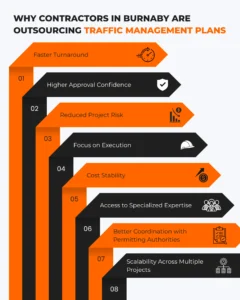
1. Faster Turnaround
Not because work is rushed but because:
- There’s no trial-and-error
- Requirements are already understood
- Common rejection points are avoided before submission
When plans are prepared by teams that deal with Burnaby approvals regularly, the process becomes streamlined. Instead of figuring things out during review, everything is already aligned before submission.
In many cases, what takes multiple revisions internally can be completed in a single cycle when handled by experienced planners.
2. Higher Approval Confidence
Plans are built with:
- Review expectations in mind
- Compliance integrated from the start
- Real-world site conditions reflected accurately
This changes the mindset from “let’s submit and see what happens” to “this should pass the first time.”
Contractors aren’t just looking for completion they’re looking for confidence at submission, knowing that the plan won’t come back with avoidable revisions.
3. Reduced Project Risk
Less uncertainty means:
- Fewer surprises
- Better planning
- More reliable scheduling
Traffic plans sit at the beginning of the project timeline. If they fail, everything else shifts.
By outsourcing, contractors reduce the risk of:
- Approval delays
- Coordination breakdowns
- Last-minute adjustments
4. Focus on Execution
Instead of managing approvals, teams focus on:
- Delivering the project
- Coordinating crews
- Managing on-site operations
Handling traffic plans internally often pulls attention away from core responsibilities. It creates a situation where project managers are juggling both execution and compliance and neither gets full attention.
Outsourcing removes that friction. It allows teams to stay focused on what actually moves the project forward.
5. Cost Stability
Avoiding rework keeps budgets controlled not reactive.
The real cost of in-house planning isn’t the effort , it’s the corrections after rejection.
These include:
- Redrawing plans
- Resubmitting documents
- Adjusting schedules
- Managing downtime
Outsourcing shifts costs from unpredictable (fixing problems) to predictable (getting it right the first time).
6. Access to Specialized Expertise
Traffic planning isn’t just drafting, it’s interpretation of standards, regulations, and real-world application.
Outsourcing gives contractors access to:
- Specialists familiar with BC MOTT and WorkSafeBC expectations
- Experience across multiple Burnaby projects
- Up-to-date knowledge of compliance changes
This level of expertise is difficult to maintain internally unless traffic planning is a core function of your business.
7. Better Coordination with Permitting Authorities
Experienced planners understand how different authorities review submissions.
They know:
- What reviewers typically flag
- How to present information clearly
- How to avoid back-and-forth communication
This reduces friction during the approval process and speeds up overall timelines.
8. Scalability Across Multiple Projects
For contractors handling multiple projects at once, in-house planning becomes a bottleneck.
Outsourcing allows you to:
- Handle multiple submissions simultaneously
- Maintain consistency across projects
- Avoid overloading internal teams
This is especially important during peak construction seasons in Burnaby.
Step-by-Step: How to Outsource Your Traffic Management Plan Effectively
Outsourcing works best when it’s done early not after problems arise.
Step 1: Provide Clear Project Context
The more accurate your input, the better the output.
Step 2: Choose Experience Over Convenience
Familiarity with Burnaby projects matters more than speed alone.
Step 3: Stay Involved in Review
Outsourcing doesn’t mean disconnecting alignment is still key.
Step 4: Plan Ahead
Early preparation removes pressure and improves outcomes.
How PlanMyTraffic Supports Burnaby Contractors
For contractors working within tight timelines, the difference often comes down to how smoothly approvals are handled.
PlanMyTraffic focuses on:
- Building plans that reflect real conditions
- Aligning with Burnaby and BC expectations
- Reducing the need for revisions
The goal isn’t just submission, it’s approval without friction.
Conclusion
A traffic management plan Burnaby is no longer just a routine requirement , it’s a critical step that can directly impact whether your project moves forward smoothly or gets delayed before it even begins. As expectations from reviewers continue to rise, the focus has shifted from simply submitting a plan to submitting one that is precise, site-specific, and fully aligned with real-world conditions. Small oversights that once went unnoticed can now lead to delays, revisions, and unnecessary project disruptions. That’s why more contractors are rethinking how they approach traffic planning not because they lack capability, but because they understand the cost of getting it wrong. When your plan is clear, accurate, and built with approval in mind, you reduce risk, avoid back-and-forth revisions, and keep your project timeline intact from the very start.
Ready to Avoid Delays and Get It Right the First Time?
Before submitting your plan, it’s worth making sure everything is aligned not just visually, but technically and contextually.
Getting it right early can make the difference between a smooth start and unnecessary delays.
Frequently Asked Questions(FAQs)
1. Why are traffic management plans becoming harder to approve in Burnaby?
Traffic management plans are becoming harder to approve in Burnaby because project environments are more complex and regulatory expectations have increased significantly. With higher traffic volumes, more pedestrian activity, and growing interaction with cyclists and public transit, authorities are placing greater emphasis on safety and accuracy. Reviewers are no longer just checking whether a plan includes the required elements they are evaluating whether it realistically reflects site conditions and manages risks effectively. This means every detail, from taper lengths to signage placement and pedestrian routing, must align precisely with standards like BC MOTT, WorkSafeBC , and TAC guidelines. Even minor inconsistencies can lead to rejection, making the approval process far more detail-driven than it used to be.
2. Is outsourcing only for large projects?
Outsourcing traffic management plans is not limited to large projects; in many cases, smaller and mid-sized projects benefit even more from it. The decision to outsource depends on the level of risk and complexity rather than the size of the project. Even relatively small jobs can require detailed planning if they involve lane closures, pedestrian disruptions, or work near busy roads. For contractors with limited internal resources, handling these requirements in-house can lead to mistakes or delays. Additionally, the impact of a delay on a smaller project can be significant, as even a few days of downtime can disrupt schedules and increase costs. For this reason, outsourcing becomes a practical way to ensure accuracy, reduce risk, and keep the project moving without unnecessary setbacks.
3. How does outsourcing reduce delays?
Outsourcing reduces delays by minimizing the chances of rejection and eliminating the need for repeated revisions during the approval process. When traffic management plans are prepared by experienced professionals, they are developed with a clear understanding of approval requirements, common rejection points, and compliance standards. This increases the likelihood of first-time approval, which is critical for keeping projects on schedule. Instead of going through a cycle of submitting, receiving feedback, making corrections, and resubmitting, contractors can move forward with confidence that the plan is complete and accurate from the start. In this way, outsourcing shifts the process from reactive problem-solving to proactive planning, ultimately saving time and preventing disruptions to the project timeline.