A Traffic Control Plan for Safe Construction Sites is not optional in British Columbia, it’s a legal requirement that directly impacts worker safety, permit approval, and project timelines. Every construction site in British Columbia that affects a road, lane, or pedestrian path legally requires a traffic control plan for construction sites BC before a single worker steps onto the roadway. Yet every week, contractors lose days because their plans are rejected for using the wrong sign codes, wrong figures, or missing required elements. This guide tells you exactly what a compliant BC construction site traffic control plan looks like, what law requires it, and how to get it approved the first time.
What Is a Traffic Control Plan for a Safe Construction Site in BC?
A construction site traffic control plan BC is a site-specific technical document that shows how all traffic vehicles, pedestrians, cyclists, and construction equipment will be safely managed while work is happening on or adjacent to a public road.
Think of it as the rulebook for your work zone. It answers three questions before anyone steps on site:
- Who controls traffic – certified Traffic Control Person (TCP/Flagger) positions and responsibilities
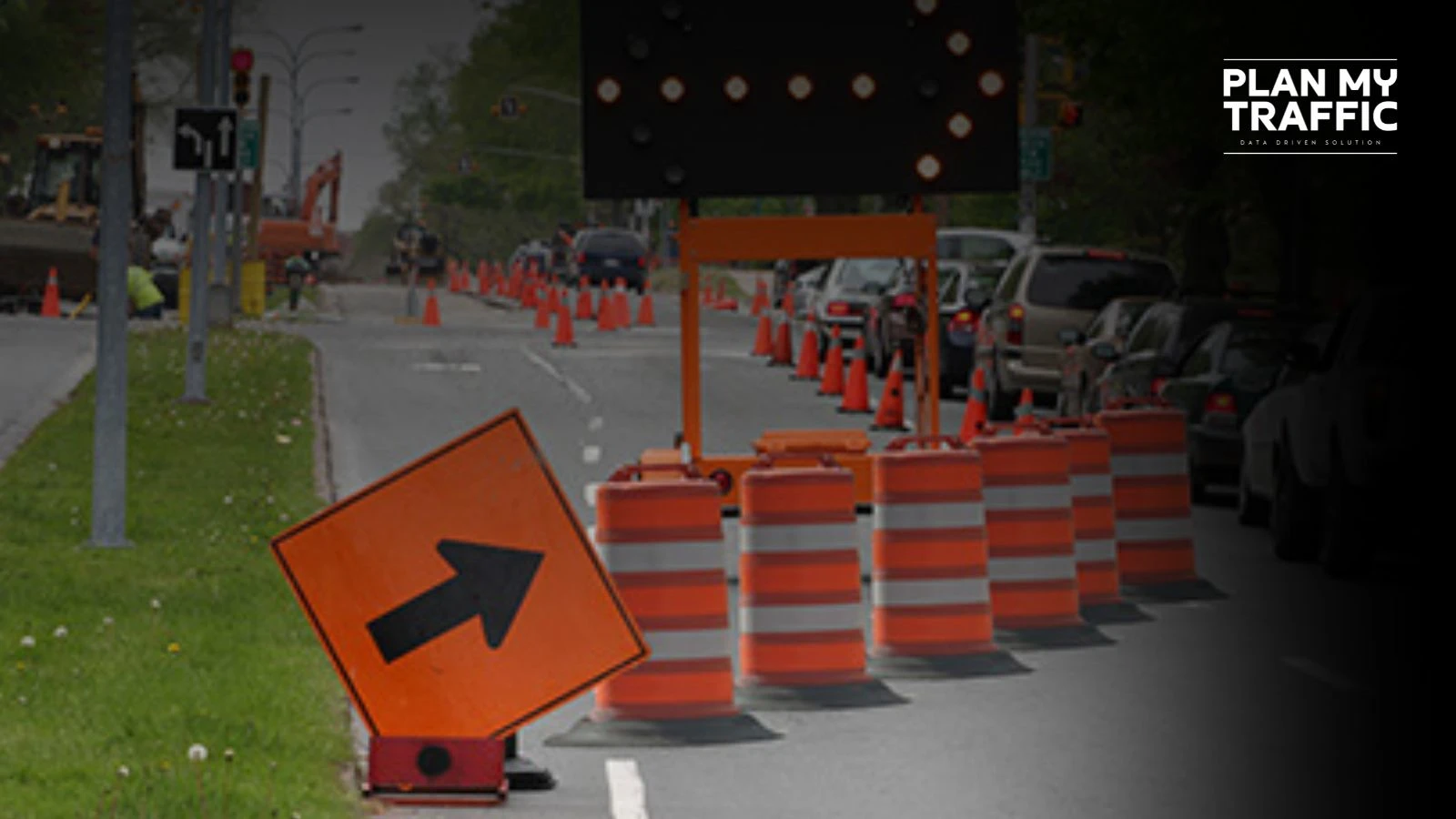
- What devices are used – BC C-series signs, barriers, drums, cones, Flashing Arrow Boards (FABs)
- Where everything goes – all five work zone areas mapped with correct taper lengths and buffer distances per BC TMM 2020
A generic template or US MUTCD based plan will not pass in BC. Every plan must be built to the BC TMM 2020 Traffic Management Manual for Work on Roadways standard.
The Legal Framework in British Columbia
Three authorities govern traffic control plan requirements BC construction sites must follow. Understanding all three is critical before you submit a single permit application.
1. BC TMM 2020 Traffic Management Manual for Work on Roadways
This is the primary technical standard for all work zones in BC, published by the BC Ministry of Transportation and Transit (MoTT). It specifies layouts, BC C-series sign codes, taper length tables, buffer zone dimensions, and flagger positioning for every construction scenario. Every TCP submitted for a BC road must reference the correct BC TMM 2020 figure no exceptions.
2. WorkSafe BC OHS Regulation Part 18 (Traffic Control)
Under Part 18 of BC’s Occupational Health and Safety Regulation, every employer must implement and maintain effective traffic control whenever traffic poses a risk to workers. This is a legal obligation with real consequences ,WorkSafe BC inspectors can issue immediate stop-work orders and monetary penalties for non-compliant construction site work zones. It also requires all Traffic Control Persons to hold a current WorkSafe BC High-Risk TCP certificate.
3. MoTT Highway Use Permit / Municipal Street Use Permit
Under Section 52 of BC’s Transportation Act, any construction work that affects traffic on a provincial highway requires a Highway Use Permit from the MoTT district office, with a compliant TCP attached. For municipal roads in cities like Vancouver, Surrey, Kelowna, or Victoria, you need a city-issued Street Use or Traffic Obstruction Permit+ also requiring a compliant TCP.
BC does not follow the US MUTCD. Using MUTCD sign codes, MUTCD taper formulas, or MUTCD zone definitions on a BC construction,* TCP is an automatic rejection. All plans must use BC C-series codes and reference BC TMM 2020 figures.
Key Components of a BC Construction Site Traffic Control Plan
A compliant work zone traffic control plan BC is made up of the following non-negotiable elements:
1. Hazard and Site Assessment
Before designing the plan, you must document the site conditions that will shape every decision in the TCP:
- Road name, nearest intersection, and municipal/provincial jurisdiction
- Posted speed limit and lane configuration
- Type of construction work and project duration (short vs. long duration)
- Peak traffic hours and any special use periods (school zones, transit routes, events)
- Presence of pedestrians, cyclists, or accessible routes that need to be maintained
- Proximity to intersections, driveways, bus stops, or emergency access points
2. Five Work Zone Areas – All Labelled and Dimensioned
BC TMM 2020 requires every construction TCP to show all five zones with correct dimensions:
| Zone | Purpose | BC TMM 2020 Key Rule |
|---|---|---|
| Advance Warning Area | First zone drivers encounter warning signs placed here | Distance from Table B Distance A based on posted speed |
| Transition Area (Taper) | Merges or shifts traffic away from work zone | Taper length from BC TMM 2020 Table A – lane width × speed formula |
| Buffer Zone | Empty safety space between live traffic and workers | Longitudinal and lateral buffer required; dimensions vary by road class and speed |
| Work Activity Area | Where workers and equipment actively operate | Must be physically separated from traffic using drums, barriers, or delineators required |
| Termination Area | Transitions traffic back to normal flow | Downstream taper required; C-080 End Road Work sign mandatory |
3. BC C-Series Signage – Correct Codes, Correct Placement
Every sign on your construction TCP must use the BC C-series sign code system. The most commonly required signs for BC construction sites are:
| BC Sign Code | Sign Name | When Required |
|---|---|---|
| C-018-1A | Construction Ahead | All construction TCPs , advance warning area |
| C-004 | Crew Working Ahead | Any time workers are present in or near the roadway |
| C-001-2 | Flagger Ahead | When a certified TCP is actively directing traffic |
| C-029 | Prepare to Stop | Single lane alternating traffic setups |
| C-030-8 | Single Lane Traffic | All single-lane alternating operations |
| C-130-R | Right Lane Closed Ahead | Multilane roads with right lane closure |
| C-053 | Lane Closure Arrow | At taper; paired with FAB at ≥ 70 km/h or flasher at ≤ 60 km/h |
| FAB | Flashing Arrow Board | Mandatory at posted speed ≥ 70 km/h , no substitution permitted under BC TMM 2020 |
| C-080 | End Road Work | Required at termination area of every TCP |
4. Certified Traffic Control Persons (TCP/Flaggers)
Under WorkSafe BC OHS Regulation Part 18, all flaggers managing live traffic on a BC construction site must hold a valid 3-year WorkSafe BC High-Risk TCP certificate. This certificate requires completing a 2-day approved training program with a minimum 80% written exam score and a hands-on practical road assessment. Night work additionally requires overhead lighting at every TCP station. The active construction speed limit must be ≤ 70 km/h while TCPs are directing traffic.
5. Emergency Vehicle Passage Plan
Per BC TMM 2020 Section 5.8.1, every construction TCP must document a clear procedure for how emergency vehicles (ambulance, fire, police) will pass through or around the work zone. This must also address what the TCP/Flagger does when an emergency vehicle approaches and what happens in the event of equipment failure or an on-site incident.
Real-Life Example: Gas Line Installation on a 2-Lane Highway in Kelowna, BC
A utility contractor in Kelowna, BC wins a contract to install a 300-metre gas line along a 2-lane rural arterial with a posted speed of 80 km/h. Work runs 2 weeks, daylight hours. Here is what their traffic control plan for construction sites BC requires:
- BC TMM 2020 Figure 7.8.2 – Single Lane Alternating with speed reduction, posted speed ≥ 60 km/h
- Reduced construction speed signs posted at the advance warning area entry point
- C-018-1A (Construction Ahead) and C-004 (Crew Working Ahead) in the advance warning area at Table B Distance A from the taper
- C-001-2 (Flagger Ahead) advance sign placed before each TCP station
- C-029 (Prepare to Stop) signs at both ends of the single-lane alternating section
- C-030-8 (Single Lane Traffic) signs at the taper entry points
- FAB (Flashing Arrow Board) – original posted speed is 80 km/h; mandatory, no substitution under BC TMM 2020
- Two certified WorkSafe BC High-Risk TCP/Flaggers one at each end of the alternating section
- Drums delineating the full work activity area and buffer zone on both sides
- C-080 (End Road Work) at the termination area downstream
- Emergency vehicle procedure per BC TMM 2020 Section 5.8.1
- Highway Use Permit submitted to MoTT via BC TMM 2020 Appendix E with the TCP attached
The contractor’s original vendor submitted a plan with no FAB shown (citing the ≤ 60 km/h substitution rule incorrect because the original posted speed was 80 km/h, not the construction speed). MoTT rejected it on day one. They contacted Plan My Traffic at 4 PM. A corrected, fully compliant plan was delivered by 9 AM the next morning. Permit approved. Zero further delays.
Common Hazards a BC Construction TCP Must Address
Beyond the technical drawing itself, your construction traffic management plan BC must show how you are actively managing these common construction site hazards:
- Heavy machinery crossing live lanes requires TCP flagger present and documented in the plan
- Reduced sight lines , dust, equipment, and stored materials blocking driver visibility; addressed with advance warning distance and additional signage
- Pedestrian detour routes if an existing sidewalk or path is blocked, an alternative accessible route must be shown on the TCP drawing
- Night work BC TMM 2020 requires additional lighting at TCP stations and increased delineator visibility; retroreflective devices must meet minimum candela ratings
- Intersections within the work zone require separate intersection-specific figures from BC TMM 2020 Figures 11.2–11.5
- School and playground zones WorkSafe BC and MoTT impose stricter controls; early morning and afternoon peak periods require additional TCPs and reduced construction speed
Stop risking delays, fines, and unsafe work zones, get a construction traffic control plan built for compliance, accuracy, and fast approval.
Traffic Control Devices Used on BC Construction Sites
Choosing the right devices and placing them correctly — is one of the most critical parts of a compliant traffic control plan for construction sites BC:
| Device | BC Use | BC TMM 2020 Requirement |
|---|---|---|
| Traffic Cones | Short duration tapers, low-speed local roads | Permitted for leading taper at ≤ 60 km/h; drums required at ≥ 70 km/h |
| Drums (Channelizing Devices) | Work activity area, buffer zone delineation | Required at ≥ 70 km/h; standard spacing per BC TMM 2020 Table C |
| Concrete Barriers (Jersey Barriers) | Long-duration highway projects, high-speed roads | Required when lateral buffer cannot be maintained; crash cushions at open ends |
| Water-Filled Barriers | Temporary separation of work zone from traffic | Acceptable as delineation device; end treatment required per BC TMM 2020 |
| Flashing Arrow Board (FAB) | Lane closure taper on roads ≥ 70 km/h | Mandatory, no substitution at posted speed ≥ 70 km/h |
| Portable Changeable Message Sign | Advance notice of lane closures, detours | Optional but strongly recommended on high-volume BC arterials and highways |
| Type A Yellow Warning Light | Low-speed roads, no workers present after hours | Permitted at ≤ 60 km/h as substitute for FAB when no workers are present |
Step-by-Step: How to Get a Traffic Control Plan for Safe Construction Sites Approved in BC
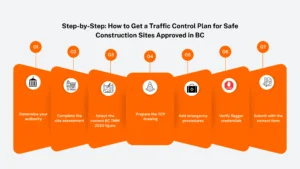
- Determine your authority – Provincial highway: MoTT district office. Municipal road: city traffic engineering department. Wrong authority = wrong permit form = delay.
- Complete the site assessment – Document road name, posted speed, lanes affected, work duration, peak traffic hours, pedestrian routes, and proximity to intersections.
- Select the correct BC TMM 2020 figure – Match your scenario (road type, speed, lanes, duration) to the right BC TMM 2020 layout figure. This is the most common rejection point.
- Prepare the TCP drawing – Include all 5 work zone areas with dimensions, BC C-series sign codes and placement, taper lengths from Table A, buffer distances, device types, and TCP/Flagger positions.
- Add emergency procedures – Document emergency vehicle passage plan per BC TMM 2020 Section 5.8.1.
- Verify flagger credentials – Confirm all TCPs hold a valid 3-year WorkSafe BC High-Risk certificate before submitting.
- Submit with the correct form – Provincial: BC TMM 2020 Appendix E (Work Notification/Lane Closure Request and Approval Form).
Municipal: varies by city verify with the local engineering department.
Most BC municipalities require plan submission at least 5–10 business days before work begins. MoTT provincial approvals for complex or high-traffic corridor projects may take longer. The fastest path to approval is a complete, first-time-right submission ,no corrections, no resubmissions.
Top Reasons BC Construction TCPs Get Rejected
- US MUTCD sign codes used instead of BC C-series codes
- Wrong BC TMM 2020 figure referenced for the road type or speed
- Taper length not calculated from BC TMM 2020 Table A
- Buffer zone missing or under-dimensioned on the drawing
- No emergency vehicle passage procedure included (required under BC TMM 2020 Section 5.8.1)
- FAB missing on roads with original posted speed ≥ 70 km/h
- Certified TCP/Flagger positions not shown on the drawing
- Expired or missing WorkSafe BC flagger certifications
- C-080 End Road Work sign missing at termination area
- Plan reused from a different site without site-specific adjustments
- Pedestrian detour route not shown when existing path is blocked
Wrong sign codes or missing details can get your plan rejected, avoid delays with a traffic control plan built to BC TMM 2020 standards.
Why BC Contractors Work With Plan My Traffic
Rejected plans do not just cost you resubmission time they delay your crew, your equipment, and your revenue. At Plan My Traffic, every traffic control plan for construction sites BC we produce is built to pass on the first submission:
- BC TMM 2020 compliant – correct figures, C-series sign codes, Table A taper lengths, all 5 zones labelled
- WorkSafe BC Part 18 aligned – flagger requirements, PPE notes, night work rules, emergency procedures
- MoTT and municipal permit-ready – we know exactly what each BC authority checks before approving
- 24-hour standard delivery – built for construction timelines and tight bid windows
- Same-day urgent service – for emergency construction starts and last-minute permit needs
- Site-specific every time – no recycled layouts, no generic templates
- Digital permit-ready PDF – ready to attach to your permit application the moment it lands in your inbox
We serve construction contractors, utility companies, civil engineering firms, and project managers across all of British Columbia from Metro Vancouver, Surrey, and Burnaby to Kelowna, Victoria, Kamloops, Prince George, and beyond.
Get Your BC Construction Site Traffic Control Plan – Free Quote Today
Don’t let a rejected or missing TCP delay your crew and your project. Tell us your site location, road type, posted speed, and work duration , we’ll send you a free quote the same business day and have your BC-compliant TCP ready in 24 hours.
Get a Free Quote Now → planmytraffic.com
Serving construction contractors, project managers, and utility companies across British Columbia -Vancouver, Surrey, Burnaby, Kelowna, Victoria, Kamloops, Prince George, and beyond.
Frequently Asked Questions
Q1: Is a traffic control plan legally required for every construction site in BC?
Yes. Under WorkSafe BC OHS Regulation Part 18, every employer must implement effective traffic control whenever construction work creates a hazard to workers from passing traffic. On provincial highways, BC’s Transportation Act (Section 52) additionally requires a Highway Use Permit with a compliant TCP before any lane-affecting work begins. Municipal roads have parallel permit requirements. There are no exemptions based on project size ,even a one-day repair job on a public road requires a compliant plan.
Q2: What is the difference between a TCP (Traffic Control Plan) and a TMP (Traffic Management Plan) for a BC construction site?
A Traffic Control Plan (TCP) is a site-specific drawing that shows exactly how traffic will be managed at a single work location ,signs, devices, zones, taper lengths, and flagger positions. A Traffic Management Plan (TMP) is a broader strategic document covering multiple phases, multiple worksites, or a full project corridor. For most single-location BC construction jobs, a TCP is sufficient. For large multi-phase projects, both a TMP and individual TCPs per phase may be required by MoTT or the municipal authority. Plan My Traffic provides both and can bundle them for a faster, more cost-effective approval process.
Q3: Can I prepare my own traffic control plan for a BC construction site, or do I need a professional?
There is no BC law that requires a traffic control plan to be prepared by a licensed engineer but it must be fully compliant with BC TMM 2020, WorkSafe BC Part 18, and meet the specific requirements of the permit authority reviewing it. In practice, self-prepared plans submitted by contractors without deep BC TMM 2020 knowledge are among the most frequently rejected. A professional plan prepared to BC standards, delivered in 24 hours, costs far less than a single day of crew downtime from a rejected permit. At Plan My Traffic, we handle the technical requirements so you can focus on running your project.