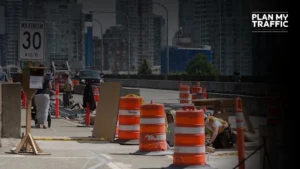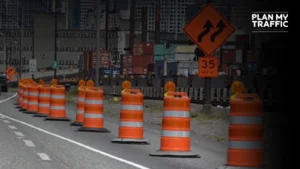
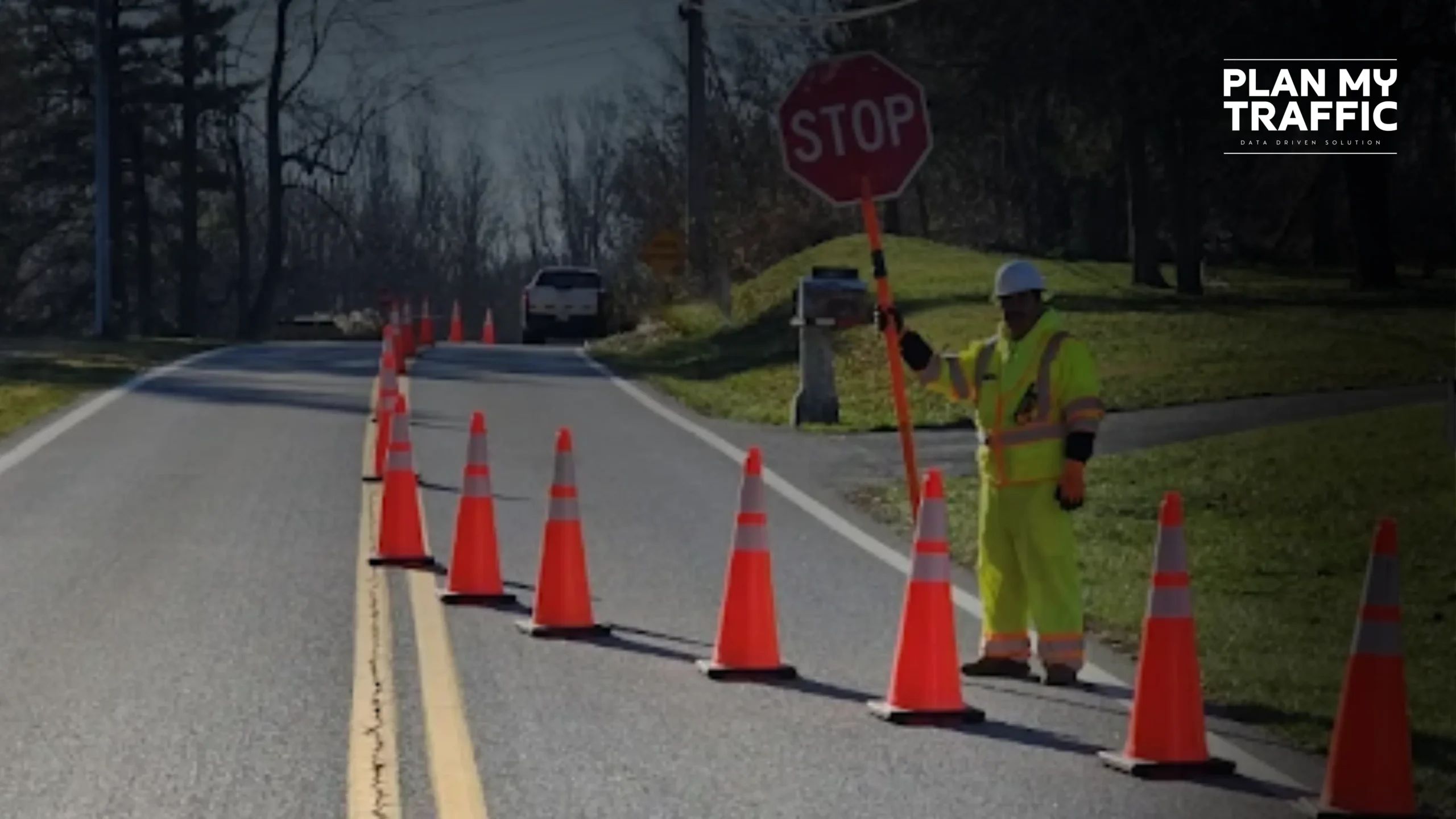
Single lane alternating traffic closures are one of the most common and most critical traffic management strategies used on British Columbia roads. Whether you’re managing a utility repair on a two-lane rural highway, a construction project on a mountain corridor, or emergency flood recovery work, getting your single lane alternating traffic closure traffic control plan in BC right is not optional.
In British Columbia, these closures are governed by the 2020 Traffic Management Manual for Work on Roadways (TMM) and enforced under WorkSafe BC OHS Regulation Part 18, specifically Section 18.3.1. Non-compliance exposes contractors to stop-work orders, fines, and most critically serious injury or death to workers and the public.
This guide explains exactly how single lane alternating traffic (SLAT) closures work in BC, what methods are permitted (flaggers, AFADs, or portable traffic signals), what the regulations require, and why a professionally designed TCP can save your project time, money, and lives.
Need a compliant TCP for your BC project?
What Is a Single Lane Alternating Traffic Closure?
A single lane alternating traffic (SLAT) closure is a temporary traffic control method used on a two-lane, two-way roadway where one lane is obstructed by construction, maintenance, or emergency work. Traffic from one direction is stopped while the other direction moves through the open lane then the process reverses.
Under the BC TMM 2020, the SLAT pattern is formally defined in Section 7 (Traffic Control Layouts). It requires:
- A defined advance warning area with appropriate signage (distance determined by posted speed)
- A transition/taper area with channelizing devices directing traffic into the open lane
- A work activity area — the active zone where work is performed
- A termination area where traffic returns to normal
This setup applies whether control is executed by a Traffic Control Person (TCP/flagger), an Automated Flagger Assistance Device (AFAD), or a portable traffic signal system.
BC TMM 2020 Compliance: What Your Traffic Control Plan Must Include
Under WorkSafe BC OHS Regulation Section 18.3.1, every employer must ensure that a traffic control plan (TCP) is developed and implemented whenever traffic could be hazardous to workers. In BC, that TCP must align with the 2020 TMM as the referenced standard.
A compliant SLAT traffic control plan in British Columbia must include:
| Element | Requirement |
|---|---|
| Advance Warning Signs | Traffic Control Person Ahead (C-001-1) + speed reduction signage |
| Channelizing Devices | Cones, delineators, or barriers forming proper taper |
| Control Method | TCP (flagger), AFAD, or portable signal based on site conditions |
| High-Visibility PPE | Class 3 CSA Z96-15 compliant garments (fluorescent colors) |
| Stop/Slow Paddles | Mandatory for TCPs; illuminated paddles allowed |
| Safety Headgear | High-visibility helmet with retroreflective tape |
| Communication Plan | Two-way radios between TCPs for coordination |
| Plan Drawings | Scaled layout with device placement, spacing & dimensions |
The traffic control plan must be prepared before work starts, signed by a qualified Traffic Control Supervisor, and available on-site at all times.
Three Methods to Achieve a Single Lane Alternating Traffic Closure in BC
The BC TMM 2020 recognizes three primary methods for managing SLAT closures. The right choice depends on site conditions, traffic volume, work duration, and posted speed.
Method 1: Flaggers (Traffic Control Persons / TCPs)
Flaggers , formally called Traffic Control Persons (TCPs) in BC remain the most widely used method for SLAT closures on lower-volume, lower-speed roadways. They are positioned at each end of the closure zone and use stop/slow paddles and standardized hand signals to alternate traffic flow.
BC Requirements for TCPs:
- Must hold a valid BC Traffic Control Person certificate (WorkSafeBC-recognized training)
- Must wear Class 3 high-visibility PPE meeting CSA Z96-15
- Must use a STOP/SLOW paddle (illuminated paddles are permitted as an enhancement)
- The distance between each TCP and the TCP Ahead sign shall not exceed 150 metres
- Two-way radio communication between TCPs is mandatory for closures where TCPs cannot see each other
Best suited for: Short-duration closures, ≤70 km/h posted speeds, lower traffic volumes, and sites where flaggers can safely operate from the shoulder.
Method 2: Automated Flagger Assistance Devices (AFADs) — Operated by Flaggers
AFADs are the future of single lane alternating traffic control in BC and WorkSafeBC is actively encouraging their adoption to remove flaggers from high-risk roadway positions.
An AFAD is a portable, remotely operated device equipped with red and yellow LED traffic signals and a gate arm with a fluorescent flag that extends into the travel lane. It mimics the stop/slow function of a human flagger but keeps the operator safely off the roadway.
Key BC TMM 2020 (T-04-25 Update) Standards for AFADs:
- One AFAD is required per lane being controlled
- When used at night, the AFAD station must be illuminated with overhead lighting
- Speed limit in the construction zone must be ≤70 km/h where AFADs are deployed
- A STOP HERE ON RED SIGNAL sign (R-280-R) must be installed on the right side of each approach at the stop point
- Gate arm must reach at least to the centre of the controlled lane (minimum 2.44 m, not including flag)
- The 2C-AFAD C-113 sign can be paired with a Flagger Controlled C-113-Ta tab as an enhancement
Best suited for: High-traffic corridors, night work, extended-duration closures, narrow shoulders where traditional flagging positions are unsafe, and locations with a history of vehicle incursions into the work zone.
Method 3: Portable Traffic Signal Systems
Portable traffic signals (also called temporary traffic signals or portable signal lights) are a third approved method under BC TMM 2020 for single lane alternating traffic on two-lane roadways. Unlike AFADs which require an operator portable signals are self-regulating or timer-based, making them ideal for long-duration projects where continuous staffing is impractical.
Key Considerations:
- Must be installed per the signal taper layout shown in BC TMM 2020 Section 7 (Figure 7.10)
- Appropriate for longer closures where queuing and delay management require predictable signal cycles
- Requires advanced regulatory approval and must be included in the submitted TCP
- “Stop Here on Red Signal” signage is mandatory at each approach
Best suited for: Long-duration projects (weeks to months), pipeline installations, bridge rehabilitation, and remote locations with limited TCP availability.
Don’t risk stop-work orders or unsafe setups get your single lane alternating traffic closure handled with a fully compliant, site-specific plan.
Get Your SLAT Traffic Control Plan Quote
Flagger Safety: The Critical Issue BC Contractors Cannot Ignore
Flaggers are among the most at-risk workers in British Columbia. WorkSafeBC data shows that between 2015 and 2024, 9 roadside workers were killed and 267 were injured seriously enough to miss work after being struck by vehicles in BC. Of all roadside workers struck in the past decade, a significant proportion were flaggers or traffic control personnel.
Over a 10-year study period ending in 2017, 124 of 229 injured roadside workers were in traffic management or flagging roles representing the single highest-risk occupation category.
According to the SPI Safety Blog:
- Work zone strikes are predominantly caused by distracted, speeding, or non-compliant drivers
- Flaggers are most vulnerable during peak hours, at night, and on high-speed rural highways
- The percentage of highway worker fatalities involving workers on foot being struck has increased year over year
BC Contractor Action Items for Flagger Safety:
- Maximize AFAD use where conditions permit, it physically removes the worker from the travel lane
- Ensure shadow vehicle protection is in place on high-speed approaches (≥80 km/h)
- Require Class 3 PPE at all times not Class 2 as mandated by WorkSafeBC
- Brief flaggers on escape routes before every shift
- Position TCPs in the safest available location behind barriers, on wide shoulders, or elevated areas wherever possible
- Never position a flagger within the travelled portion of an active lane
WorkSafeBC is actively encouraging the use of AFADs precisely because they eliminate the single greatest risk factor for flaggers: being in proximity to moving vehicles.
Real-World Proof: Highway 8 Flood Recovery, British Columbia
The value of well-executed single lane alternating traffic closures was proven at scale during the B.C. Highway Flood Recovery Project Highway 8 between Spences Bridge and Merritt.
When the devastating November 2021 floods washed away large sections of Highway 8, the BC Ministry of Transportation and Transit faced the challenge of rebuilding 25 erosion sites and three bridges while keeping the corridor open for local residents, Indigenous communities, and critical freight movement.
SLAT closures implemented through a combination of flaggers and phased control measures were deployed across multiple active sites simultaneously. As recently as July 2025, the project’s highway newsletter confirmed that single lane alternating traffic was active at:
- Site 1 (45 km east of Spences Bridge)
- Sites 9–10 (14 to 15.3 km east of Spences Bridge)
The result: a complex multi-site flood recovery project involving 40+ engineering and construction disciplines was completed with the corridor remaining open. The new bridges at sites 9 and 10 opened to full two-lane vehicle traffic by December 2025.
The lesson for BC contractors: Properly designed and implemented SLAT closures are not just a regulatory checkbox they are a mission-critical operational tool that keeps projects moving and workers safe under the most demanding conditions.
Key Components of a BC-Compliant Single Lane Alternating Traffic Control Plan
A professionally prepared Traffic Control Plan (TCP) for a SLAT closure in British Columbia must address the following:
-
Site Assessment
- Road classification, posted speed, and sight lines
- Shoulder width and available space for TCP positioning
- Traffic volume (ADT) and peak hour patterns
- Work duration and hours (day/night/24-hour)
-
Advance Warning Area Layout
- Signs sized and spaced per BC TMM 2020 Tables for posted speed
- Traffic Control Person Ahead C-001-1 sign positioned correctly
- Speed reduction signage as required
- Dynamic Message Sign (DMS) for high-traffic or long-closure situations
-
Control Method Selection & Placement
- TCP (flagger) stations with confirmed sight lines and escape routes
- AFAD placement meeting T-04-25 gate arm and lighting requirements
- Portable signal placement per TMM Figure 7.10
-
Channelizing Device Layout
- Taper design (typically 15 metres for SLAT taper, 5 equally spaced devices)
- Cone/delineator spacing appropriate for posted speed
- Barriers where required (e.g., drop-off protection ≥300mm from barrier back)
-
Communication Protocol
- Two-way radio requirement documented
- Pilot car provisions if applicable
- Emergency response contact list
-
Contingency Plans
- Traffic backup procedures
- Incident response protocol
- After-hours contact for the Traffic Control Supervisor
Need a compliant single lane alternating traffic closure in BC? Avoid rejections, reduce risk, and keep your project moving.
Training & Certification Requirements in BC
All Traffic Control Persons (TCPs) operating in BC must hold certification under a WorkSafeBC-recognized training program. The industry-standard certification in BC is provided through the BC Construction Safety Alliance (BCCSA), which also publishes the TCP Guide including the official SLAT layout.
Traffic Control Supervisors (TCS) have additional certification requirements and are responsible for the overall design and implementation of the TCP on site.
Key certification facts:
- TCP certification must be renewed periodically
- Supervisors must ensure all TCPs on their site hold current, valid certificates
- Under OHS Regulation Part 18, it is the employer’s responsibility to ensure certified TCPs are used
Common Mistakes That Delay Approval or Create Safety Risks
- Incorrect sign spacing for posted speed class — most common TCP rejection reason
- No sight line analysis — TCPs positioned where they cannot see each other or oncoming traffic
- Missing STOP HERE ON RED SIGNAL signs when AFADs are specified
- Inadequate taper length — especially on high-speed approaches (≥80 km/h)
- Generic TCPs not localized to the actual site — regulators and MoTT inspectors will reject these
- No night work provisions — forgetting overhead lighting requirements for AFAD stations
- Wrong PPE class specified — Class 2 is not sufficient; Class 3 is mandatory in BC
How Plan My Traffic Delivers Compliant Single Lane Alternating Traffic Control Plans — Fast
At Plan My Traffic, we specialize in BC-compliant Traffic Control Plans that are:
- Built to BC TMM 2020 standards – not generic templates
- Inclusive of all three SLAT control methods – flaggers, AFADs, and portable signals
- Reviewed by qualified Traffic Control Supervisors with BC project experience
- Designed for first-time approval – reducing costly revision cycles
Our digital-only process means no back-and-forth delays. Submit your project details, and we’ll return a quote-ready, site-specific TCP within 24 hours.
Ready to Get Your Single Lane Alternating Traffic Closure TCP Approved Fast?
Don’t risk a stop-work order or a WorkSafeBC compliance order. Whether you need a flagger-based plan, an AFAD layout, or a portable signal TCP for your BC highway project Plan My Traffic delivers a compliant, site-specific Traffic Control Plan in 24 hours.
Request a Quote
Ready to Work Together? Build a project with us!
Frequently Asked Questions (FAQ)
Q1: What is the difference between a flagger and an AFAD for a single lane alternating traffic closure in BC?
A flagger (TCP) is a certified human traffic control person who physically stands at the closure point and uses a stop/slow paddle to control traffic. An AFAD (Automated Flagger Assistance Device) is a remotely operated machine that performs the same stop/go function using LED signals and a gate arm, but keeps the operator safely off the roadway — often 30+ metres from the travel lane. Under BC TMM 2020, both are approved methods for SLAT closures. WorkSafeBC actively recommends AFADs to reduce the risk of flaggers being struck by vehicles. For high-speed corridors (≥80 km/h), night work, or extended-duration projects, AFADs are strongly preferred.
Q2: Is a Traffic Control Plan required for a single lane alternating traffic closure in British Columbia?
Yes — absolutely. Under WorkSafe BC OHS Regulation Section 18.3.1, any employer whose workers could be exposed to traffic hazards must have an effective traffic control plan in place before work begins. For SLAT closures specifically, the plan must comply with the BC 2020 Traffic Management Manual for Work on Roadways and include a scaled site drawing, control method selection, sign layout, device placement, and communication procedures. Failure to have a compliant TCP in place can result in immediate stop-work orders and WorkSafeBC enforcement action.
Q3: Can a portable traffic signal be used instead of a flagger for a single lane alternating closure in BC?
Yes. Portable traffic signals are a recognized third option under BC TMM 2020 for single lane alternating traffic on two-lane, two-way roadways. They are particularly effective for long-duration closures where continuous staffing would be impractical or where predictable signal timing improves queue management. However, portable signals require advance approval, must be designed into the TCP with proper signage (including “Stop Here on Red Signal” signs at each approach), and are subject to the same compliance inspection as flagger or AFAD setups. They are not a way to avoid regulatory requirements they are simply a different compliant method.