Professional Traffic Control Plan services in Canada are often underestimated until the waste starts. When budgets are tight and timelines are compressed, traffic control planning gets treated as something a supervisor can handle internally. Download a template, adjust a few signs, sketch a lane closure, and submit it. It feels efficient. But here is the reality most Canadian contractors discover the hard way: a DIY TCP rarely saves money in the long run.
Operational waste does not always appear on a spreadsheet immediately. It shows up as rejected permits, idle crews, reworked layouts, inspector corrections, and missed mobilization windows. A professional Traffic Control Plan in Canada does not just meet compliance standards it protects your project from exactly this kind of preventable waste. This guide breaks down why contractors across Canada consistently choose professional TCP services over DIY and what it costs when they do not.
What Is a Professional Traffic Control Plan in Canada?
A Traffic Control Plan (TCP) is a site-specific document that defines how vehicle traffic, pedestrians, cyclists, and emergency services will be safely managed around a construction or maintenance work zone. In Canada, TCPs must align with the Transportation Association of Canada (TAC) Temporary Traffic Control guidelines and meet provincial or municipal review standards before work can begin.
The word “professional” is not just a marketing term. It refers to a TCP that is designed by a qualified traffic management specialist using real site measurements, accurate taper calculations, proper device spacing, and first-pass approval in mind. A professional Traffic Control Plan in Canada is built to pass review — not just to be submitted.
What a Professional TCP Includes
A professionally prepared TCP covers all elements reviewing authorities in Canada expect to see:
- Clear lane closure strategy with justified phasing for multi-step operations
- Proper taper lengths calculated per TAC standards and posted speed limits
- Buffer zone dimensions that meet national work zone safety requirements
- Accurate signage type, placement, and spacing specific to site conditions
- Pedestrian accommodation with alternate routing and accessibility compliance
- Emergency vehicle access maintained through all construction phases
- Device quantities, spacing intervals, and buffer requirements precisely calculated
- Clear labelling, legend, north arrow, scale, and revision block
Who Needs a Professional TCP in Canada
Any contractor, developer, or project manager whose work impacts a public road, sidewalk, or right-of-way in Canada will require a TCP. This includes:
- Road resurfacing and reconstruction projects
- Utility trenching and repair within active road corridors
- Lane closures for municipal or territorial highway work
- Construction staging near active intersections
- Special events affecting public traffic flow
- Emergency repairs requiring rapid permit submission
For guidance on Canadian work zone standards, contractors can refer to the Transportation Association of Canada Temporary Traffic Control guidelines the national standard for TCP compliance in Canada.
Why the Choice Between Professional and DIY Costs More Than You Think
At first glance, creating a TCP internally seems practical. You know the jobsite. You have done similar projects before. Why pay for outside traffic management services? Because traffic control is not just about placing cones it is about predicting traffic behaviour under changing conditions and producing documentation that passes regulatory review on the first submission.
The real cost of DIY TCP planning rarely shows up as a single line item. It compounds across permits, labour, equipment, scheduling, and safety. Here is what that actually looks like on a Canadian project:
COST OF DIY TCP — WHERE THE WASTE APPEARS
• Permit rejection: Each revision cycle adds 3–7 business days to approval timeline
• Idle crew costs: Workers on standby waiting for permit clearance
• Equipment rescheduling: Cranes and excavators re-booked at premium rates
• Overtime: Compressed timelines force evening and weekend shifts
• Field corrections: Inspector-flagged errors cost half a day minimum to reset
• In Yukon / Northern Canada: A 2-week TCP delay can push work into the following season
For Canadian contractors working in compressed seasonal windows particularly in BC, Yukon, and Northern territories even a one-week TCP delay can affect overall project profitability by 15–25 percent due to crew standby, equipment rescheduling, and overtime costs.
5 Ways a Professional Traffic Control Plan Reduces Operational Waste in Canada
The value of a professional Traffic Control Plan in Canada is not theoretical it is measurable at every stage of your project. Here are the five most significant ways professional TCP planning reduces waste compared to DIY approaches.
-
Higher First-Pass Approval Rates No Revision Delays
One of the biggest setbacks Canadian contractors face is TCP rejection. Reviewing authorities whether municipal engineering departments or provincial highway offices expect submissions that comply with TAC standards, MUTCD requirements, and local permit conditions. Missing details, incorrect taper distances, or incomplete detour information send your plan back for revisions.
Real example: A utility contractor in British Columbia submitted a DIY TCP for a lane closure on a 60 km/h corridor. The plan was rejected because taper length calculations did not match the posted speed. The contractor lost 5 working days resubmitting a cost that could have been avoided entirely with a professionally prepared first submission.
Professional TCP providers understand local review standards and documentation requirements across Canadian provinces. Plans are structured correctly, labelled clearly, and aligned with compliance frameworks significantly improving first-pass approval speed.
-
Accurate Resource Forecasting No Equipment Over or Underuse
DIY planners often add extra cones or signs as a safety buffer, increasing material handling and transport costs. Others underestimate requirements and get flagged by inspectors mid-project, forcing same-day changes at premium cost.
A professional TCP Canada calculates exact device quantities, spacing intervals, and buffer requirements based on actual site conditions. This precision improves budget forecasting and eliminates the guesswork that creates equipment waste on Canadian construction projects.
-
Faster Field Execution No On-Site Adjustment Delays
Even when a DIY plan gets approved, problems often surface during setup. Crews arrive on-site and discover that sign spacing does not match real-world conditions, taper lengths feel too short for the actual road width, or pedestrian routing is unclear. Field corrections begin. Labour hours stretch. Supervisors step in.
Professionally engineered TCPs reduce guesswork. They are built using real measurements, traffic flow data, and practical execution knowledge. Clear diagrams and precise measurements let crews deploy confidently without constant adjustments keeping your project schedule intact.
-
Reduced Safety and Liability Exposure
Safety incidents are the most expensive form of operational waste. Even a minor collision near a work zone can trigger insurance complications, legal reviews, and lasting reputation damage. DIY TCPs frequently overlook:
- Sight distance requirements for the specific road geometry
- Night visibility considerations for evening or early morning shifts
- ADA-compliant pedestrian pathways that meet Canadian accessibility standards
- Emergency vehicle access continuity throughout all project phases
- Buffer zone dimensions for the actual posted speed not a generic estimate
Professional plans prioritise safety standards from the beginning, reducing risk exposure and creating defensible documentation if audits, WorkSafeBC inspections, or liability claims arise.
-
Long-Term Cost Control Delays Do Not Compound
Operational waste compounds over time. Delays trigger overtime. Overtime affects profit margins. Rework impacts downstream schedules. A single DIY TCP rejection at the start of a project can create a chain reaction that affects every phase that follows.
Choosing a professional Traffic Control Plan in Canada breaks this chain at the source. By investing in structured, first-pass-ready documentation upfront, contractors protect every phase of their project schedule from the risks that DIY planning introduces.
Common DIY TCP Mistakes That Cause Rejection in Canada
Understanding why DIY TCPs fail is as important as knowing what a professional Traffic Control Plan delivers. These are the most frequent rejection reasons seen on Canadian construction projects each one preventable with professional planning.
Mistake 1: Incorrect Taper Length Calculations
Taper length is calculated using a formula based on posted speed limit and lane width, per TAC Temporary Traffic Control standards. A TCP that uses a 30-metre taper on a 70 km/h roadway when the correct calculation requires 120+ metres will be rejected immediately by any Canadian reviewing authority.
This is the single most common technical rejection reason on Canadian TCP submissions. Professional planners calculate taper lengths precisely for every project.
Mistake 2: Generic Templates Not Specific to the Site
A TCP downloaded from the internet or copied from a previous project will not reflect actual site conditions road width, signal configuration, intersection proximity, or corridor-specific permit conditions. Canadian reviewers are trained to identify generic templates, and they are returned without approval.
Professional TCPs are drawn from real site measurements, not standard templates. This is why first-pass approval rates are significantly higher with professional providers.
Mistake 3: Missing Pedestrian Accommodation Diagrams
Any work that disrupts a sidewalk, crosswalk, or pedestrian access zone must include a complete alternate routing diagram showing detour path, temporary signage placement, and accessibility compliance. Plans that omit pedestrian accommodation are returned regardless of how accurate the vehicle lane closure portion is.
Mistake 4: No Emergency Vehicle Access Plan
Every TCP must demonstrate that emergency vehicle access is maintained throughout all project phases. On rural Canadian highway corridors where no alternate route exists, this requirement is especially scrutinised. A plan that does not address emergency access will not pass review.
Mistake 5: Incomplete or Missing Device Schedules
Reviewers expect to see a complete list of every traffic control device signs, cones, delineators, arrow boards, barricades with quantities, spacing distances, and placement diagrams. Plans that show a layout without a corresponding device schedule are flagged for revision.
Avoid TCP rejection before it happens. Talk to our team free consultation, no commitment.
How to Get a Professional Traffic Control Plan in Canada: Step-by-Step
Switching from DIY to professional TCP planning does not have to be complicated. Here is a straightforward process that Canadian contractors follow to get a compliant, approval-ready TCP without delays.
Step 1: Identify Your Project Scope and Requirements
Before requesting a professional TCP, confirm what your project involves road classification, posted speed, lane count, work duration, and whether the project is on a municipal road or provincial highway. This determines which reviewing authority will process your permit and what standards apply.
Step 2: Gather Complete Site Data Before Reaching Out
Professional TCP providers can turn around a compliant plan in 24 hours but only when site data is complete. Before contacting your provider, have the following ready:
- Road name, classification, and posted speed limit
- Lane width and number of lanes affected
- Traffic volume approximate daily counts or AADT if available
- Nearby sensitive locations: schools, hospitals, transit stops
- Planned work scope, phasing, and construction duration
- Equipment and material staging requirements
Step 3: Choose a Provider That Knows Canadian Review Standards
Not every TCP provider is familiar with Canadian provincial review standards. A professional TCP Canada provider understands TAC taper calculation requirements, WorkSafeBC work zone standards, municipal permit conditions in BC and Yukon, and what local reviewers expect to see in first-pass submissions.
PlanMyTraffic delivers professional Traffic Control Plans across Canada built for first-pass approval, delivered within 24 hours. Learn about our TCP services
Step 4: Review the Plan Before Submission
Before submitting your TCP to the reviewing authority, verify that the plan reflects your actual construction sequence not a generic staging layout. Confirm that mobilization dates, equipment staging, and crew scheduling are all reflected in the phasing diagrams. A TCP that matches your operational plan will execute more smoothly on site.
Step 5: Submit Early and Build Buffer Time
Even with a 24-hour professional TCP delivery, municipal or provincial review takes time. Build buffer time into your schedule: allow 3–5 business days minimum for municipal reviews and longer for complex provincial highway projects. Submitting your completed TCP application the moment your plan is ready maximises your review buffer before mobilization.
Why Canadian Contractors Choose PlanMyTraffic for Professional TCP Services
PlanMyTraffic specialises in professional Traffic Control Plans for contractors, project managers, and municipalities across Canada with a proven track record of first-pass approvals on municipal road projects, utility corridor work, highway maintenance, and special event traffic management.
Here is what sets professional TCP delivery apart from DIY:
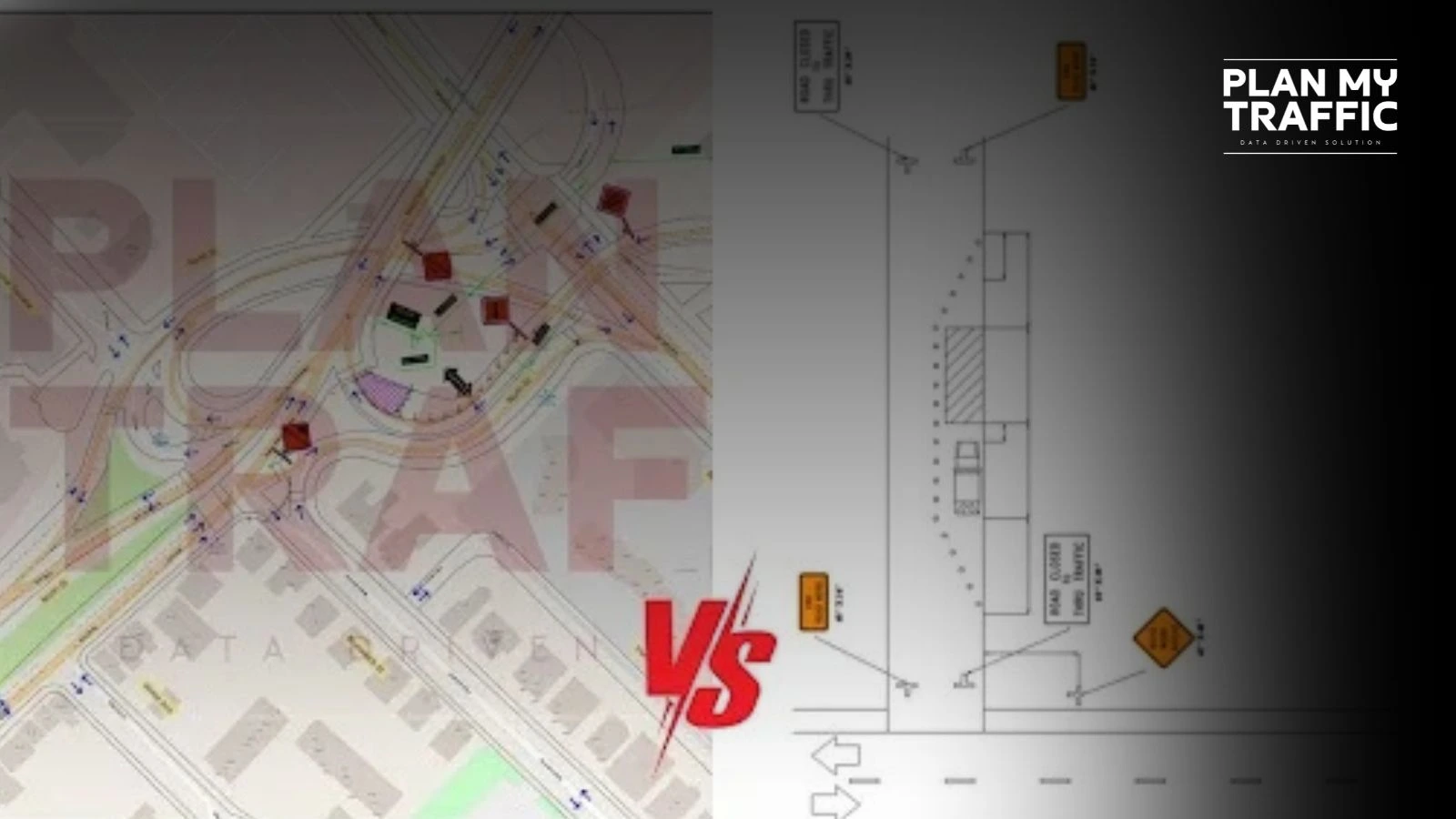
| DIY TCP | Professional TCP — PlanMyTraffic |
| Generic template not site-specific | Site-specific design from real measurements |
| Taper lengths estimated or guessed | TAC-compliant taper calculations every time |
| Frequent revision requests from reviewers | Built for first-pass approval |
| Pedestrian routing often missed | Full ADA/accessibility compliance included |
| No device schedule | Complete device quantities and spacing |
| Days lost to corrections and resubmissions | 24-hour delivery – approval-ready |
| High liability exposure on site | Defensible documentation for audits and claims |
Contractors across Canada trust PlanMyTraffic for traffic management plan services that reduce permit delays, protect project timelines, and deliver first-pass approval results.
See how we prevent common TCP mistakes that cost contractors money and why professional planning is the most cost-effective choice on every Canadian project.
Conclusion: In Canada, Professional TCP Planning Is Not an Expense It Is Protection
DIY Traffic Control Plans may appear to reduce upfront drafting costs, but they consistently introduce hidden operational waste across permits, labour, equipment, scheduling, and safety. Every rejection, field correction, and scheduling delay that a DIY TCP causes costs more than a professional Traffic Control Plan Canada would have cost from the start.
For Canadian contractors who value efficiency, compliance, and project profitability, professional TCP planning is not an added expense it is a strategic investment that pays back across every phase of the project.
In traffic management, precision protects profit. Choose professional every time.
Ready to get a professional Traffic Control Plan in Canada within 24 hours? Submit your project details below and our team will get started immediately.
Ready to stop wasting money on DIY TCPs? Get your professional Traffic Control Plan in 24 hours free quote below.
Request a Quote
Ready to Work Together? Build a project with us!
Frequently Asked Questions
What is a professional Traffic Control Plan in Canada?
A professional Traffic Control Plan (TCP) in Canada is a site-specific document prepared by a qualified traffic management specialist. It defines how vehicles, pedestrians, cyclists, and emergency services will be safely managed around a work zone. Unlike DIY plans, a professional TCP uses real site measurements, TAC-compliant taper calculations, accurate device schedules, and pedestrian routing diagrams all designed to pass first-pass review by municipal or provincial authorities without revision requests.
Why do DIY Traffic Control Plans get rejected in Canada?
DIY TCPs are most commonly rejected for incorrect taper length calculations, use of generic templates that do not reflect actual site conditions, missing pedestrian accommodation diagrams, absent emergency vehicle access plans, or incomplete device schedules. Canadian reviewing authorities from Whitehorse municipal offices to BC Ministry of Transportation compare submissions against TAC standards and local permit conditions. Even one missing element triggers a revision request and delays your permit by 3–7 business days.
How quickly can PlanMyTraffic deliver a professional TCP?
PlanMyTraffic delivers professionally prepared, approval-ready Traffic Control Plans within 24 hours of receiving complete site information. Our process includes immediate site data review, same-day drafting by a traffic management specialist, TAC compliance verification, and clear digital delivery in reviewer-ready format. Revision responsiveness is included. The faster you provide accurate site data, the faster your compliant TCP is ready for submission.
Is a professional TCP worth the cost for small projects?
Yes — for any project involving a public road, lane closure, or right-of-way disruption in Canada, a professional TCP is worth the investment. The cost of a single rejection cycle idle crew, equipment rescheduling, resubmission time typically exceeds the cost of a professionally prepared plan. For small projects, the 24-hour turnaround and first-pass approval reliability make professional TCPs the most cost-efficient option, not just the safest one.
Does PlanMyTraffic prepare TCPs for projects outside British Columbia?
Yes. PlanMyTraffic prepares professional Traffic Control Plans for contractors and project managers across Canada including British Columbia, Yukon, Alberta, and other provinces. Our plans are built to local review standards for each region, whether that means BC MOTI permit conditions, Yukon territorial highway requirements, or municipal permit frameworks in cities across Canada. Contact our team to discuss your specific project location and requirements.