Newfoundland and Labrador’s 2026‑27 Roads Plan is putting more than $250 million into highway and bridge projects across the province. For contractors bidding on bridge rehabilitation work this season, a clear, compliant Traffic Control Plan (TCP) will be the difference between smooth approvals and costly delays.
This guide explains, in simple terms, how to prepare a TCP specifically for bridge rehabilitation jobs under the new Roads Plan.
1. Why Bridge Rehabilitation TCPs Are Different
Bridge rehabilitation work zones are more complex than a standard paving job or shoulder repair. You are often dealing with:
-
Narrow cross‑sections and limited shoulder space.
-
Height and structure constraints (trusses, girders, overhangs).
-
Lane drops or full closures with no easy detour.
-
Changing conditions as stages move from deck repair, to joints, to railing and approaches.
Because of these constraints, traffic control is under more scrutiny, and a basic “copy‑paste” TCP from a generic road job will not be enough.
2. What Newfoundland’s Roads Plan Means for Contractors
The 2026‑27 Roads Plan includes dozens of bridge‑related projects across Trans‑Canada Highway, regional trunk roads, and local routes. That means:
-
More tenders where TCP quality can decide who wins the work.
-
Higher expectations from the Department of Transportation and Infrastructure for safe, efficient work zones.
-
Increased focus on minimizing delays on key links like the Trans‑Canada Highway and Trans‑Labrador Highway.
If your TCP does not clearly show how you will keep traffic moving safely around a bridge work zone, your tender or permit can be delayed or rejected.
3. Core Components of a Bridge Rehabilitation TCP
When you prepare a TCP for a bridge rehabilitation work in Newfoundland and Labrador, make sure it clearly includes the following.
3.1 Site and Project Details
-
Route number and exact bridge name/location.
-
Type of work (deck rehab, bearing replacement, joint repair, railing upgrade, approach work).
-
Planned start and end dates and daily working hours.
-
Expected traffic volumes and truck percentages (where available).
3.2 Work Staging and Lane Configuration
Bridge projects almost always require staging. Your TCP should show:
-
How many stages the work will be broken into (for example, Stage 1 – north half of deck, Stage 2 – south half).
-
Whether you will maintain two‑way traffic with a single lane and temporary signals or TCPs, or whether full closures and detours are required.
-
Lane widths in each stage and how you will handle oversize/overweight loads if the route carries heavy trucking.
3.3 Traffic Control Devices and Layout
For each stage, include a clear diagram showing:
-
Taper lengths, advance warning sign spacing, and buffer zones.
-
Exact sign types and messages (for example, “Prepare to Stop”, “Single Lane Ahead”, “Traffic Control Ahead”).
-
Use of temporary traffic signals versus trained traffic control persons (flaggers).
-
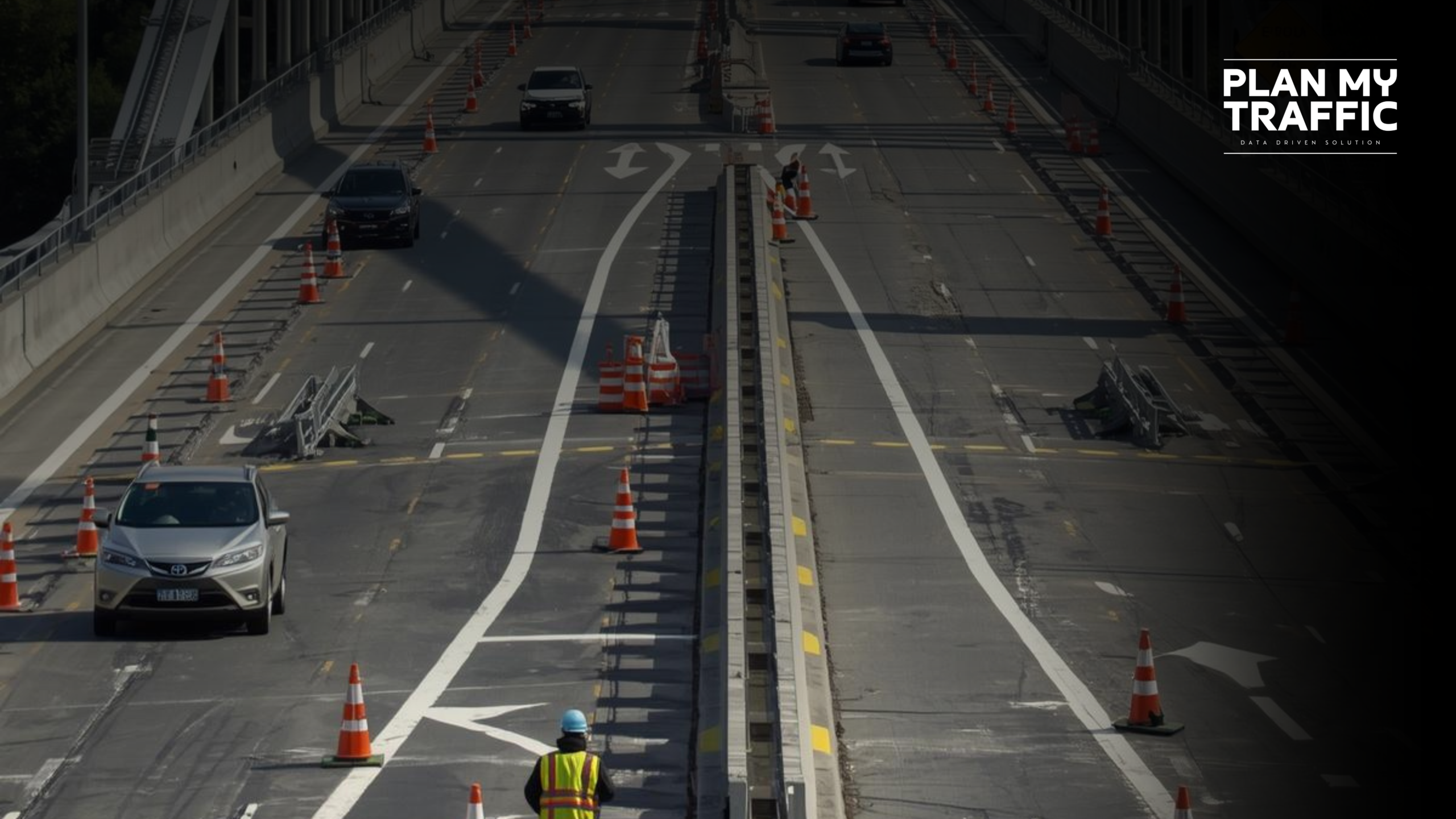
Placement of cones, barrels, barricades, and any temporary barriers.
The drawing should be to scale or at least proportionally accurate, so reviewers can see that distances and sight lines are reasonable.
3.4 Pedestrian and Local Access
If there are nearby driveways, side roads, or pedestrian routes:
-
Show how access will be maintained or temporarily restricted.
-
Describe any temporary pedestrian walkways or crossings you will provide.
-
Explain how you will notify local residents or businesses of access changes.
3.5 Emergency and Incident Management
Bridge work on a major route cannot afford long closures from crashes or breakdowns. In your TCP, outline:
-
How emergency vehicles will pass through the work area at each stage.
-
Where disabled vehicles can be moved to quickly (if shoulder space is limited, you may need specific pull‑out areas marked).
-
Who is responsible for contacting enforcement/response agencies and how communication will occur.
Don’t let a weak or generic TCP delay your bridge project , get a site-specific plan that reflects real staging, traffic flow, and approval requirements.
Get Your Bridge TCP Delivered in 24 Hours
4. Common Reasons Bridge TCPs Get Rejected
Contractors often lose time and money because their TCP is missing key elements. Typical issues include:
-
No clear staging plan for how traffic will be handled when the bridge is partially closed.
-
Inadequate taper lengths or sign spacing for actual operating speeds.
-
No consideration for high truck volumes or oversize loads.
-
Missing details about how emergency access will be maintained at all times.
-
Drawings that are too generic and not tailored to the actual bridge location and geometry.
Fixing these issues after submission can push you to the back of the queue and delay your start date.
5. Practical Steps to Get Your TCP Right the First Time
Here is a simple, step‑by‑step approach to preparing a strong TCP for a bridge rehabilitation work under Newfoundland’s Roads Plan:
-
Review the tender and drawings carefully
Note lane widths, shoulder widths, grades, nearby intersections, and detours shown on plan. -
Do a site assessment (virtual or in person)
Confirm sight distances, existing signage, and real‑world constraints that might not be clear on paper. -
Select the safest staging strategy
Decide whether to keep one lane open with temporary signals/TCPs or plan full night or short‑term closures with detours. -
Draft scale‑appropriate TCP drawings for each stage
Include all signage, tapers, devices, and lane widths. Make sure each stage has its own clear diagram. -
Add a short written description for each stage
In plain language, explain what traffic will experience (for example, “Single‑lane alternating traffic controlled by TCPs with 60 km/h reduced speed”). -
Check compliance with provincial TCP requirements
Confirm that TCPs are properly trained and that all devices meet current standards for Newfoundland and Labrador. -
Have the plan reviewed by someone experienced in bridge work zones
A quick pre‑submission review can catch issues that inspectors would flag.
6. How We Help Contractors on Newfoundland Bridge Projects
If you are bidding on or delivering a bridge rehabilitation work/project under Newfoundland’s $250M Roads Plan, we can:
-
Build project‑specific TCPs that reflect actual bridge geometry and staging.
-
Optimise layouts to reduce delays while keeping workers and drivers safe.
-
Make sure your TCP meets provincial expectations for hazard assessment, device placement, and worker protection.
-
Support you with revisions if site conditions change or the owner requests adjustments
Request a Quote
Ready to Work Together? Build a project with us!
Frequently Asked Questions(FAQ)
1. What should a contractor include in a TCP for bridge rehabilitation work in Newfoundland and Labrador?
A strong bridge rehabilitation TCP should include exact site and route details, the type of bridge work being done, work dates and hours, expected traffic conditions, and a clear staging plan for how traffic will move during each phase. It should also show taper lengths, warning sign placement, buffer zones, lane configurations, and the location of devices such as cones, barrels, barricades, temporary barriers, signals, or traffic control persons. If the bridge route carries heavy truck traffic, oversize vehicles, or has nearby driveways or side roads, the TCP should address those conditions clearly. Emergency access and incident response must also be included so reviewers can see how the site will remain functional and safe even if something goes wrong.
2. Do I need separate TCP layouts for each construction stage on a bridge project?
Yes. Bridge rehabilitation work almost always requires multiple stages, and each stage can affect traffic differently. For example, one phase may close part of the deck while another changes lane positioning, signal control, or access conditions. If your TCP only shows one general layout, it may not be enough for reviewers to understand how traffic will be managed throughout the job. A better approach is to prepare a separate drawing or clearly defined layout for each stage, along with a short written explanation of what traffic will experience in that phase. This improves review clarity, reduces questions, and helps the field team follow the plan correctly once work starts.
3. Why is emergency access such an important part of a bridge rehabilitation TCP?
Emergency access is critical because bridge projects often take place on routes where there are limited alternate paths and little room for vehicles to maneuver around a blocked work zone. If a crash, breakdown, or medical emergency occurs, responders need a clear and practical way to reach the site and move through it without confusion. Your TCP should explain how emergency vehicles will pass through each stage of the work area, where disabled vehicles can be moved if shoulder space is limited, and who will coordinate communication with response agencies. A plan that ignores emergency access is one of the fastest ways to raise red flags during review.
4. What are the most common reasons bridge rehabilitation TCPs get rejected?
Bridge rehabilitation TCPs are often rejected because they are too generic or do not reflect the actual bridge geometry and traffic conditions. Common issues include missing or unclear staging plans, incorrect taper lengths, poor sign spacing, no explanation of how emergency access will be maintained, and no consideration for truck volumes or oversize loads. Another major problem is submitting drawings that look copied from a standard roadway project instead of being tailored to the specific bridge. When reviewers cannot clearly understand how traffic will be managed during each stage of work, they are more likely to request revisions, which can delay your approval and push back your start date.