If you are a contractor working on a BC roadway, you already know the basic rule: before a single cone goes down, you need a compliant lane closure traffic control plan (TCP) in BC. What many contractors discover too late is that non-compliant or incomplete plans get rejected by permit authorities pushing start dates back by days and exposing your crew to WorkSafe BC liability. This guide breaks down exactly what BC requires, so you get it right the first time.
What BC Law Says
In British Columbia, lane closure traffic control plans are governed by three authorities that work together:
1. BC TMM 2020 Traffic Management Manual for Work on Roadways
The BC Ministry of Transportation and Transit (MoTT) publishes this as the primary technical standard for all work zone setups on BC provincial highways. It defines exact layouts, BC-standard sign codes (C-series), taper distances, buffer zones, and flagger positioning rules. Every TCP submitted for a BC provincial highway must reference a BC TMM 2020 figure.
2. WorkSafe BC OHS Regulation – Part 18 (Traffic Control)
Under BC’s Occupational Health and Safety Regulation, Part 18, every employer must ensure effective traffic control is in place whenever traffic could be hazardous to a worker. This is a legal obligation not a guideline. WorkSafe BC can issue stop-work orders and fines for non-compliance.
3. MoTT Highway Use Permit
Under Section 52 of the Transportation Act, any work requiring a lane closure on a provincial highway requires a Lane Closure Permit from the MoTT district office. You must complete BC TMM 2020 Appendix E ,the Work Notification/Lane Closure Request and Approval Form with a compliant TCP attached.
Municipal roads (e.g., City of Surrey, City of Vancouver, District of North Vancouver) follow the same BC TMM 2020 standard but have their own permit process through the city’s traffic engineering department.
Real-Life Example: Utility Repair on a 4-Lane Arterial in Surrey, BC
A utility contractor in Surrey, BC wins a contract to replace a 200-metre section of water main along a 4-lane arterial road with a posted speed of 70 km/h. Work is daytime, weekday.
Here is what they need before a single worker steps onto the road:
-
A lane closure traffic control plan BC built to BC TMM 2020 Section 9.6 , Right Lane Closed, Short and Long Duration on a multilane divided highway
-
Two C-130-R (Right Lane Closed Ahead) signs with a C-130-T distance tab placed in advance of the taper
-
A Flashing Arrow Board (FAB) mandatory at ≥ 70 km/h posted speed; no substitution is permitted under BC TMM 2020
-
At least one certified Traffic Control Person (TCP/Flagger) holding a valid 3-year WorkSafe BC High-Risk TCP certificate
-
A Lane Closure Permit submitted to the City of Surrey’s Traffic Engineering department with the full TMP attached
-
Barricades at both ends of the work activity area required for long-duration work
The contractor submits an incomplete plan that uses US MUTCD sign codes instead of BC C-series codes. The City rejects it. Two business days lost before work even starts.
This is the most common reason plans get rejected in BC and it is entirely avoidable.
What a Compliant Lane Closure TCP in BC Must Include
A compliant construction traffic control plan BC is not just a sketch. It must contain all of the following:
Site Assessment Data
-
Road name, location, and nearest intersection
-
Posted speed limit and number of lanes affected
-
Work duration (short vs. long) and time of day (day/night/peak hours)
-
Presence of pedestrians, cyclists, or transit routes
BC TMM 2020-Referenced Layout Drawing
Every plan must reference the correct BC TMM 2020 figure for your scenario:
BC-Standard Signage with Correct Sign Codes
-
C-130-R – Right Lane Closed Ahead (with C-130-T distance tab)
-
C-004 – Crew Working Ahead
-
C-018-1A – Construction Ahead
-
C-053 – Lane Closure Arrow (with conditions at ≤ 60 km/h)
-
C-001-2 – Flagger Ahead (optional advance warning)
-
C-029 – Prepare to Stop
-
C-030-8 – Single Lane Traffic
-
FAB (Flashing Arrow Board) – mandatory at ≥ 70 km/h; no substitution
TCP Positioning and Certification
TCPs must hold a valid 3-year WorkSafe BC High-Risk TCP certificate, earned through a 2-day certification program with a minimum 80% exam score and a practical road assessment. The construction speed limit must be ≤ 70 km/h when TCPs are actively directing traffic. Night work requires overhead lighting at the TCP station.
Contingency and Emergency Procedures
Per BC TMM 2020 Section 5.8.1, every plan must address how emergency vehicles will pass through the work zone. This includes what happens if equipment fails or an incident occurs within the work zone.
BC TMM 2020 Section 9.6 – Plain-English Breakdown
This is the most commonly needed setup for lane closures on BC arterials and highways. Here is exactly what it requires:
Standards (Mandatory for All)
-
Two C-130-R (Right Lane Closed Ahead) signs: one upstream with C-130-T distance tab, one closer to the taper
-
FAB at posted speeds ≥ 70 km/h , no substitution, no exceptions
Options for Posted Speed ≤ 60 km/h
-
Upstream C-130-R with distance tab may be removed, with C-004 or C-018-1A moved downstream per Table B Distance A
-
Tubular markers may replace drums for the leading taper
Guidance Notes
-
Signage should be installed along the divided median; smaller signs are acceptable if median space is limited
-
Where wide shoulders may be confused for travel lanes, install shoulder tapers per BC TMM 2020 Table A
Avoid permit rejections, stop-work risk, and costly resubmissions with a lane closure TCP built to BC TMM 2020 standards.
Request Your BC TMM 2020-Compliant TCP
Types of Lane Closures in BC
5 Steps to Get Your Lane Closure Plan Approved in BC
-
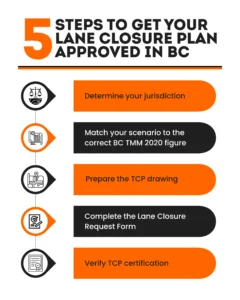
Determine your jurisdiction – Provincial highway goes to the MoTT district office; municipal road goes to the city’s traffic engineering department
-
Match your scenario to the correct BC TMM 2020 figure – Wrong figure = automatic rejection
-
Prepare the TCP drawing – Use BC C-series sign codes, correct taper lengths (Table A), buffer zones, and work activity area boundaries
-
Complete the Lane Closure Request Form – BC TMM 2020 Appendix E for provincial highways
-
Verify TCP certification – Confirm all flaggers hold a valid 3-year WorkSafe BC High-Risk TCP certificate before the plan is submitted
Typical Approval Timeline: 2–5 business days for standard municipal permits. Complex provincial highway closures or high-traffic corridors may take longer. Having a complete, compliant plan ready on Day 1 is the single biggest factor in avoiding delays.
Common Mistakes That Get BC Plans Rejected
-
Using US MUTCD sign codes instead of BC C-series codes
-
Missing the FAB on roads with posted speed ≥ 70 km/h
-
No emergency vehicle passage plan included (BC TMM 2020 Section 5.8.1)
-
Expired or unverified TCP flagger certification
-
Wrong taper length not following BC TMM 2020 Table A
-
Generic plan not referenced to a BC TMM 2020 figure
-
No barricades shown for long-duration work
Don’t let a rejected or incomplete lane closure TCP delay your BC project, get a fully compliant plan built for first-time approval.
Get Your Lane Closure TCP in 24 Hours
Why BC Contractors Work With Plan My Traffic
Getting your traffic control plan BC right on the first submission saves days and in construction, days are money. At Plan My Traffic, every plan we produce is:
-
Built to BC TMM 2020 correct C-series sign codes, referenced figures, proper taper lengths
-
Aligned with WorkSafe BC OHS Regulation Part 18
-
Reviewed against MoTT and municipal permit checklists
-
Delivered in 24 hours on standard lane closure plans
-
Same-day service available for urgent and emergency jobs
-
Digital delivery no back-and-forth, no wasted time
Whether you need a single lane closure traffic control plan BC for a one-day utility repair or a full construction traffic management plan BC for a multi-phase infrastructure project, we handle it end to end fast, compliant, and permit-ready.
Get Your BC Lane Closure Plan in 24 Hours – Free Quote
Don’t let a rejected or missing TCP push your project start date. Tell us your road type, BC location, and work duration we’ll send you a quote the same business day.
Get a Free Quote Now → planmytraffic.com
Serving contractors, project managers, and utility companies across British Columbia including Vancouver, Surrey, Burnaby, Kelowna, Victoria, and beyond.
Frequently Asked Questions
Q1: Do I need a traffic control plan for every lane closure in BC?
Yes. Under BC TMM 2020 and WorkSafe BC OHS Regulation Part 18, any work that requires closing a lane on a provincial or municipal road requires a compliant TCP and, in most cases, a lane closure permit from the relevant authority. Submitting work without one can result in an immediate stop-work order and WorkSafe BC fines.
Q2: How long does it take to get a lane closure permit approved in BC?
For provincial highways, plans are submitted to the MoTT district office using the BC TMM 2020 Appendix E form. Standard approvals typically take 2–5 business days. Municipal cities like Surrey process permit applications within 3–7 business days. The single biggest factor that speeds up approval is submitting a complete, BC TMM 2020-compliant plan on the first try — no corrections, no resubmissions.
Q3: Can I reuse a template TCP for multiple BC job sites?
No. BC TMM 2020 requires a site-specific plan that references the correct layout figure for your exact road type and scenario. A plan prepared for a 2-lane rural road (Figure 7.8) cannot be reused for a multilane arterial (Section 9.6). Permit authorities check the figure reference against your site conditions mismatches are a leading cause of plan rejections in BC.