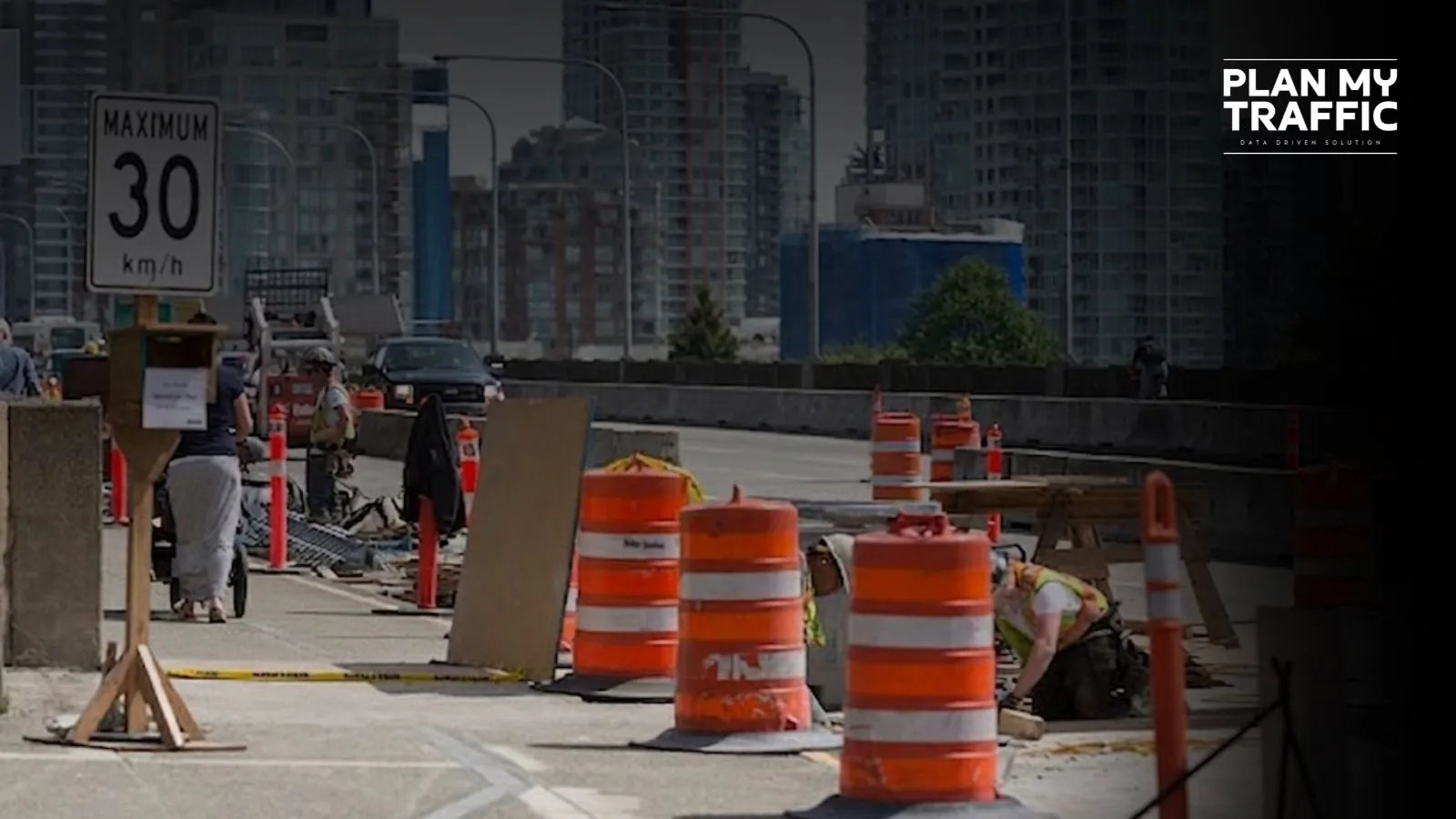
If you’re a contractor or developer working in Surrey, you’ve probably faced this before your permit is ready, your crew is scheduled, but your construction traffic control plan Surrey submission gets delayed or rejected.
And just like that, your timeline slips.
A single missing detail in your traffic control plan can lead to permit rejection, project delays, and unexpected costs. In a fast-moving construction environment like Surrey that’s not just frustrating , it’s expensive.
This guide breaks down exactly how to create a permit-ready construction traffic control plan Surrey authorities will approve quickly, what requirements you must meet, and how to avoid the mistakes that cost contractors time and money.
What Is a Construction Traffic Control Plan in Surrey?
A construction traffic control plan Surrey is a detailed document that outlines how traffic including vehicles, pedestrians, and cyclists will be safely managed around a construction zone.
It is typically required when your project impacts:
- Roadways or intersections
- Sidewalks or pedestrian access
- Lane closures or detours
- Public safety near active work zones
In British Columbia, these plans must align with:
- BC MOTT (Ministry of Transportation and Transit) guidelines
- WorkSafeBC safety standards
- TAC (Transportation Association of Canada) guidelines
Whether you’re working on a road widening project or utility installation, your TCP must clearly show how traffic will flow safely without disruption.
Why Your Traffic Control Plan Matters More Than You Think
Let’s be real most contractors don’t think much about traffic plans until something goes wrong. But here’s the catch: a poorly prepared construction traffic control plan Surrey can trigger a chain reaction of problems.
If your plan is incomplete or unclear, approval can take 5–10 business days longer. That means delayed mobilization and idle crews.
Every delay costs money: Equipment sitting unused , Crew rescheduling , Overtime to catch up. Even a 3-day delay can cost thousands on mid-size projects.
Based on real submission patterns, many TCPs get rejected due to:
- Missing signage details
- Poor lane closure justification
- Non-compliance with BC standards
A well-prepared plan can be approved quickly often within standard timelines helping your project stay on track and stress-free.
Core Requirements for a Permit-Ready Construction Traffic Control Plan Surrey
This is where most contractors either get it right or run into trouble.
A compliant construction traffic control plan Surrey must include several key components:
1. Detailed Site Layout
Your plan must clearly show:
- Road geometry
- Work zone boundaries
- Traffic flow direction
In a recent Surrey road project, a plan was delayed simply because the lane taper length wasn’t clearly marked.
2. Signage and Traffic Devices
You must include:
- Regulatory signs
- Warning signs
- Cones, barricades, and delineators
All signage must follow TAC standards and be placed at correct distances.
3. Pedestrian and Cyclist Management
This is a big one and often overlooked.
Your plan should show:
- Safe pedestrian detours
- Accessibility compliance
- Temporary walkways if sidewalks are closed
4. Lane Closure Justification
Authorities like BC MOTT often reject plans that don’t explain:
- Why the lane closure is necessary
- Why alternative methods aren’t feasible
5. Traffic Control Personnel (TCPs)
Include:
- Number of flaggers
- Their positions
- Communication methods
Not sure if your plan covers all Surrey and BC requirements? Get a quote and we’ll assess it within 24 hours.
Common Mistakes Contractors Make And Why Plans Get Rejected
Even experienced contractors run into these issues:
- Using generic templates that don’t match actual site conditions
- Incorrect taper lengths based on wrong speed assumptions
- Missing pedestrian routing in busy areas
- Poor or incorrect sign placement
- No clear emergency access provision
Most rejections don’t happen because the plan is completely wrong they happen because small but critical details are missing.
Avoid rejection before it delays your project get your plan checked by experts before submission.
Step-by-Step: How to Get Your TCP Approved Faster in Surrey
Follow this checklist to create a construction traffic control plan Surrey that gets approved without delays:
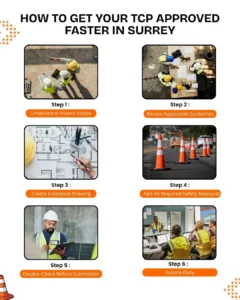
Step 1: Understand Project Scope
Define:
- Type of construction
- Duration
- Traffic impact level
Step 2: Review Applicable Guidelines
Always check:
- BC MOTT standards
- WorkSafeBC requirements
Step 3: Create a Detailed Drawing
Use professional tools to map:
- Traffic flow
- Safety zones
- Equipment placement
Step 4: Add All Required Safety Measures
- Proper signage placement
- Pedestrian safety routes
- Flagging operations
Step 5: Double-Check Before Submission
Review for:
- Missing details
- Compliance gaps
- Clarity issues
Step 6: Submit Early
Avoid last-minute pressure. Early submission gives room for revisions if needed.
Real Example: How a Small Mistake Delayed a Surrey Project
To understand how these issues play out in real projects, consider a recent case from a road utility upgrade in Surrey.
A contractor had everything ready crew scheduled, equipment on-site, and the project timeline tightly planned. The only thing pending was approval of their construction traffic control plan . The plan looked complete at first glance, but it was built using a generic template and didn’t fully reflect the actual site conditions. The taper length shown didn’t match the road’s speed requirements, and there was no clearly defined pedestrian detour for a nearby sidewalk.
When the plan was reviewed, it was rejected. The contractor had to revise the drawing, correct the taper calculations, and add missing pedestrian routing. This resulted in a delay of nearly a week, pushing back the project start and forcing the team to reschedule resources. What seemed like a minor oversight ended up affecting the entire project timeline and increasing costs.
Situations like this are more common than most contractors expect. In many cases, plans are not rejected because they are completely wrong they are rejected because small but critical details are missing or not aligned with Surrey and BC requirements.
How PlanMyTraffic Helps Contractors Get Fast Approvals
Here’s the thing creating a compliant TCP takes time, expertise, and attention to detail.
That’s where working with specialists makes a difference.
At PlanMyTraffic, the focus is simple:
- Permit-ready traffic control plans
- Designed specifically as per the standards and requirements
- Fast turnaround to meet tight project deadlines
In many real-world cases, contractors who switched to expert-prepared plans saw fewer rejections and faster approvals, helping them avoid costly delays.
Ready to Get Your Traffic Control Plan Approved Without Delays?
If you’re working on a project in Surrey, don’t let a rejected or delayed construction traffic control plan slow you down.
Get a fast quote today and make sure your plan is compliant, complete, and ready for approval.
Frequently Asked Questions (FAQs)
1. Why do traffic control plans get rejected in Surrey?
Traffic control plans in Surrey are often rejected due to missing details or non-compliance with local standards like BC TMM 2020 and municipal guidelines. Common issues include incorrect signage placement, lack of proper lane closure justification, missing pedestrian routing, or unclear work zone layouts. In many real cases, even small mistakes like incorrect taper lengths or missing buffer zones lead to immediate rejection. This not only delays approvals but can push your project timeline back by several days or even weeks. To avoid rejection, your TCP must be detailed, site-specific, and aligned with both municipal and provincial requirements from the start.
2. Do I need a traffic control plan for small construction projects?
Yes, in most cases, even small construction projects in Surrey require a traffic control plan especially if your work impacts public roads, sidewalks, or traffic flow. For example, activities like sidewalk closures, utility work, or partial lane disruptions typically require a TCP to ensure safety for both workers and the public. Many contractors assume small jobs don’t need formal planning, but this often leads to permit issues or stop-work notices. Even for short-duration or low-impact work, having a basic but compliant TCP helps you avoid penalties, ensures smoother approvals, and keeps your project moving without interruptions.
3. What is the fastest way to get a TCP approved?
The fastest way to get a TCP approved is to submit a complete, compliant, and error-free plan on the first attempt. Most delays don’t happen because of the approval process itself, they happen due to revisions. To speed things up, it’s important to use the correct BC TMM 2020 layout for your specific scenario, include all required signage, taper lengths, and buffer zones, clearly define pedestrian and emergency access, and submit the plan to the correct authority (municipal or provincial). When everything is prepared accurately from the start, approvals can move quickly within standard timelines. Professionally prepared plans often avoid back-and-forth revisions, saving several days of delay and preventing costly downtime for your project.
4. How long does it take to get a traffic control plan approved in Surrey?
In Surrey, a traffic control plan typically takes 5 to 10 business days for approval when submitted correctly. However, this timeline can vary depending on project complexity, road type, and authority workload. If your plan has errors or missing details, approval can take significantly longer due to revisions sometimes adding another 5–10 days. This is where most contractors lose time and money, as crews remain idle and schedules get disrupted. A well-prepared, permit-ready TCP can help you stay within standard approval timelines and avoid unnecessary delays, keeping your project on track.