If you are managing a construction project on a BC road, you legally cannot break ground or place a single cone without a compliant construction traffic control plan for British Columbia. But here is the problem most contractors face: generic plans get rejected. BC has its own standard the BC TMM 2020 and permit authorities check every detail. This guide tells you exactly what BC requires, what mistakes to avoid, and how to get your plan approved on the first submission.
What Is a Construction Traffic Control Plan in BC?
A construction traffic control plan BC (also called a TCP or work zone traffic control plan) is a site-specific document that shows exactly how traffic vehicles, cyclists, and pedestrians will be safely managed construction work is happening on or near a road.
It is not a general sketch. It is a technical drawing that must:
- Reference the correct BC TMM 2020 figure for your road type and scenario
- Use BC C-series sign codes not US MUTCD codes
- Show all five work zone areas with correct dimensions and taper lengths
- Identify certified Traffic Control Person (TCP/Flagger) positions
- Include an emergency vehicle passage procedure
Every construction project on a BC provincial highway or municipal road that affects traffic flow requires one, no exceptions.
What BC Law Requires
Three authorities govern traffic control plan requirements BC construction projects must follow:
1. BC TMM 2020 Traffic Management Manual for Work on Roadways
Published by the BC Ministry of Transportation and Transit (MoTT), this is the technical Bible for every work zone setup in British Columbia. It defines layouts, sign codes, taper lengths, buffer distances, and flagger rules for every construction scenario. If your TCP does not reference a BC TMM 2020 figure, it will be rejected.
2. WorkSafe BC OHS Regulation Part 18 (Traffic Control)
Under Part 18 of BC’s Occupational Health and Safety Regulation, every employer is legally required to implement effective traffic control whenever traffic could be hazardous to a worker. This is not a best practice, it is a legal obligation. WorkSafe BC inspectors can issue immediate stop-work orders and fines for non-compliant work zones.
3. MoTT Highway Use Permit / Municipal Street Use Permit
Under Section 52 of BC’s Transportation Act, any construction activity requiring a lane closure on a provincial highway requires a Highway Use Permit from the MoTT district office. Municipal roads such as those in Vancouver, Surrey, Kelowna, or Victoria require a Street Use or Traffic Obstruction Permit from the relevant city’s traffic engineering department. Your approved traffic control plan BC must be attached to the permit application.
Key rule: BC does not follow the US MUTCD. All sign codes on your TCP must use BC’s C-series system (e.g., C-004, C-018-1A, C-130-R). Submitting a plan with MUTCD codes is one of the fastest ways to get rejected in BC.
The 5 Work Zone Areas Every BC Construction TCP Must Show
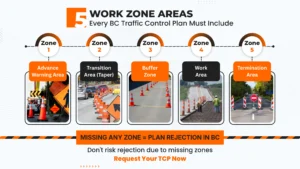
BC TMM 2020 defines five mandatory zones in every work zone traffic control plan BC. Each zone must be clearly labelled and dimensioned on your drawing:
| Zone | What It Is | BC TMM 2020 Key Rule |
|---|---|---|
| 1. Advance Warning Area | Begins where drivers first see warning signs | Distance determined by posted speed per Table B Distance A |
| 2. Transition Area (Taper) | Merges lanes or shifts traffic away from work zone | Taper length from BC TMM 2020 Table A based on lane width and speed |
| 3. Buffer Zone | Empty space between traffic and active workers | Longitudinal buffer required; lateral buffer based on speed and road type |
| 4. Work Activity Area | Where workers and equipment are actively operating | Must be physically separated from live traffic with drums, barriers, or delineators |
| 5. Termination Area | Transitions traffic back to normal conditions | Downstream taper required; end of road work signage (C-080) must be placed |
Missing or mislabelled zones are among the top reasons construction traffic control plan BC submissions get sent back for revision.
BC-Standard Signs You Must Use on a Construction TCP
Every sign on a traffic control plan for construction sites BC must use the correct BC C-series code. Here are the most commonly required signs:
| BC Sign Code | Sign Name | When Required |
|---|---|---|
| C-018-1A | Construction Ahead | All construction TCPs — advance warning |
| C-004 | Crew Working Ahead | When workers are present in or near the roadway |
| C-001-2 | Flagger Ahead | When a TCP is actively directing traffic |
| C-029 | Prepare to Stop | Alternating single-lane traffic setups |
| C-030-8 | Single Lane Traffic | Any single-lane alternating operation |
| C-130-R | Right Lane Closed Ahead | Multilane roads with right lane closure |
| C-130-T | Distance Tab | Paired with C-130-R upstream sign |
| C-053 | Lane Closure Arrow | At taper — with FAB on roads ≥ 70 km/h; with flasher at ≤ 60 km/h |
| C-080 | End Road Work | Required at the termination area of every TCP |
| FAB | Flashing Arrow Board | Mandatory at posted speed ≥ 70 km/h , no substitution permitted |
Avoid WorkSafeBC fines, permit delays, and stop-work risk with a construction traffic control plan built to BC TMM 2020 standards.
Request Your BC Construction TCP
Real-Life Example: Road Base Rehabilitation in Burnaby, BC
A construction contractor in Burnaby, BC wins a contract to rehabilitate the road base along a 400-metre stretch of a 4-lane arterial with a posted speed of 60 km/h. The project runs 3 weeks, daytime hours, Monday to Friday.
Here is what their construction traffic control plan BC must include:
- BC TMM 2020 Section 9.6 — Right Lane Closed, Long Duration on a multilane divided road
- Advance Warning Area with C-018-1A (Construction Ahead) and C-004 (Crew Working Ahead) placed at Table B Distance A from the taper
- C-130-R with C-130-T distance tab upstream and a second C-130-R closer to the taper
- C-053 Lane Closure Arrow at the taper, with a 360° flashing light and 4-way flashers, FAB substitution is allowed at 60 km/h under BC TMM 2020
- Drums delineating the full length of the work activity area and buffer zone
- One certified TCP/Flagger at peak hours when equipment is moving across lanes WorkSafe BC Part 18 compliant
- C-080 End Road Work sign at the termination area
- Emergency vehicle passage plan per BC TMM 2020 Section 5.8.1
- Street Use Permit submitted to the City of Burnaby’s Engineering department with the full TCP attached
The contractor’s previous vendor submitted a generic plan with MUTCD signs and no buffer zone labelling. Burnaby Engineering rejected it on Day 1. They switched to Plan My Traffic compliant plan delivered in 18 hours, permit approved within 3 business days. Work started on schedule.
How to Get Your Construction TCP Approved in BC: Step by Step
- Identify your jurisdiction — Is the road a BC provincial highway (MoTT district office) or a municipal road (city engineering department)? The permit process and form differ.
- Determine your BC TMM 2020 scenario — Match your road type, number of lanes, speed limit, and work duration to the correct BC TMM 2020 figure. Wrong figure = automatic rejection.
- Conduct a site assessment — Document road name, posted speed, lane configuration, peak traffic hours, proximity to intersections, pedestrian and cyclist routes, and any transit stops within the work zone.
- Prepare the TCP drawing — Use BC C-series sign codes, correct taper lengths from Table A, all 5 work zone areas labelled, buffer distances, delineator spacing, and TCP/Flagger positions.
- Add emergency and contingency procedures — Per BC TMM 2020 Section 5.8.1, document how emergency vehicles will pass through the work zone and what happens if equipment fails mid-operation.
- Verify TCP flagger credentials — All flaggers must hold a valid 3-year WorkSafe BC High-Risk TCP certificate before the permit is submitted.
- Submit with the correct permit form — Provincial: BC TMM 2020 Appendix E (Work Notification/Lane Closure Request). Municipal: varies by city — check with the local traffic engineering department.
Many BC municipalities require plan submission at least 5–10 business days before work begins. For MoTT provincial highways, the timeline can extend further for high-traffic corridors or multi-phase projects. Submit early and submit complete.
Don’t let a rejected or non-compliant construction traffic control plan delay your BC project, get a site-specific TCP built for first-time approval.
Get Your Construction TCP in 24 Hours
How Much Does a Construction Traffic Control Plan Cost in BC?
This is one of the most common questions we get and the honest answer is: it depends on your project scope. Here is a general guide to traffic control plan cost BC factors:
| Factor | Lower Cost | Higher Cost |
|---|---|---|
| Road type | Local municipal road, low speed | Provincial highway, high speed, multilane |
| Work duration | Short duration (1 day) | Long duration (weeks/months), multi-phase |
| Number of lanes affected | 1 lane partial closure | Full road closure, multiple intersections |
| Pedestrian/cyclist requirements | No active pedestrian routes nearby | Active school zones, bus stops, bike lanes |
| Turnaround time | Standard 24h delivery | Same-day urgent delivery |
At Plan My Traffic, we provide a free quote for your construction traffic control plan BC same business day. No commitment required. You tell us your project details and we give you a clear price upfront.
Common Mistakes That Get BC Construction TCPs Rejected
- Using US MUTCD sign codes instead of BC C-series codes
- Referencing the wrong BC TMM 2020 figure for the road type or scenario
- Missing taper length calculations not using BC TMM 2020 Table A
- No buffer zone shown or buffer zone under-dimensioned
- No emergency vehicle passage procedure (BC TMM 2020 Section 5.8.1)
- FAB missing on roads with posted speed ≥ 70 km/h
- TCP flagger positions not shown on the drawing
- Expired or unverified WorkSafe BC flagger certifications listed on the plan
- C-080 End Road Work sign missing at the termination area
- Plan not site-specific reused from a different location or project
Why BC Contractors Choose Plan My Traffic
A rejected TCP does not just delay paperwork it delays your crew, your equipment, and your revenue. At Plan My Traffic, we build every construction traffic control plan for British Columbia to pass on the first submission:
- BC TMM 2020 compliant — correct figures, C-series sign codes, and taper lengths every time
- WorkSafe BC Part 18 aligned — flagger requirements, work zone safety, and emergency procedures included
- MoTT and municipal permit-ready — we know what each BC authority checks before approving
- 24-hour standard delivery — we understand construction timelines and bid pressures
- Same-day urgent service — for emergency or last-minute construction starts
- Site-specific every time — no recycled templates, no generic layouts
- Digital delivery — permit-ready PDF, no delays, no back-and-forth
Whether you are a general contractor, utility company, civil engineering firm, or project manager working anywhere in BC from Vancouver and Surrey to Kelowna, Victoria, Prince George, and beyond we have you covered.
Get Your Construction Traffic Control Plan BC – Free Quote in Hours
Stop gambling with plan rejections. Tell us your project location, road type, and work duration we will send your free quote the same business day and have your BC-compliant TCP ready in 24 hours.
Serving construction contractors, project managers, and utility companies across British Columbia includes Vancouver, Surrey, Burnaby, Kelowna, Victoria, Prince George, Kamloops, and beyond.
Frequently Asked Questions
Q1: Is a construction traffic control plan required by law in British Columbia?
Yes. Under WorkSafe BC OHS Regulation Part 18, every employer must implement effective traffic control whenever traffic poses a hazard to workers. On provincial highways, BC’s Transportation Act (Section 52) also requires a Highway Use Permit with an attached TCP for any work that affects traffic flow. Municipal roads have parallel requirements through city street use permit processes. Operating without a compliant plan exposes you to stop-work orders, WorkSafe BC fines, and permit cancellation.
Q2: Can I use a US MUTCD-based traffic control plan for a BC construction project?
No. British Columbia operates under the BC TMM 2020 Traffic Management Manual for Work on Roadways, which uses BC’s own C-series sign coding system and layout figures. MUTCD-based plans use different sign codes, different taper formulas, and different zone conventions. BC permit authorities will reject any plan that references MUTCD instead of BC TMM 2020. Your plan must be built specifically to BC standards from the ground up.
Q3: How quickly can I get a construction traffic control plan for British Columbia?
At Plan My Traffic, standard construction traffic control plan BC delivery is 24 hours from the time you provide project details. For urgent or emergency construction starts, we offer same-day service. Once your TCP is ready, typical municipal permit approval takes 3–7 business days, and MoTT provincial highway approvals typically take 2–5 business days provided your plan is complete and compliant on the first submission.